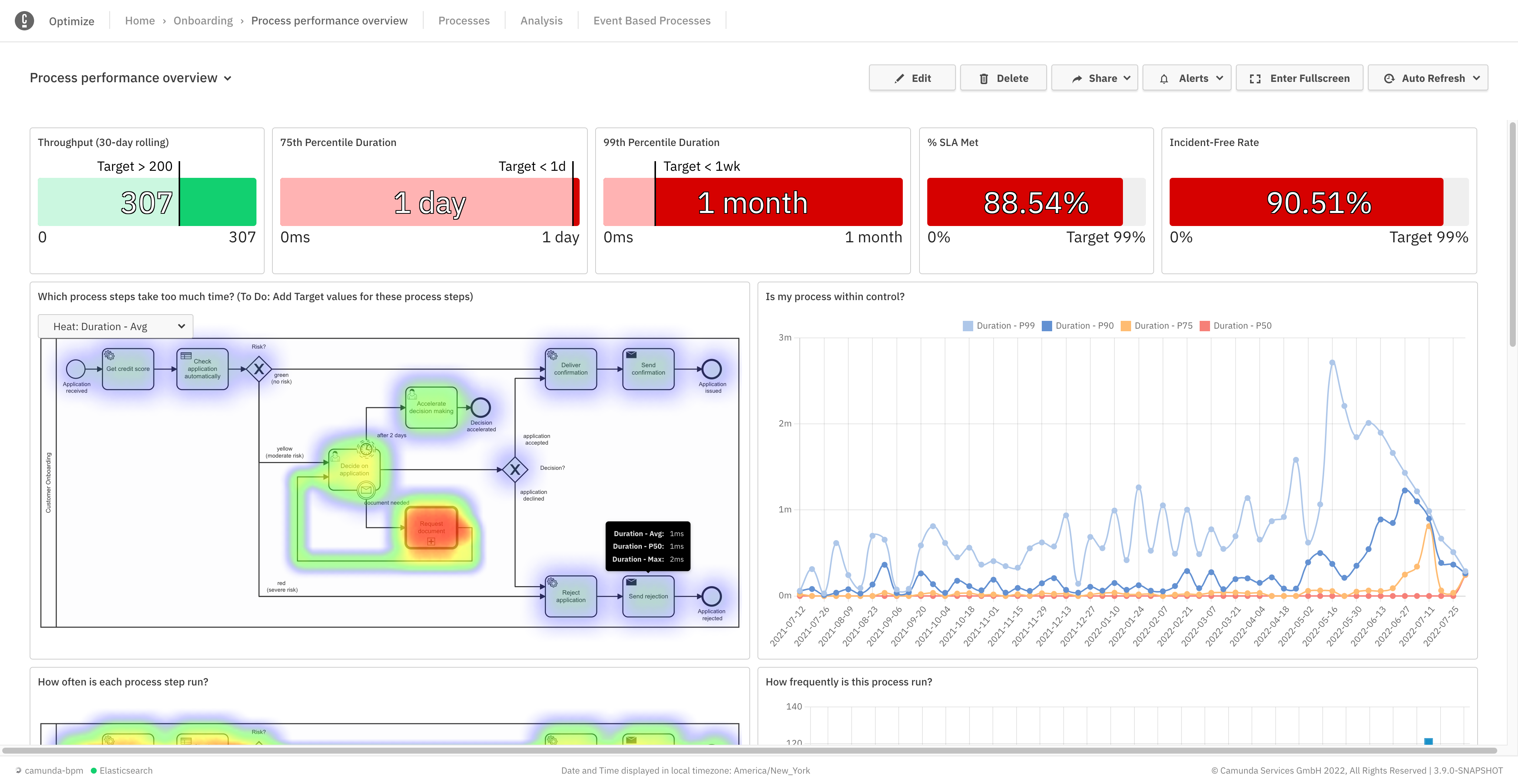
Camunda is a process orchestration tool designed to help organizations design, automate, and improve any process. Built for business and IT collaboration using BPMN and DMN standards, Camunda aims to enable seamless integration across endpoints to transform mission-critical processes.
N/A
Alfresco
Score 9.9 out of 10
N/A
The Alfresco platform, from Hyland, delivers comprehensive cloud-native content services. It is used to intelligently activate processes and content to accelerate the flow of business.
N/A
Pricing
Camunda
Alfresco
Editions & Modules
Self-Managed Enterprise
Contact Sales
per year
SaaS Enterprise
Contact Sales
per year
No answers on this topic
Offerings
Pricing Offerings
Camunda
Alfresco
Free Trial
Yes
Yes
Free/Freemium Version
Yes
Yes
Premium Consulting/Integration Services
No
No
Entry-level Setup Fee
No setup fee
No setup fee
Additional Details
—
—
More Pricing Information
Community Pulse
Camunda
Alfresco
Features
Camunda
Alfresco
Customization
Comparison of Customization features of Product A and Product B
Camunda
9.0
Ratings
38% above category average
Alfresco
-
Ratings
API for custom integration
9.00 Ratings
00 Ratings
Reporting & Analytics
Comparison of Reporting & Analytics features of Product A and Product B
Camunda
8.0
Ratings
1% below category average
Alfresco
-
Ratings
Dashboards
8.00 Ratings
00 Ratings
Standard reports
7.00 Ratings
00 Ratings
Custom reports
9.00 Ratings
00 Ratings
Process Engine
Comparison of Process Engine features of Product A and Product B
Camunda
8.5
Ratings
17% above category average
Alfresco
-
Ratings
Process designer
9.00 Ratings
00 Ratings
Process simulation
9.00 Ratings
00 Ratings
Business rules engine
7.00 Ratings
00 Ratings
SOA support
9.00 Ratings
00 Ratings
Process player
9.00 Ratings
00 Ratings
Form builder
5.00 Ratings
00 Ratings
Model execution
10.00 Ratings
00 Ratings
Business Process Automation
Comparison of Business Process Automation features of Product A and Product B
Camunda
9.0
Ratings
39% above category average
Alfresco
-
Ratings
Business Process Modeling
9.00 Ratings
00 Ratings
Decision Modeling
9.00 Ratings
00 Ratings
Enterprise Content Management
Comparison of Enterprise Content Management features of Product A and Product B
Camunda
-
Ratings
Alfresco
8.0
Ratings
0% above category average
Content capture & imaging
00 Ratings
3.10 Ratings
File sync, storage & archiving
00 Ratings
9.00 Ratings
Document management
00 Ratings
10.00 Ratings
Records management
00 Ratings
8.00 Ratings
Content search & retrieval
00 Ratings
10.00 Ratings
Enterprise content collaboration
00 Ratings
8.00 Ratings
Content publishing & creation
00 Ratings
8.00 Ratings
Security, risk management & information governance
Camunda Platform is well suited for scenarios where there are different stages in a business flow and the flow is driven by user action at each stage. For example placing of an order on an ecommerce platform. Depending on whether user was able to make the payment or not the workflow would go to dispatch or retry stage. Now the retry stage would trigger further actions like sending follow up emails etc. Likewise, dispatch stage would have a different set of actions. Since every order is important and we need to know where it stands, using Camunda Platform is imperative. Camunda Platform might not be a right choice where just a one off thing needs to be done. For example, uploading of product information by user or periodic processing of heavy images by a worker. These are all either one step processes or periodic automated processes where we can track the status without using a business modeler like Camunda Platform.
If you have regulatory or business needs that require saving email into Alfresco and you are using Outlook for Mac, you may need to perform significant customization to make it work. Additionally, if you will have users that will be members to a large numbers of sites over time, you need to thoroughly explore what functionality will be degraded or lost and how to mitigate the impact. Other than these two scenarios, I cannot think of any scenarios where Alfresco would not be well suited to an organization's needs.
Documentation - It is usually daunting for beginners because of lack of good documentation
Simplified setup on local machine for Camunda Server would help developers test changes quickly
Easier migration from one deployment version of a Camunda process to another deployment version would help in making changes and deploying them faster.
Heap memory management becomes issue at times resulting in stuck processes. This needs to be resolved.
Alfresco Process Services and Alfresco Application Development Framework integration makes for best functionality/application of ECM.
Use case alignment - Marketing content and documentation of specific business requirements and user stories being available as reference material/documentation.
As per the current market and the line of products that are available for content and document management system, Alfresco is a very good option compared to other systems in terms of features and cost. Plus the community support is great. Also since the product is open source, it can be extended or understood in a better way.
I am not big fan of Alfresco Content Services' support; it works on its own speed and sometimes it becomes challenging to achieve business needs. However, I appreciate regular delivery of security patches and updates
Process was relatively smooth and overall, downtime minimal. MSI was very responsive to our needs and made the transition easier than it otherwise might have been.
The integration is very easy and can be done with minimal time. The features like sending email, inbuilt integration with CAMEl, MULE, BOX, etc. In addition to this, the adoption of activiti-7 (the microservice version) wins the race against other tools. As the infrastructure and application modules can be deployed independently.
It definitely has a positive ROI in the overall business, as content management has become easier and more centralized.
Video and image content management has become a major plus, as they play an important role in dynamic digital marketing. Once the code is written to accommodate image and videos, we can change this content any time depending on the season of the year, what products we are looking to market, and to what type of clients.
It helps with easy control of the system with the business teams rather than having control with the technology teams. Hence it makes it easy to customize and make changes at any time. This also reduces the overlap that technology has with business and helps treat both of them as separate entities.