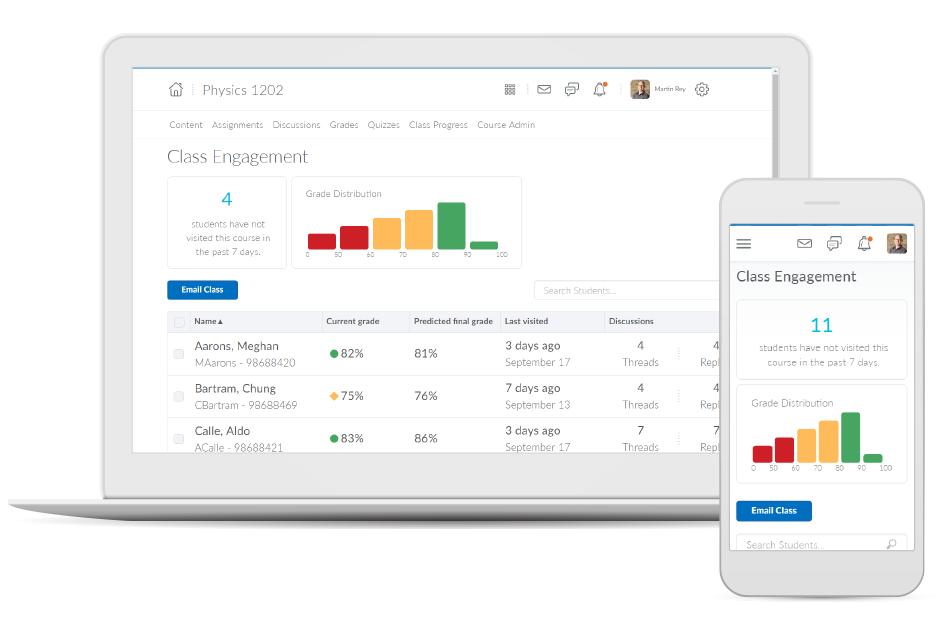
Brightspace is an academic and corporate learning management platform. It provides core e-learning features, as well as mobile accessibility and granular personalization and analytics insights.
N/A
Tovuti LMS
Score 10.0 out of 10
Mid-Size Companies (51-1,000 employees)
Designed as a people-centric LMS, Tovuti aims to make learning fun and management simple to boost productivity for users and admins alike. Users can generate courses with AI and increase learner engagement with interactive videos, memory games, and 40+ other gamification options, as well as create bespoke experiences with customizable learning paths. Tovuti is designed to integrate into currently in place ecosystems, and supports data-driven decisions with its internal reporting feature.…
N/A
Pricing
D2L Brightspace
Tovuti LMS
Editions & Modules
No answers on this topic
No answers on this topic
Offerings
Pricing Offerings
D2L Brightspace
Tovuti LMS
Free Trial
Yes
Yes
Free/Freemium Version
No
No
Premium Consulting/Integration Services
No
No
Entry-level Setup Fee
No setup fee
Required
Additional Details
Must contact vendor for pricing information. 30-day free trial is available.
—
More Pricing Information
Community Pulse
D2L Brightspace
Tovuti LMS
Features
D2L Brightspace
Tovuti LMS
Learning Management
Comparison of Learning Management features of Product A and Product B
As a member of a large-scale organization with a wide variety of employment positions, I view Brightspace as primarily an administrative solution for continuous learning and engagement. As an educational platform, Brightspace works perfectly for setting learning goals for particular groups or departments. Furthermore, there are many customization options intent on personalizing the overall user experience for employees. The platform also does a wonderful job of increasing overall engagement, retention, and completion of learning goals. However, I do not necessarily view Brightspace as the learning tool for all employees. There are production employees within my company and they may better benefit from other learning tools that do not require being on a computer.
Tovuti is really well suited for anything that involves instruction, whether that be to a class or to provide training to your company's staff. While the interactive content is wonderful and allows for many accommodations (visual and hearing impairments included), it is not always an easy task to create activities that work comfortably for individuals with mobility/dexterity disabilities.
The grade book is very customizable. There is a learning curve, as there always is if something is flexible, but there are a lot of good options available for grading, displaying grades, and calculation of grades.
Adding course content of many types can easily be done using drag & drop or copy-paste. It is easy to retain stored content from semester to semester. Updating an item takes three clicks. It is easy to organize and reorganize content and allows sub-sections. It records whether individual students have opened material and how much time they spent using an item.
I like the flexibility of organizing the dropbox for student submissions. Deadlines in the dropbox or discussions automatically appear in the course calendar.
I like the range of quiz question options, in particular, the "multi-select" question type.
The use of rubrics in the discussion area and the quizzes area could use some TLC. The rubrics actually have to be added to the grade book item for them to be functional. In the Discussion area the instructor is unable to grade them discussions and publish them to the grades area. In quizzes, students are not able to see the rubric at all. If the rubric functioned in these two tools like they do in the dropbox they would be a very useful tool.
The discussion area could benefit from a few different enhancements. There is currently no way to grade group restricted discussions without having to manually enter the grades in the grade book or setup a different grade item for each group and then someone restrict those grade book items to individual groups. It is not an easy process one way or the other. The discussion area would also benefit from the ability to add categories so that Forums could be grouped by a certain category (i.e. Units)
D2L needs to invest some time and resources to develop/redevelop blogging, journaling, and wiki in the LMS.
I would love to see Tovuti LMS add privacy measures that would confine visibility by course to allow more external partner participation.
While I appreciate the speed of response from the solution team, efficiency could be added by allowing quick video calls for identifying issues. It often takes a lot of effort to describe the issue, and it would be a quicker process to be able to show the problem.
Our faculty and students are satisfied with D2L, find its features to be mostly intuitive, and it is sufficient for our needs. After version 10.4, D2L will be going to a continuous incremental release model, which will allow them to innovate more frequently. The introduction of version 10 has been a tremendous improvement over prior versions. D2L has integrated well with our ERP (Peoplesoft) and it has become a core part of our technology suite.
We have established the training department to extend our training capabilities into one central area. I have mentioned training production, internal and external sales staff. But the training department will surely delve into the HR area of new hire orientation, annual recertification processes, etc. We truly have just scratched the surface of this iceberg. Now that we have made the investment, we will surely continue with this product. I cannot see us moving to another product at all. We will definitely renew our subscription with Tovuti
For me, someone who is reasonably technologically proficient, it was a bear to learn, but once I did it was relatively intuitive. However, for most of the professors I work with who are not comfortable with technology, I can see how they would be overwhelmed by D2L and then, as a result, just refuse to use it--which is what is happening to a certain degree
The in-platform authoring tool really isn't an authoring tool. It is a content management system/database that requires you to build each and every component of your course under another tab and remember and correctly string them together. You can't author anything directly into a Tovuti LMS course. Everything is its own separate 'thing.'
Both students and instructor enjoy the 24-hoiur access. After, all isn't that the point of online learning. As an instructor located in an Eastern time zone state it is great to connect with students located in a Pacific time zone state. I have gotten comments about the early hours I am in the course room grading assignments . . . 4:00 a.m. PST; 7:00 a.m. EST So, it's sleep time for my students and "first cup of coffee" time for me.
I have worked with so many software packages that are slow to load, take for ever for screen changes, etc. I do not have that issue here with Tovuti at all. I have yet to really do any reporting on it as we are fairly new with the package, but if it operates like the rest of the system, then I am going to assume that reporting will be no more difficult than the rest of the platform
I have had excellent support from Desire2Learn. Any ticket that I submit is acknowledged immediately and the correction is usually almost as quick. We use this for thousands of classes and it is pretty well liked by both faculty and students. We have been using it for almost 4 years now and most of our instructors have become pretty proficient with it.
The pre-sales team was very helpful and responsive and then stopped responding to my mail as soon as I had signed the contract, not even a reply from the last couple of emails sent. The post-sale teams are engaged and quick to respond and really good. Unfortunately, I need to use them more than I should, and sometimes the reply is "we don't support that feature", but the support from the support team is excellent.
The training provided online did not, necessarily, fit the version of the system that I was using. Screens were somewhat different and not all options were readily available. This could have been due to customization on the part of my institution however, I rather believe it was due to version changes and training materials not yet being updated.
Hayden was awesome. He knows his product inside and out and was able to answer all my questions. I had a lot of questions. I was actually starting to build courses while I was going through the training so that when the next session on the schedule came up, I had even more questions about what I had done vs the way I maybe should have. In the end, I was doing my own hands-on while going through the training. Tovuti is that easy to use.
The implementation had extremely wonderful support from Tovuti in the form of a series of one-on-one meetings to hear the clients needs and intended usage and then to set up the platform to meet those needs while demonstrating how to use it.
In looking at Brightspace versus its competitors currently, it continues to provide the widest functionality, great value, and better ability to tailor the user experience of it to our organizations needs. The longer that our institution has had Brightspace, the more we've been able to leverage it for one-off projects and long-term organizational needs, many of which would not have been possible if we would've had a competitor's product.
I keep coming back to this, but the customization of Tovuti is fantastic. There is a bit of a learning curve, but if you dive in, there are wonderful tools to create engaging content. BizLibrary has a great existing library of courses, but that is not what we needed. The ability to create specific permission levels for users that overlap in unique ways due to the nature of workforce development makes Tovuti stand out for our needs. BizLibrary and Schoology just were not as flexible in this regard. And while Schoology has strong content creation features, it mainly serves educational organizations and is developed to suit their needs. Again, just not as flexible as we needed.
During my first semester working with Desire2Learn the integrated learning management system was more down than up. This meant reconfiguring assignment due dates, frustration for both the instructor, students, and help desk staff. After an upgrade, Desire2Learn has been reliable.
Scalability is great. We bought their first 'size' package and that covers 300 trainees. Transitioning to the next level is more a matter of accounting and payment. My take on it is that its just a matter of paying the higher level of subscription and its done
I cannot speak to whether this system is less expensive than the more fully featured Blackboard, but employees are far less efficient, frustrated, and require frequent calls to the help center to set up fairly simple course templates.
I have been asked to consider teaching courses which will be completely online at my current institution. I have done such online courses several times at other universities, but I have decided Desire2Learn is too frustrating and cumbersome to do so. I am now exploring using Google Drive to teach a course online. Otherwise, I will not teach online until required or I find an alternate system.