Bonita is an open-source business process and workflow management platform created by the French National Institute for Research in Computer Science. It is available as a free community edition or as a commercial subscription product.
N/A
Process Street
Score 8.2 out of 10
N/A
Process Street in San Francisco offers their application which allows teams to create simple recurring checklists, collaborate around them and track as they’re completed.
$0
per month per user
Pricing
Bonita Platform
Process Street
Editions & Modules
No answers on this topic
Free
$0
per month per user
Pro
$25
per month per user
Enterprise
Custom
per month per user
Offerings
Pricing Offerings
Bonita Platform
Process Street
Free Trial
No
Yes
Free/Freemium Version
Yes
Yes
Premium Consulting/Integration Services
No
No
Entry-level Setup Fee
No setup fee
No setup fee
Additional Details
—
—
More Pricing Information
Community Pulse
Bonita Platform
Process Street
Features
Bonita Platform
Process Street
Reporting & Analytics
Comparison of Reporting & Analytics features of Product A and Product B
Bonita Platform
6.4
Ratings
24% below category average
Process Street
10.0
Ratings
20% above category average
Dashboards
6.00 Ratings
10.00 Ratings
Standard reports
5.50 Ratings
10.00 Ratings
Custom reports
7.70 Ratings
10.00 Ratings
Process Engine
Comparison of Process Engine features of Product A and Product B
Bonita Platform
7.7
Ratings
8% below category average
Process Street
9.7
Ratings
15% above category average
Process designer
9.00 Ratings
9.20 Ratings
Process simulation
6.90 Ratings
00 Ratings
Business rules engine
8.20 Ratings
00 Ratings
SOA support
6.40 Ratings
00 Ratings
Process player
6.70 Ratings
00 Ratings
Support for modeling languages
9.00 Ratings
00 Ratings
Form builder
8.10 Ratings
10.00 Ratings
Model execution
6.90 Ratings
10.00 Ratings
Collaboration
Comparison of Collaboration features of Product A and Product B
Bonita Platform
5.9
Ratings
35% below category average
Process Street
9.0
Ratings
7% above category average
Social collaboration tools
5.90 Ratings
9.00 Ratings
Content Management Capabilties
Comparison of Content Management Capabilties features of Product A and Product B
Well suited for low code/no code applications centered around approval flows. It has built-in task management for users to see their pending actions, comments, statuses, etc. It has a very nice design for process flows. Less appropriate may be for generic type applications with complex screens and logic within those screens that need a lot of data to process.
if you have standard processes that are often executed, it's worth to use. If you are a small company it is generally not worth to implement because you will need somebody who permanently works with it and maintains the processes.
Efficient and fast prototyping: a process can be modeled and tried out quickly and with low investment.
Full stack prototyping for development and implementation allows the process to be developed and implemented as an application from the prototype. It's not just drawings and wire frames that are tossed over the wall to developers.
Data modeling is integral from the beginning of the prototype which is appropriate for the stakeholders in the beginning.
There is only one business data model. Even if deploying new processes does not require stopping the platform, the BDM update requires it.
During the platform evolution often new bugs were introduced so it was risky to deploy the platform in the low minor version. For example, there were memory leaks from 7.2.0 to 7.2.3.
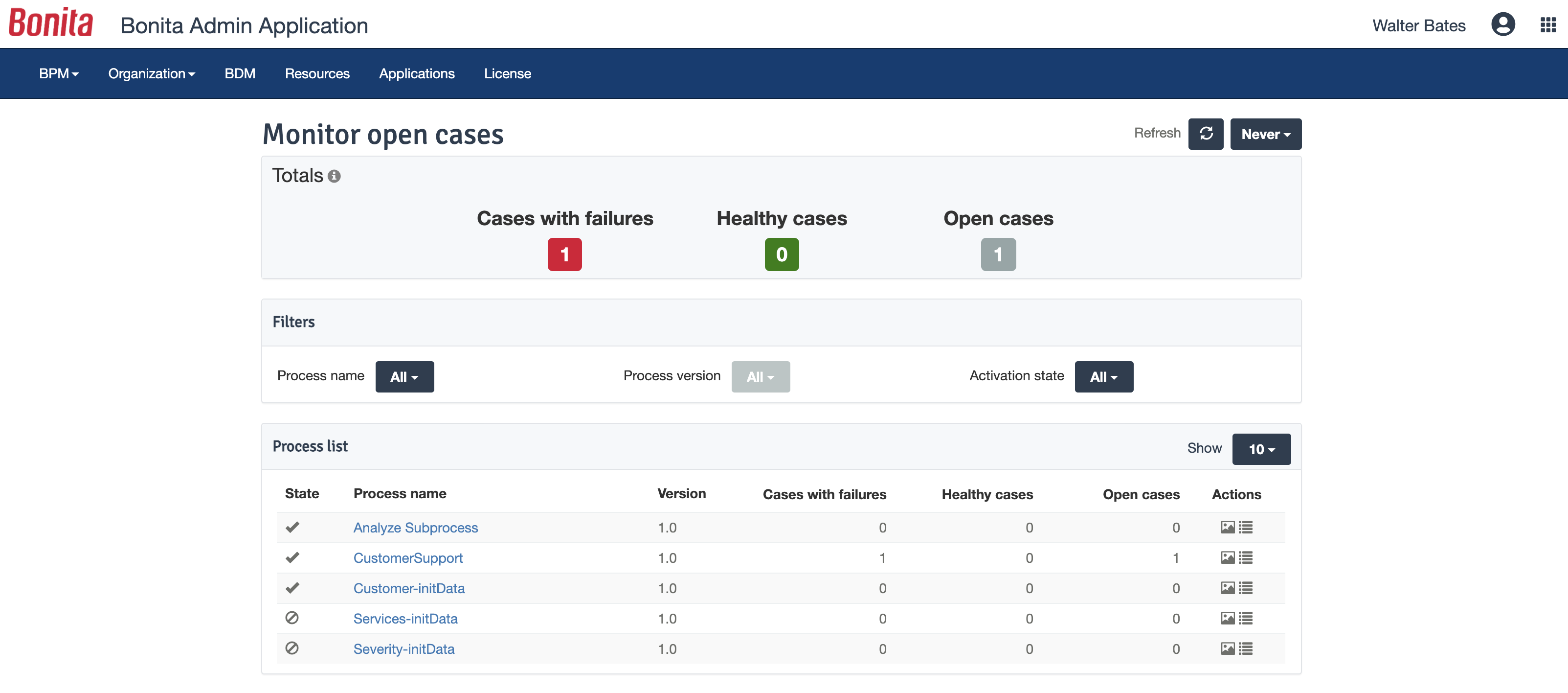
The administrator portal could be improved. It is hard to look at subprocess data, for example and it is sometimes better to investigate with SQL queries. I don't like new (7.3) task list either.
If you had the ability to drag tasks around in a nonlinear way, it could be a cool creative feature. An example is to have a subtask next to another that says N/A if the task wasn't executed because it wasn't applicable.
Inbox tab can be overwhelming but that may just be the style in which I built my checklists.
Bonita Platform has allowed us to develop GUI relatively fast using its UI Designer while being able to seamlessly integrate our business logic in Java in a BPMN2 process diagram. It gives a nice productivity boost but still requires programming know-how to be able to deliver the final solution to your business problems.
Engine itself is efficient enough for most cases I dealt with. It can also be extended by clustering. I have done performance tests with JMeter and only managed to induce the crash of... JMeter. If there are efficiency issues they usually concern bad design/implementation of created apps or bottlenecks in integrated systems. Although I have met two cases with efficiency loss.
1. Java 7 related PermGen saturation caused by big number of installed apps (there is no jar dependency reusal between apps option).
2. Big number of waiting event handlers in processes stresses the database.
Since my last login into the platform, the latest update made the app much easier to use and learn. It's incredibly clean, and everything is exactly where it should be location-wise. You can tell they listen to their user base for features.
I've tried other checklist tools like Google Keep, but it was too simple. I've tried Flowster, which is very similar to Process Street, but I like Process Street better. The interface is a lot more balanced and pleasant to look at. I found Flowster to be a less appealing interface even though the features were similar. I also briefly tried systemHUB but it is very expensive for what it offers compared to Process Street.
Respect of BPMN standard over the long term. Good enhancements by Bonitasoft for new use cases, for example the introduction of a real form editor even if it has been technically difficult to manage. Once done though, we have far greater possibility of human interaction.
We've had serious problems with 'automated' processes in earlier versions of Bonita (via Talend), especially with connectors. In Bonita 7 we replaced these with REST calls, hoping for better performance.
Overall, using Bonita has not had a positive impact on our development efficiency. Moving from Talend (using Bonita 5) to Bonita 7 has improved this somewhat. Still, it remains a pain to integrate Bonita in the development and delivery process.
Migrating from Bonita 7.0 to 7.1 has proven to be a difficult undertaking, mainly on the database level. This has cost us a lot of time and better support would be welcomed.
Because of Process Street I am no longer losing money when having to redo things
It helps me eliminate those nasty "egg on the face" situations with clients because now nothing slips through the cracks. The team is able to be on top of it!