Bonita is an open-source business process and workflow management platform created by the French National Institute for Research in Computer Science. It is available as a free community edition or as a commercial subscription product.
N/A
Oracle APEX
Score 8.5 out of 10
N/A
Oracle APEX (or Oracle Application Express) is an online low-code application builder that allows users to develop a database-drive application, customize the application's UI, and then give their users access to the application via URL. Oracle APEX includes a suite of pre-built productivity applications and examples, such as a Survey Builder, Bug Tracking, P-Track project management, etc
Well suited for low code/no code applications centered around approval flows. It has built-in task management for users to see their pending actions, comments, statuses, etc. It has a very nice design for process flows. Less appropriate may be for generic type applications with complex screens and logic within those screens that need a lot of data to process.
It is appropriate for database application development supporting data driven processes, online transaction processing, BI/reports/analytics ... for addressing about any business data processing need I can think of. Oracle Application Express is fantastic for creating beautiful rich user interfaces with support for all major browsers rendering well on a range of devices. It is less appropriate for applications requiring native low level access to device peripherals and is less appropriate for applications that must execute offline without network/internet connection to supporting application and database servers.
Efficient and fast prototyping: a process can be modeled and tried out quickly and with low investment.
Full stack prototyping for development and implementation allows the process to be developed and implemented as an application from the prototype. It's not just drawings and wire frames that are tossed over the wall to developers.
Data modeling is integral from the beginning of the prototype which is appropriate for the stakeholders in the beginning.
There is only one business data model. Even if deploying new processes does not require stopping the platform, the BDM update requires it.
During the platform evolution often new bugs were introduced so it was risky to deploy the platform in the low minor version. For example, there were memory leaks from 7.2.0 to 7.2.3.
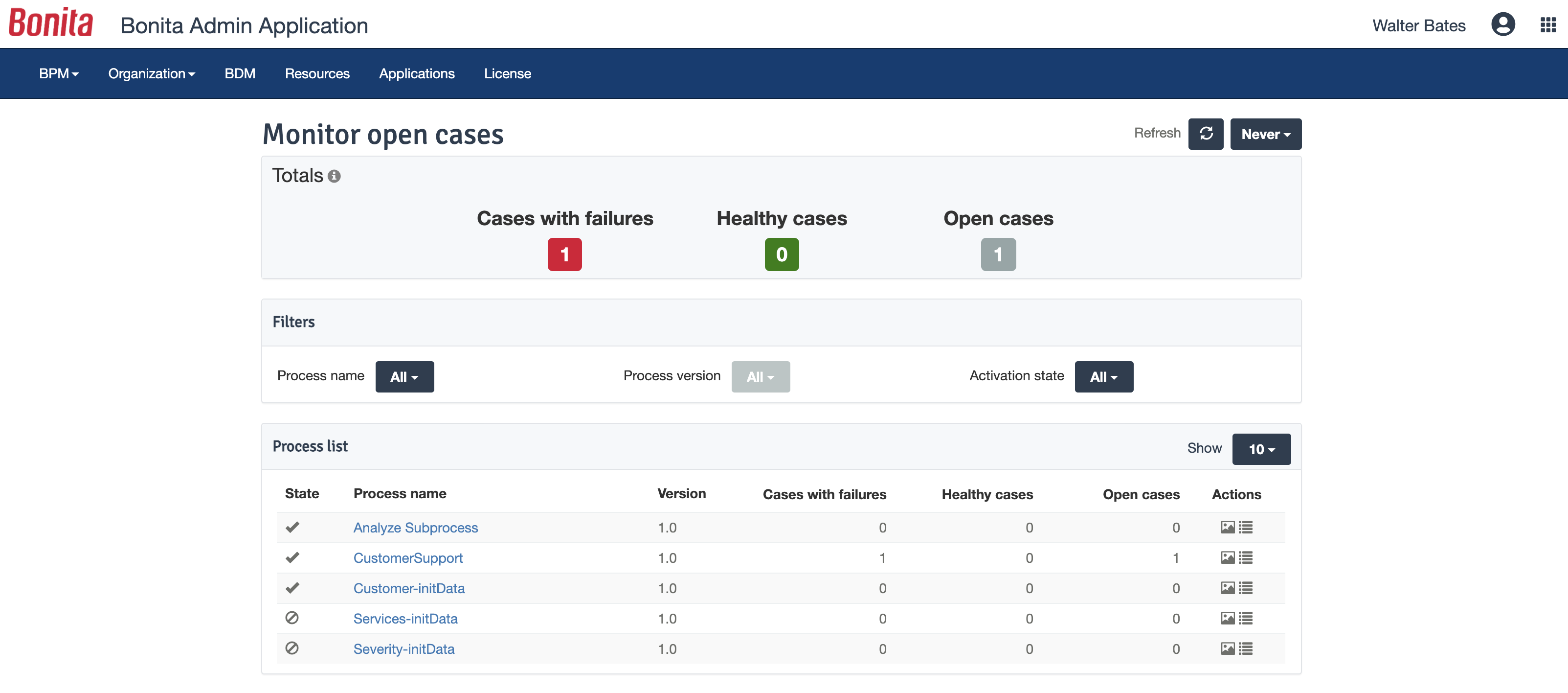
The administrator portal could be improved. It is hard to look at subprocess data, for example and it is sometimes better to investigate with SQL queries. I don't like new (7.3) task list either.
For complex APEX applications you need to be a pro expert in PL/SQL
Debugging in APEX can be complicated if there is a logical error. Syntax errors will end up shown as ORA errors
Lack of designer interface. Even though you are designing a form you need to do it by means of APEX interface using a series of steps, no UI for design
Oracle specific not applicable for other databases
I felt very comfortable using Oracle Application Express from the start. I designed my data model and quickly developed the basic CRUD pages for master tables. Then I designed the main functionality and was able to test and deploy it in a couple of days work. I will probably share the app with other members of the team and continue adding some features in the short term.
Bonita Platform has allowed us to develop GUI relatively fast using its UI Designer while being able to seamlessly integrate our business logic in Java in a BPMN2 process diagram. It gives a nice productivity boost but still requires programming know-how to be able to deliver the final solution to your business problems.
Because it's very easy to develop, fast, secure, has a lot of features. It's like a prototyping tool such as figma, but it can be used as a real product. Dynamic action, plugin, rest api, minimize a lot of coding, a lot of templates, PWA, really bring Oracle APEX functionality to be able to solve most common internal users pain points.
Engine itself is efficient enough for most cases I dealt with. It can also be extended by clustering. I have done performance tests with JMeter and only managed to induce the crash of... JMeter. If there are efficiency issues they usually concern bad design/implementation of created apps or bottlenecks in integrated systems. Although I have met two cases with efficiency loss.
1. Java 7 related PermGen saturation caused by big number of installed apps (there is no jar dependency reusal between apps option).
2. Big number of waiting event handlers in processes stresses the database.
Very active and knowledgeable community support includes quick and helpful responses from the Oracle employees on the product development team. I've never had to raise an official support request - everything is dealt with via forums and user groups - or via direct emails. The supposrt commuinty is one of the great things about Apex.
Using it on the cloud is really simple, the entire process of configuring and provisioning an Oracle Database takes only a few minutes (less than 10) and then Oracle APEX is already deployed on the database, so you just have to start using it. I would strongly recommend using APEX on Oracle Cloud Free Tier.
Oracle APEX and Oracle Visual Builder are both low-code development platforms within the Oracle ecosystem, but they serve different purposes. Oracle APEX is more suited for the people who are familiar with SQL, PLSQL. It provides rapid application development features based on data residing in Oracle database. It's a low code platform and best suited for web based applications/extensions based on Oracle DB that may use REST APIs and other web services. It also provides mobile application support. Oracle Visual Builder is best suited for web applications based on Oracle Cloud services. It utilizes javascript based drag-drop UI builder. It's very deeply integrated with Oracle Fusion Cloud platform.
Respect of BPMN standard over the long term. Good enhancements by Bonitasoft for new use cases, for example the introduction of a real form editor even if it has been technically difficult to manage. Once done though, we have far greater possibility of human interaction.
We've had serious problems with 'automated' processes in earlier versions of Bonita (via Talend), especially with connectors. In Bonita 7 we replaced these with REST calls, hoping for better performance.
Overall, using Bonita has not had a positive impact on our development efficiency. Moving from Talend (using Bonita 5) to Bonita 7 has improved this somewhat. Still, it remains a pain to integrate Bonita in the development and delivery process.
Migrating from Bonita 7.0 to 7.1 has proven to be a difficult undertaking, mainly on the database level. This has cost us a lot of time and better support would be welcomed.
It has increased our development output over Forms greatly. For instance, when starting at my current company, I was able to replace our aging ASP Intranet site within 4 months when our IT manager had budgeted over a year for the task.
We've been able to standardize under one technology, incorporating previously unsupportable disparate systems under one roof.
It's free with an Oracle Database so the only investment was our time, something we now have more of thanks to Application Express.