Autodesk BIM Collaborate Pro (formerly BIM360) is a construction software for project managers, site managers, and Building Information Modelling (BIM) managers. It is designed to connect the office and site components of construction, providing cloud-based access to plans and models.
$480
per user/per year
Bluebeam
Score9.1 out of 10
N/A
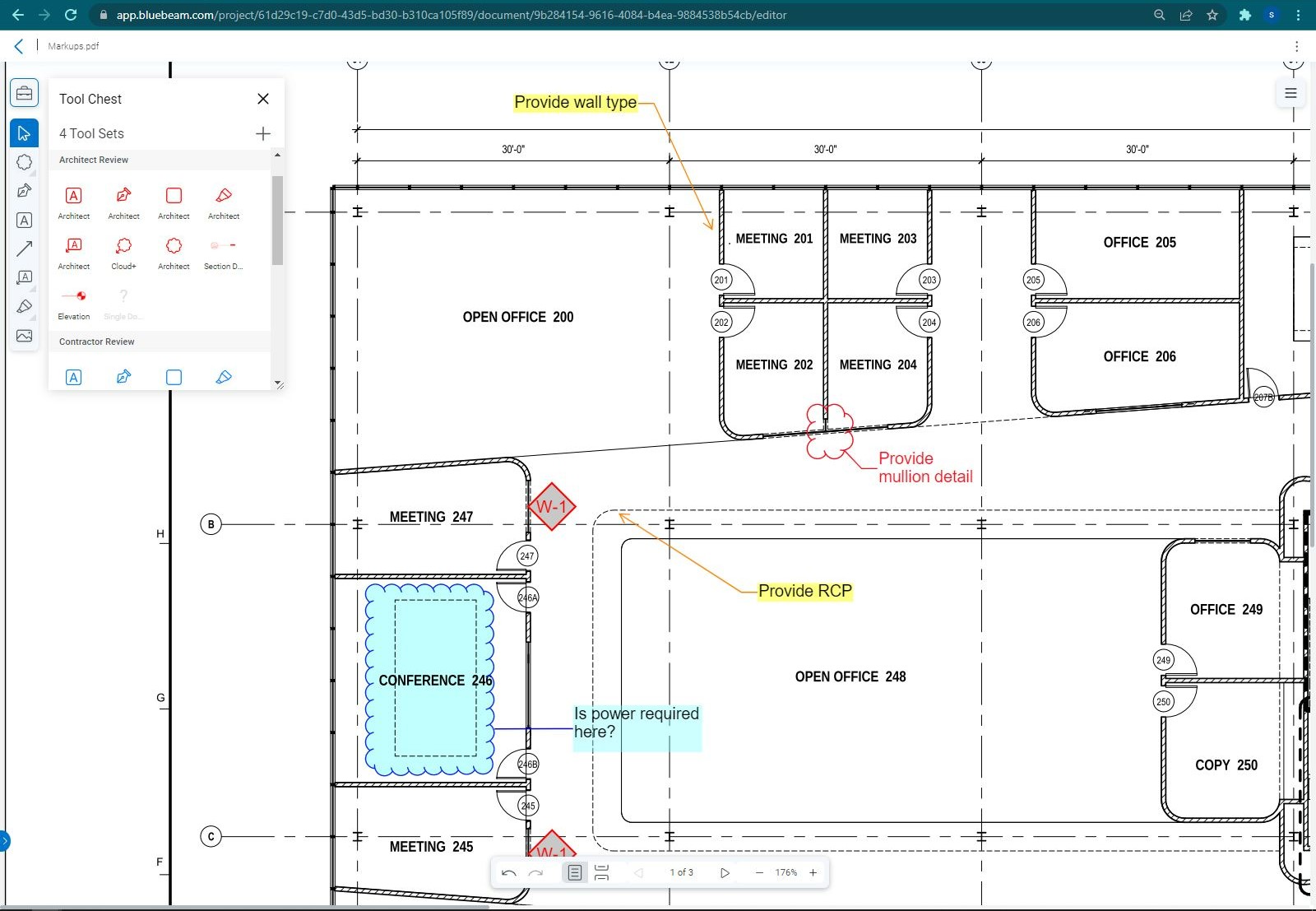
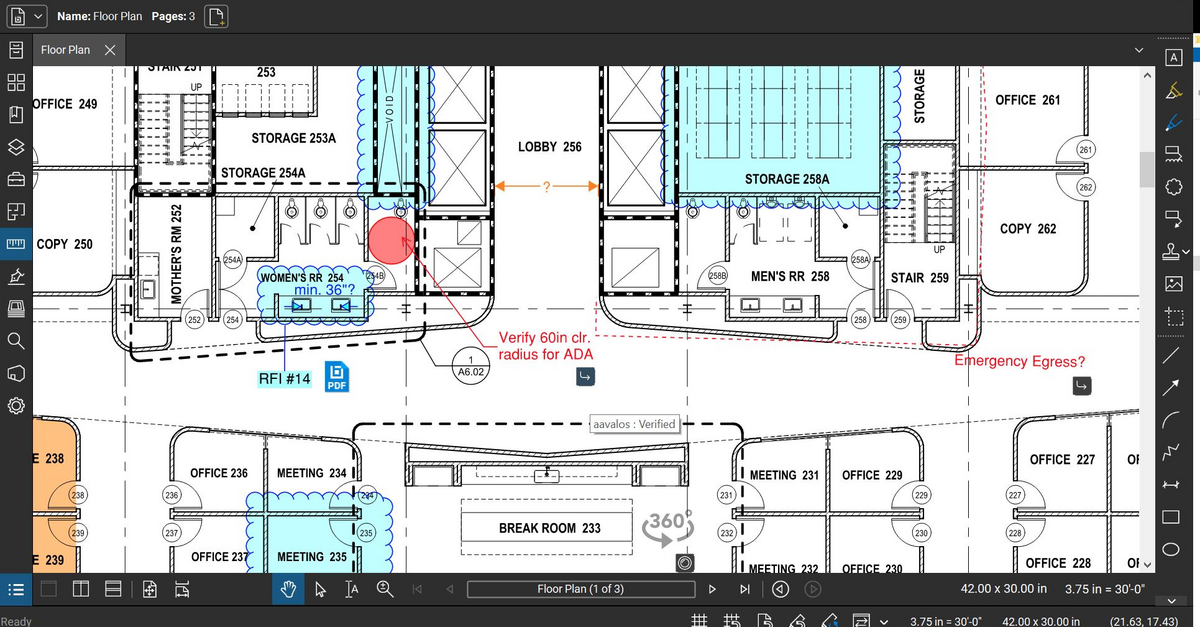
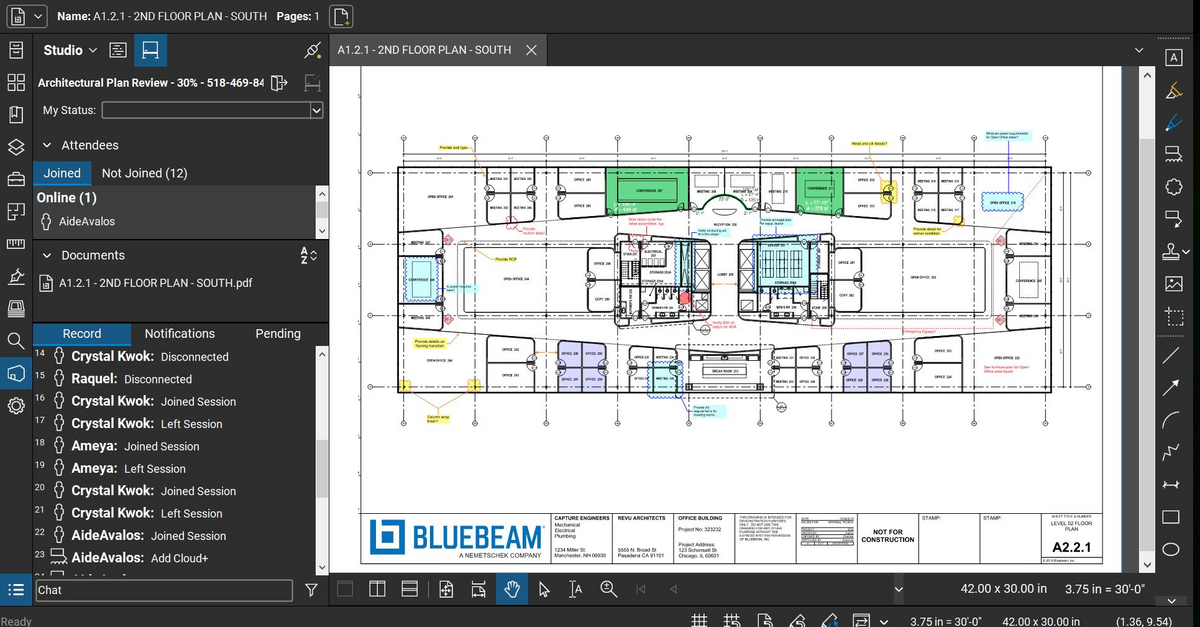
Bluebeam Revu is a PDF management, control, and editing tool. It enables collaboration and markup within shared documents across projects’ life cycles and has takeoff and bid creation capabilities.
$240
per year per user
Pricing
Autodesk BIM Collaborate Pro
Bluebeam
Editions & Modules
Autodesk Bim 360
$480.00
per user/per year
Revu Standard
$349
per seat
Revu CAD
$449
per seat
Revu eXtreme
$599
per seat
Offerings
Pricing Offerings
Autodesk BIM Collaborate Pro
Bluebeam
Free Trial
No
Yes
Free/Freemium Version
No
No
Premium Consulting/Integration Services
No
Yes
Entry-level Setup Fee
No setup fee
No setup fee
Additional Details
—
—
More Pricing Information
Community Pulse
Autodesk BIM Collaborate Pro
Bluebeam
Considered Both Products
Autodesk
Verified User
Chose Autodesk BIM Collaborate Pro
BIM360 serves us better for live collaboration than any other product. Because it is under the Autodesk umbrella it is compatible with Revit and AutoCAD MEP and Civil 3D. Unlike the other software where the data sharing is a static process. We went with BIM360 ultimately for …
A de minimis incentive was given to thank the reviewer for their time. The incentive was not used to bias or drive a particular response, nor was the incentive contingent on a positive endorsement. More Info
Project Engineer at Okland Construction (Construction, 501-1000 employees)
Chose Autodesk BIM Collaborate Pro
I think BIM360 has much better quality control tools that are much more streamlined than what is available on Procore. However the RFI, Submittal, Drawings tools in Procore are much easier to use and the drawings are much easier to access and view in the field using Procore. …
A de minimis incentive was given to thank the reviewer for their time. The incentive was not used to bias or drive a particular response, nor was the incentive contingent on a positive endorsement. More Info
Project Engineer at Okland Construction (Construction, 501-1000 employees)
Chose Bluebeam
I have used Adobe PDF viewers and editors and they do their job alright and I was able to easily use them. But when it comes down to which program better suits the work I do in the construction Bluebeam is far more focused in its design to meet my needs and uses in the …
A de minimis incentive was given to thank the reviewer for their time. The incentive was not used to bias or drive a particular response, nor was the incentive contingent on a positive endorsement. More Info
Autodesk Bim 360 is well suited to the majority of construction projects in my opinion. On the construction side I could see how the straightforward nature of the platform would be well liked. The new update with the widgets is a great touch and allows for ease of site visits by showcasing good to know info like project location on a map and the local weather. You can also customize the "widgets" as you see fit to add more information if necessary to the home screen. From my experience as a LEED consultant, Bim 360 does not differ much from other platforms used for submittal review like Procore. It is easy enough to search for what you want but searches do take a while and you need to move the cursor over every time you search and do not find what you're looking for, which seems very unnecessary. Overall it is fine for reviewing documentation but isn't anything extraordinary.
A de minimis incentive was given to thank the reviewer for their time. The incentive was not used to bias or drive a particular response, nor was the incentive contingent on a positive endorsement. More Info
The program is great for editing construction drawings, stamping/approving official documents and overlaying revised documents to see design changes. You can use it as an estimating takeoff tool, estimating database, document control, cloud document storage, the list goes on! Bluebeam poses many applications for the user to utilize for the desired needs. There may be some other software that has one specific function that can perform the specific task better, but Bluebeam is a holistic program with many tools for use.
A de minimis incentive was given to thank the reviewer for their time. The incentive was not used to bias or drive a particular response, nor was the incentive contingent on a positive endorsement. More Info
A de minimis incentive was given to thank the reviewer for their time. The incentive was not used to bias or drive a particular response, nor was the incentive contingent on a positive endorsement. More Info
Once you set Bluebeam Revu as your default PDF handler, it launches immediately when clicking a PDF to open. The speed with which it opens documents is impressive.
Creating PDF's out of other documents, such as Word, Excel, JPG's, etc. is simple.
Digitally signing documents is a simple, secure process. You can keep your signature password-protected, yet still access it quickly.
The Bluebeam Revu mobile application ( I use the iOS version on an iPad Pro), is awesome. Not only does it handle PDF's like you would expect it to, it allows for effortless digital signing of documents on the fly. Nice to be able to quickly sign a document and email right back out from the tablet no matter where I am.
A de minimis incentive was given to thank the reviewer for their time. The incentive was not used to bias or drive a particular response, nor was the incentive contingent on a positive endorsement. More Info
Bim360 is extremely unintuitive and frequently confusing to end users.
There are multiple avenues of sharing and collaboration for models and information. The advantages/disadvantages of each and how to perform even the most basic of tasks requires extensive training and mentoring for even the most advanced of users.
There are many enormous limitations and constraints to BIM 360 that are not immediately obvious and even contrary to published marketing materials and even product naming.
Development cycles of the product are seemingly monthly, but incredibly minor. This makes the desperately-needed and glaringly obvious massive usability, capability, and performance improvements into deal-breakers and hair pulling events. Change cannot come fast enough.
There are no integrations into Microsoft's Azure AD SSO or other 3rd party SSOs available for SMBs. This makes the provided MFA a huge headache for all SMBs.
There are no integrations into the Microsoft 365 ecosystem for SharePoint/OneDrive or Outlook. This is desperately needed for most organizations using Bim360.
A de minimis incentive was given to thank the reviewer for their time. The incentive was not used to bias or drive a particular response, nor was the incentive contingent on a positive endorsement. More Info
If you have several tabs open and you try to drag one out for a side by side view then you do not have all the modification options and you have to combine them back together.
There is a lag time when hitting the print option.
There is also a lag time when opening files, sometimes I think the window is frozen.
I wish the basic version also had basic file editing, as in editing a document as Adobe does.
A de minimis incentive was given to thank the reviewer for their time. The incentive was not used to bias or drive a particular response, nor was the incentive contingent on a positive endorsement. More Info
Bluebeam is a powerful PDF viewer and mark-up tool. We are more familiar with it than Adobe Acrobat Pro or other viewers, and it has more features geared towards construction document managers than Acrobat Pro does.
A de minimis incentive was given to thank the reviewer for their time. The incentive was not used to bias or drive a particular response, nor was the incentive contingent on a positive endorsement. More Info
It's not very difficult to use for majority of all our users. We really like storing and managing all our project data in one location so users have only one option to access the requested information. Managing our architectural engineering projects with two workflows in one system is really a good asset
A de minimis incentive was given to thank the reviewer for their time. The incentive was not used to bias or drive a particular response, nor was the incentive contingent on a positive endorsement. More Info
I'm constantly finding that Bluebeam Revu does more than I knew it could. And when I find something that it can't do, I've found that Bluebeam truly listens to its user base and will work to incorporate any good suggestion when feasible.
A de minimis incentive was given to thank the reviewer for their time. The incentive was not used to bias or drive a particular response, nor was the incentive contingent on a positive endorsement. More Info
AutoDesk support is slow and if you are not an enterprise customer they will likely tell you to go to forums and post for help pushing the support on the high-level end-users (some of which are AutoDesk employees). I haven't actually had issues requiring support with docs altough there are some features I wish it had
A de minimis incentive was given to thank the reviewer for their time. The incentive was not used to bias or drive a particular response, nor was the incentive contingent on a positive endorsement. More Info
Its hard for me to give a rating on this one as we rarely have to use the support feature for Bluebeam. However, when we have used it, they have been ultra supportive in helping us get exactly what we needed. I know another engineer was trying to figure out a feature and the rep gave a detailed tutorial on how to complete the task
A de minimis incentive was given to thank the reviewer for their time. The incentive was not used to bias or drive a particular response, nor was the incentive contingent on a positive endorsement. More Info
The saving in reduced field changes/mistakes quickly paid for the license plus some. The software allows for easy data collection, especially at project completion for field software by checklist creation. Furthermore, the internal punch-list tracking, tracking completion lists and punch lists created for us by others is optimal compared to the competition. We chose Bim360 over other options due to its ability to import out of other software programs directly into the system, adding reports in one location and then distributing it to subcontractors and internally from there to fix deficiencies. It does the tracking, importing, markups of pictures and document viewing well and fulfills our needs.
A de minimis incentive was given to thank the reviewer for their time. The incentive was not used to bias or drive a particular response, nor was the incentive contingent on a positive endorsement. More Info
We feel there is not another program out there that would compare to Bluebeam at this current time. Some of the other programs out there do not include studio or the overlaying process which is one of our main uses. The ease of hyperlinking makes this product stand out the most.
A de minimis incentive was given to thank the reviewer for their time. The incentive was not used to bias or drive a particular response, nor was the incentive contingent on a positive endorsement. More Info
The fact that your files are not on your servers. Anytime that the Autodesk servers go down you are down; it does not happen very often but when it does there is nothing you can do about it except wait.
Because of how BIM360 licensing is setup it does force you to manage the personnel on a project closer. This can at times be viewed as a negative but in the long run is positive because with better management comes better profit.
A de minimis incentive was given to thank the reviewer for their time. The incentive was not used to bias or drive a particular response, nor was the incentive contingent on a positive endorsement. More Info
A major positive aspect is being able to take your computer home without taking the entire set of paper drawings. They have made it so easy to navigate a set of drawings that I can work at home using only the digital drawings.
Collaboration with owners and architects has been a great feature. Setting up a Bluebeam studio and having everyone get in and mark things up, then having the architect be able to go in and see what markups have been added, has made the constructability review process much much better.
Even when not working on drawings, Bluebeam is a very good tool for working with standard PDF documents. The markup tools are very easy to use.
The negative aspect is the takeoff function because some people would like estimators to use the Bluebeam takeoff because it would make their job easier down the road; however, the actual act of doing a full scale takeoff in Bluebeam would require much more time.
A de minimis incentive was given to thank the reviewer for their time. The incentive was not used to bias or drive a particular response, nor was the incentive contingent on a positive endorsement. More Info