Azure DevOps (formerly VSTS, Microsoft Visual Studio Team System) is an agile development product that is an extension of the Microsoft Visual Studio architecture. Azure DevOps includes software development, collaboration, and reporting capabilities.
$2
per GB (first 2GB free)
Planview AgilePlace
Score 9.9 out of 10
N/A
AgilePlace is a project management solution built around flexibility, data-driven analytics, and workflow automation. The software was acquired by Planview in December 2017 to expand that company's capabilities.
$19
per user, per month
Pricing
Azure DevOps Services
Planview AgilePlace
Editions & Modules
Azure Artifacts
$2
per GB (first 2GB free)
Basic Plan
$6
per user per month (first 5 users free)
Azure Pipelines - Self-Hosted
$15
per extra parallel job (1 free parallel job with unlimited minutes)
Azure Pipelines - Microsoft Hosted
$40
per parallel job (1,800 minutes free with 1 free parallel job)
Basic + Test Plan
$52
per user per month
Teams
$19
per user, per month
Scaled Teams
$29
per user, per month
Custom
Contact Sales for Quote
per user, per month
Offerings
Pricing Offerings
Azure DevOps Services
Planview AgilePlace
Free Trial
No
Yes
Free/Freemium Version
No
No
Premium Consulting/Integration Services
No
No
Entry-level Setup Fee
No setup fee
No setup fee
Additional Details
—
All editions include unlimited boards.
More Pricing Information
Community Pulse
Azure DevOps Services
Planview AgilePlace
Features
Azure DevOps Services
Planview AgilePlace
Project Management
Comparison of Project Management features of Product A and Product B
Azure DevOps Services
-
Ratings
Planview AgilePlace
7.4
Ratings
3% below category average
Task Management
00 Ratings
10.00 Ratings
Resource Management
00 Ratings
9.90 Ratings
Gantt Charts
00 Ratings
10.00 Ratings
Scheduling
00 Ratings
9.90 Ratings
Support for Agile Methodology
00 Ratings
9.30 Ratings
Support for Waterfall Methodology
00 Ratings
4.00 Ratings
Document Management
00 Ratings
6.50 Ratings
Email integration
00 Ratings
7.30 Ratings
Mobile Access
00 Ratings
2.10 Ratings
Timesheet Tracking
00 Ratings
6.40 Ratings
Change request and Case Management
00 Ratings
7.20 Ratings
Visual planning tools
00 Ratings
7.30 Ratings
Agile Development
Comparison of Agile Development features of Product A and Product B
ADO is well suited for the visibility of day-to-day tasks and responsibilities as well as things such as Features, user stories, etc. Off the top of my head, I can't think of any scenario where it might not be well suited, as you can customize ADO to your liking to a degree.
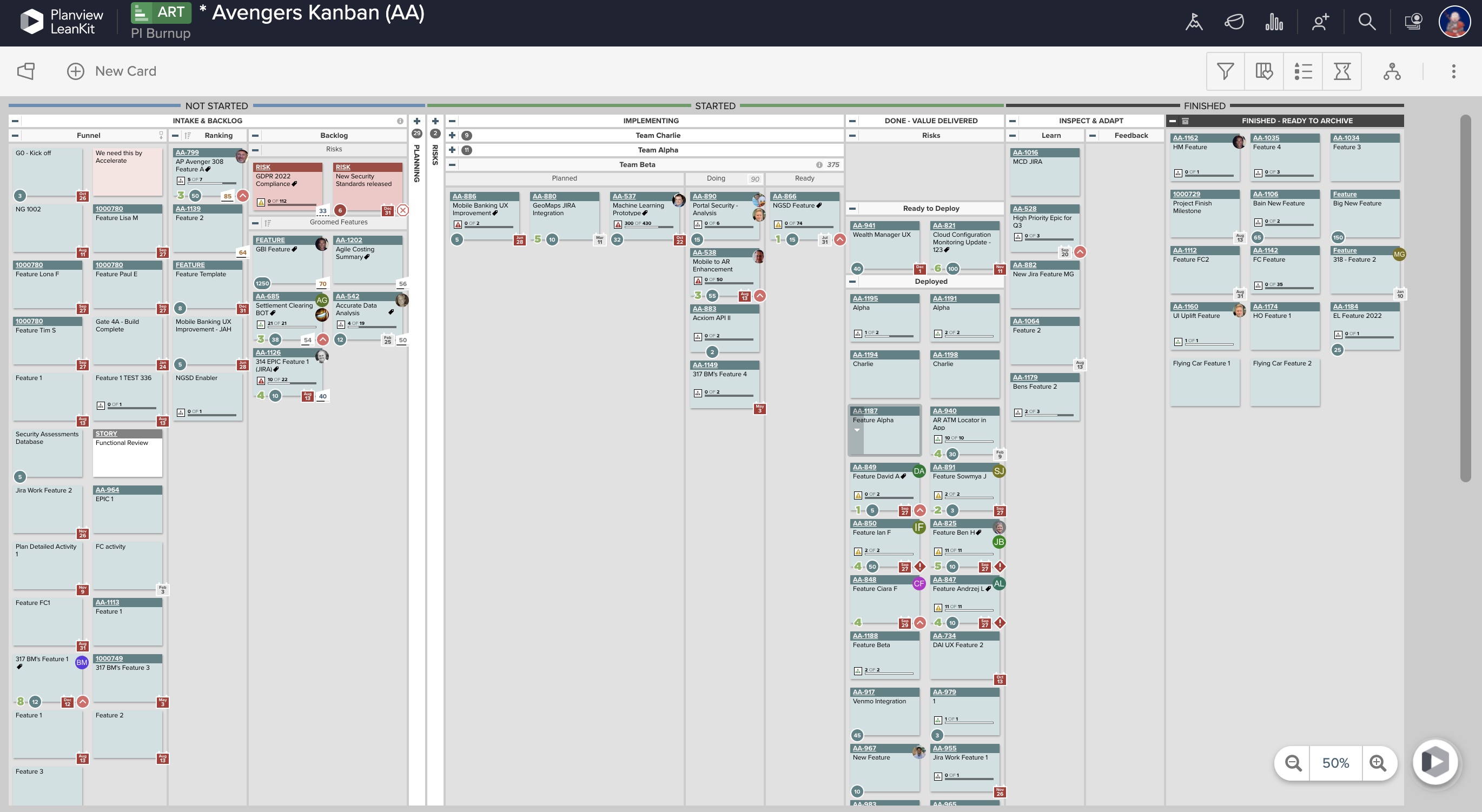
AgilePlace is a great way for teams, or individuals, to bring visibility to the work in process and in their backlog. The color coding and icon use helps to quickly analyze the type of work or status of the work. The product team is doing a good job at listening to their user's feedback and implementing improvements. Where it falls short is when reporting needs to occur.
Flexible Requirements Hierarchy Management: AZDO makes it easy to track items such as features or epics as a flat list, or as a hierarchy in which you can track the parent-child relationship.
Fast Data Entry: AZDO was designed to facilitate quick data entry to capture work items quickly, while still enabling detailed capture of acceptance criteria and item properties.
Excel Integration: AZDO stands out for its integration with MS Excel, which enables quick updates for bulk items.
Okta Integration: We love using SSO for all our SaaS apps, and as new team members join, they can be automatically joined to the appropriate LeanKit boards.
Filtering and viewing: Can filter and refine by several fields as well as custom fields. Assigned Users, Tagged, Card Type, Date, etc
Their analytics and reporting can be helpful for PMs, especially if they have several teams they oversee.
Need to make the changes so that it doesn't occupy most of the CPU utilization and memory
Execution of Bulky SQl Queries leads to either the SQl being out of exception or the VS being unresponsive
Integration with Microsoft products is easy, but with non-Microsoft products it is more difficult, and you have to make a lot of configuration changes to integrate
With every upgrade of the Visual Studio, like from VS 2010 to VS 2013 , we need to upgrade our hardware/machine, as the VS hardware requirement also increases
If code is getting compiled in one visual studio, like in VS 2010, that the same code could possibly give an error when compiled in VS 2013, due to certain changes in keyword, data format, etc., with the VS upgrade
I don't think our organization will stray from using VSTS/TFS as we are now looking to upgrade to the 2012 version. Since our business is software development and we want to meet the requirements of CMMI to deliver consistent and high quality software, this SDLC management tool is here to stay. In addition, our company uses a lot of Microsoft products, such as Office 365, Asp.net, etc, and since VSTS/TFS has proved itself invaluable to our own processes and is within the Microsoft family of products, we will continue to use VSTS/TFS for a long, long time.
Azure DevOps is a powerful, complex cloud application. As such there are a number of things it does great and something where there is room for improvement. One of those areas would be in usability. In my opinion it relies too much on search. There is no easy way to view all projects or to group them in a logical way. You need to search for everything.
LeanKit isn't the best designed Kanban system I've seen, but overall it's pretty usable. The boards I've used are pretty complex, so it can be difficult to find things. I found that searching and filtering for specific cards was somewhat of a challenge. Dragging a card from one lane to another is kind of a fun way to get things done though.
When we've had issues, both Microsoft support and the user community have been very responsive. DevOps has an active developer community and frankly, you can find most of your questions already asked and answered there. Microsoft also does a better job than most software vendors I've worked with creating detailed and frequently updated documentation.
Every time I have reached out to the AgilePlace support team I have received a timely response in addition to professional & personal feedback. Their consultants are knowledgeable and the management team is happy to jump in and help when needed.
Jira is fantastic for project management and customer facing portal. It is not good for pure development (no integration with Git, pipeline management, automated testing features). If DevOps were to integrate and adopt the project features of Jira as well as the customer facing interfaces, I feel it would be a complete project management system.
Originally, we had evaluated two other tools next to Planview LeanKit: Kanbantool and Kanbanflow. The latter was a close contestant for productive use, as it was also very customizable and a joy to work with and look at. It also had lower user fees and a mobile integration. In the end, we picked Planview LeanKit because of several reasons: Aesthetics: The look was much more clean and professional. Reporting: It was obvious from the start that we could use Planview LeanKit as a tool for improvement. API: We needed to integrate the Kanban into our central systems and Planview LeanKit API was (and still is) a way to do it. Card Headers: This sounds like a simple thing, but the headers above the titles fit our work perfectly and looked perfect, which helped the decision.