Azure Backup vs. NetApp Cloud Volumes ONTAP

Overview
ProductRatingMost Used ByProduct SummaryStarting Price
Azure Backup
Score 8.2 out of 10
N/A
Microsoft's Azure Backup is a cloud backup service.
$5
NetApp Cloud Volumes ONTAP
Score 9.1 out of 10
Enterprise companies (1,001+ employees)
NetApp's Cloud Volumes ONTAP combines data control with enterprise-class storage features for various use cases, including file shares and block-level storage serving NAS and SAN protocols (NFS, SMB / CIFS, and iSCSI), Disaster Recovery (DR), Backup and Archive, DevOps, Databases (SQL, Oracle, NoSQL), or any other enterprise workload.
$0.64
Hourly
Pricing
Azure BackupNetApp Cloud Volumes ONTAP
Editions & Modules
Storage in GB/Month
$0.0224 to $0.0569
per GB
Backup Instance <50GB
$5.00 + storage consumed
Backup Instance > 50 GB but < or = 500 GB
$10.00 + storage consumed
Backup Instance Instance is > 500 GB
$10 for each 500 GB increment + storage consumed
Explore
$0.64
Hourly
Standard
$1.68
Hourly
Premium
$2.71
Hourly
Bring Your Own License (BYOL)
Purchased from NetApp
Offerings
Pricing Offerings
Azure BackupNetApp Cloud Volumes ONTAP
Free Trial
NoYes
Free/Freemium Version
NoNo
Premium Consulting/Integration Services
NoNo
Entry-level Setup FeeNo setup feeNo setup fee
Additional DetailsVisit https://cloud.netapp.com/pricing for the pricing breakdown.
More Pricing Information
Community Pulse
Azure BackupNetApp Cloud Volumes ONTAP
Features
Azure BackupNetApp Cloud Volumes ONTAP
File Sharing & Management
Comparison of File Sharing & Management features of Product A and Product B
Azure Backup
8.7
Ratings
3% above category average
NetApp Cloud Volumes ONTAP
-
Ratings
Versioning9.00 Ratings00 Ratings
Video files9.10 Ratings00 Ratings
Audio files8.20 Ratings00 Ratings
Document collaboration9.00 Ratings00 Ratings
Access control9.10 Ratings00 Ratings
File search7.80 Ratings00 Ratings
Device sync9.00 Ratings00 Ratings
Cloud Storage Security & Administration
Comparison of Cloud Storage Security & Administration features of Product A and Product B
Azure Backup
8.7
Ratings
0% above category average
NetApp Cloud Volumes ONTAP
-
Ratings
User and role management9.10 Ratings00 Ratings
File organization9.00 Ratings00 Ratings
Device management8.20 Ratings00 Ratings
Cloud Storage Platform
Comparison of Cloud Storage Platform features of Product A and Product B
Azure Backup
9.0
Ratings
6% above category average
NetApp Cloud Volumes ONTAP
-
Ratings
Performance9.10 Ratings00 Ratings
Reliability9.10 Ratings00 Ratings
Storage Reports8.80 Ratings00 Ratings
Best Alternatives
Azure BackupNetApp Cloud Volumes ONTAP
Small Businesses
SugarSync
SugarSync
Score 5.8 out of 10
SugarSync
SugarSync
Score 5.8 out of 10
Medium-sized Companies
Druva Security Cloud
Score 9.7 out of 10
Druva Security Cloud
Score 9.7 out of 10
Enterprises
Druva Security Cloud
Score 9.7 out of 10
Druva Security Cloud
Score 9.7 out of 10
All AlternativesView all alternativesView all alternatives
User Ratings
Azure BackupNetApp Cloud Volumes ONTAP
Likelihood to Recommend
9.1
(0 ratings)
9.0
(0 ratings)
Usability
8.0
(0 ratings)
-
(0 ratings)
Support Rating
9.7
(0 ratings)
9.0
(0 ratings)
User Testimonials
Azure BackupNetApp Cloud Volumes ONTAP
Likelihood to Recommend
By using Azure Backup, you can back up your NAS device you use locally as a file server, virtual machines you use in [a] production environment, critical databases, and everything you can think of. I do not know if there are scenarios that are not suitable, it meets all my needs.
Read full review
It is well suited to store lower-tier data in the cloud to free up space on primary storage. For our use, it is really only currently viable for things like snapshots and backups. Other organizations may find it useful for secondary-tier archival storage as well. At this point, I don't really trust any cloud solution as primary storage for anything. This may change in the future, but for backups and such, it is a nice option.
Read full review
Pros
  • Azure Backup is fast! Coupled with the fact that Microsoft created Azure and Windows - these two operate phenomenally together!
  • Administering the backups inside of Azure is a breeze. The ability to mount, restore entire backups, or recover files, has been made very easy. You do not have to download any media to recover something, you do this all in the cloud and it gets mounted in Microsoft's systems. Making this process less than a quarter of the time you would have spent with your 'other' backup solutions.
Read full review
  • Integrates into major Cloud vendors.
  • Integrates with NetApp infrastructure.
Read full review
Cons
  • backup schedule calendar would be cool
  • Backup vaults should ask if you want to send notifications when you first set it up, there have been a couple of times when I noticed a month later that, backup job failures were not configured to send email notifications.
Read full review
  • Tighter integration with third-party (non-storage) monitoring tools
  • CMDB classifications break down when integrating with ServiceNow
  • Migrating storage workloads from one cloud service provider to another
Read full review
Usability
Azure backup is easy to implement, accessible by using the web portal GUI, and has the ability to restore at the file level or the complete VM. We have experienced zero issues with the backup process or performing file-level restorations. We have not restored an entire VM to date.
Read full review
No answers on this topic
Support Rating
One of the differentials of the solution is the high level of guarantee and support of the Azure Backup solution. Microsoft is a reference in a technology company with a highly trained support team and helps us with any questions or technical problems with the tool. Service is fast and efficient with trained engineers.
Read full review
Haven't had to use it.
Read full review
Alternatives Considered
The cost, not only in the short term, but in our long-term calculations.
Even in need of improvements, the pre-sale and post-sale support is very good.
The ease, like many Microsoft products about scheduling backups, the friendly interface, the fact that there is no need for an expensive resource dedicated to this backup and some other details, made us choose Azure Backup.
Read full review
ScienceLogic SL1 and SolarWinds Storage Resource Monitor (SRM) were the closest competitors to meeting our business objectives. Tivoli Storage Manager was not able to meet the initial requirements. There was a significant overlap of capabilities between ScienceLogic SL1, SolarWinds SRM, and NetApp Cloud Volumes ONTAP. The latter provided a more positive and cohesive experience for our administrators and executives.
Read full review
Return on Investment
  • It allowed us to have our VMs protected very quickly and with simple implementation.
  • It saved us from taking backups from Azure workloads from the on-prem environment, or even deploying a Backup environment on the cloud.
  • It has a low/'controlled' cost as you "pay-as-you-go."
Read full review
  • Increased costs at lower data volumes but better pricing by 20% over 10Tb
  • Easier to manage storage volumes with NetApp Cloud Volumes ONTAP
  • Better performance with NetApp Cloud Volumes ONTAP
Read full review
ScreenShots

NetApp Cloud Volumes ONTAP Screenshots

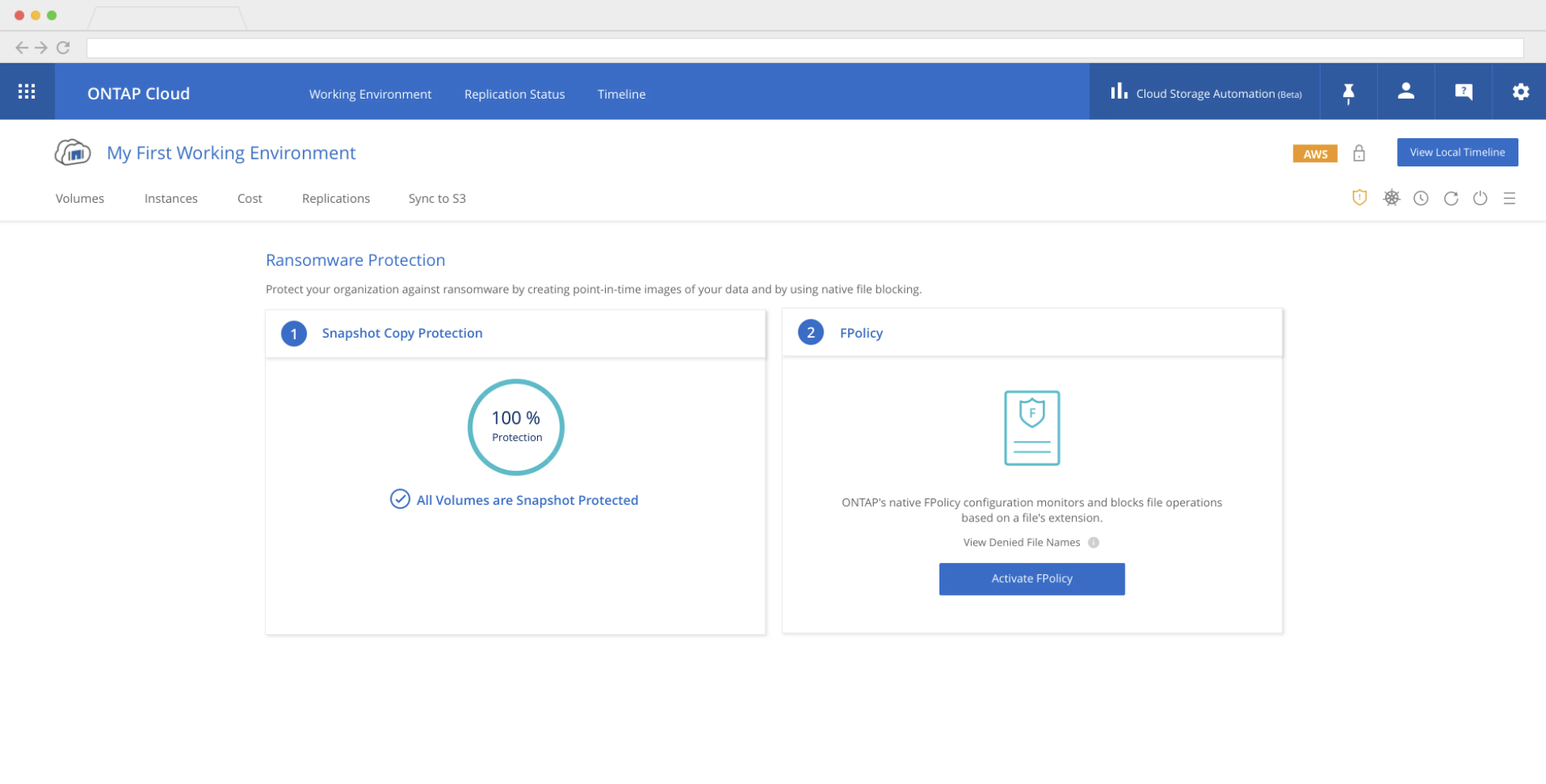
Screenshot of RansomwareScreenshot of Working EnvironmentScreenshot of Cost DashboardScreenshot of Working EnvironmentsScreenshot of VolumesScreenshot of Cloud Compliance