Microsoft's Azure API Management supports creation of API.
$0.04
Lightweight and serverless version of API Management service, billed per execution
Anypoint Platform
Score 7.8 out of 10
N/A
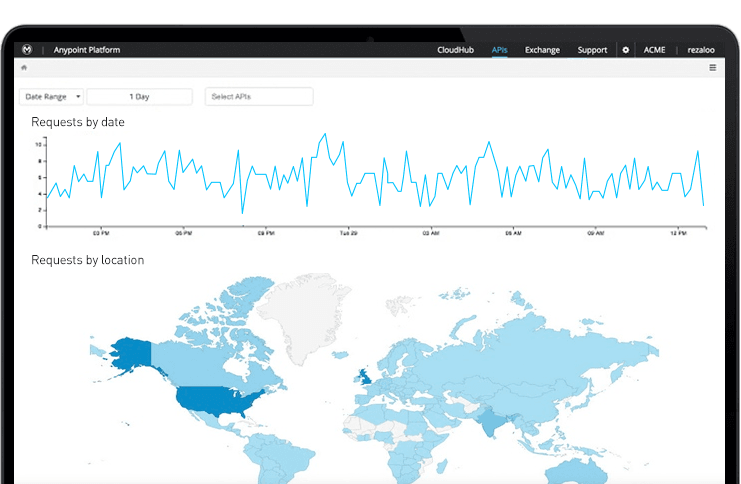
The Anypoint Platform developed by MuleSoft and acquired by Salesforce in early 2018 is designed to
connect apps, data, and devices anywhere, on-premises or in the cloud. This platform was built to
offer out-of-the-box connectors as well as tools that architects and developers can adopt quickly to
design, build and manage the entire lifecycle of their APIs, applications, and products.
N/A
Pricing
Azure API Management
MuleSoft Anypoint Platform
Editions & Modules
Consumption
0.042 per 10,000 calls
Lightweight and serverless version of API Management service, billed per execution
Developer
$48.04
per month Non-production use cases and evaluations
Basic
$147.17
per month Entry-level production use cases
Standard
$686.72
per month Medium-volume production use cases
Premium
$2,795.17
per month High-volume or enterprise production use cases
Isolated
TBA
per month Enterprise production use cases requiring high degree of isolation
No answers on this topic
Offerings
Pricing Offerings
Azure API Management
Anypoint Platform
Free Trial
No
Yes
Free/Freemium Version
No
Yes
Premium Consulting/Integration Services
No
No
Entry-level Setup Fee
No setup fee
No setup fee
Additional Details
—
—
More Pricing Information
Community Pulse
Azure API Management
MuleSoft Anypoint Platform
Features
Azure API Management
MuleSoft Anypoint Platform
API Management
Comparison of API Management features of Product A and Product B
Azure API Management
8.0
Ratings
4% below category average
MuleSoft Anypoint Platform
-
Ratings
API access control
8.90 Ratings
00 Ratings
Rate limits and usage policies
5.40 Ratings
00 Ratings
API usage data
8.90 Ratings
00 Ratings
API user onboarding
9.00 Ratings
00 Ratings
API versioning
8.90 Ratings
00 Ratings
Usage billing and payments
5.20 Ratings
00 Ratings
API monitoring and logging
9.80 Ratings
00 Ratings
Cloud Data Integration
Comparison of Cloud Data Integration features of Product A and Product B
The range of policies that enable the APIs to loosely couple it with security, rate limit, retry, etc. are good. We can easily tie authentication mechanisms to external and other internal services without having to modify the backend.
MuleSoft Anypoint Platform is best tool in the market for developing APIs with complex structures communicating with various different types of applications including web applications as well as legacy applications. Also applications including database connectivity for fetching and updating data in the DB tables. I cant think of any scenario which MuleSoft Anypoint Platform could not be used for developing the integrations.
Provides wide range of popular connectors like salesforce, netsuite, sftp and many more. A user can easily integrate with those services using specific connector.
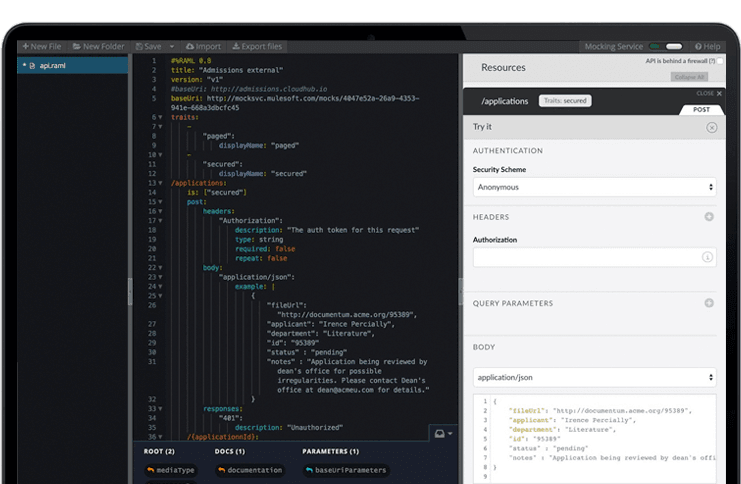
Support API development using RAML and desing tool. The platform is very good in data type classification.
Cloud deployment and post deployment monitoring is easy. A user can configure application worker as per need. Alert and notifications are real time.
Cost - the upfront cost is a bit restrictive. I've been told it is because there are a few underlying VMs that are running this service. So if you're just starting out with API management, it can be an expensive proposition. Value increases as you add additional APIs. If you're using Azure B2C for the developer portal, you'll require Standard or Premium since they support AAD integration.
Security granularity - at time of writing, APIM doesn't support breaking out operations to products. For example, if you have an API that has a GET and a POST operation, and you want the POST operation to require a different subscription. There is a work around, but it makes management a bit messy.
Developer and Publisher portal - it's a little weird. Microsoft hasn't migrated all the publisher portal functionality into the "native" Azure portal. So some of it feels a little weird - especially when working with the content management side of things for the developer portal.
Scaling - while it's easy to scale up, the cost of APIM ramps up very quickly. Standard -> Premium is a 4x jump.
Has more features than what we really need so we're paying for more than we use. Sort of like paying for an Abrams tank when all we really need is a Toyota Corolla.
Not a value product, tends to be expensive.
Takes a while for developers to learn to use Mulesoft Anypoint.
MuleSoft Anypoint Platform is really very easy to adopt for application integration. Simple UI and easy data weave language allows user to focus on business portion only. The API management and deployment of application are hassle free.
Anypoint Platform support is very responsive. There is also a huge knowledge base and an active online forum where answers to most questions can be found. When needed support engages the engineering group so adequate solutions or workarounds are always provided.
Once we have moved all of our system integration APIs to the MuleSoft Anypoint Platform, we will need to communicate with a wide variety of external systems. All of our business and service logic is stored in the aforementioned core systems. Anypoint Platform (and all of our APIs) makes it easy to connect to various other platforms. In order to link to these many other systems, connectors and/or components are utilized, and they are simple to configure and integrate.
It’s really pay as you go, so it's not that costly to get in and try it out. There’s no expensive client to buy and manage, but you do need to stay on top of the rapidly changing Azure environment to be sure you upgrade or adjust when needed.
It’s not great having more than one API tool, but it’s ok to spread out your work, as you always want the right tool for the right job. For example, if you are a Salesforce-heavy organization, I’d go with Mule over Azure.
It was easy getting an external consultant access to the tool to build their own API for a project they were working on for us.