The vendor presents AWS Control Tower as the easiest way to set up and govern a new, secure multi-account AWS environment. With AWS Control Tower, builders can provision new AWS accounts in a few clicks, while knowing new accounts conform to company-wide policies.
N/A
Microsoft Defender for Cloud
Score 8.5 out of 10
N/A
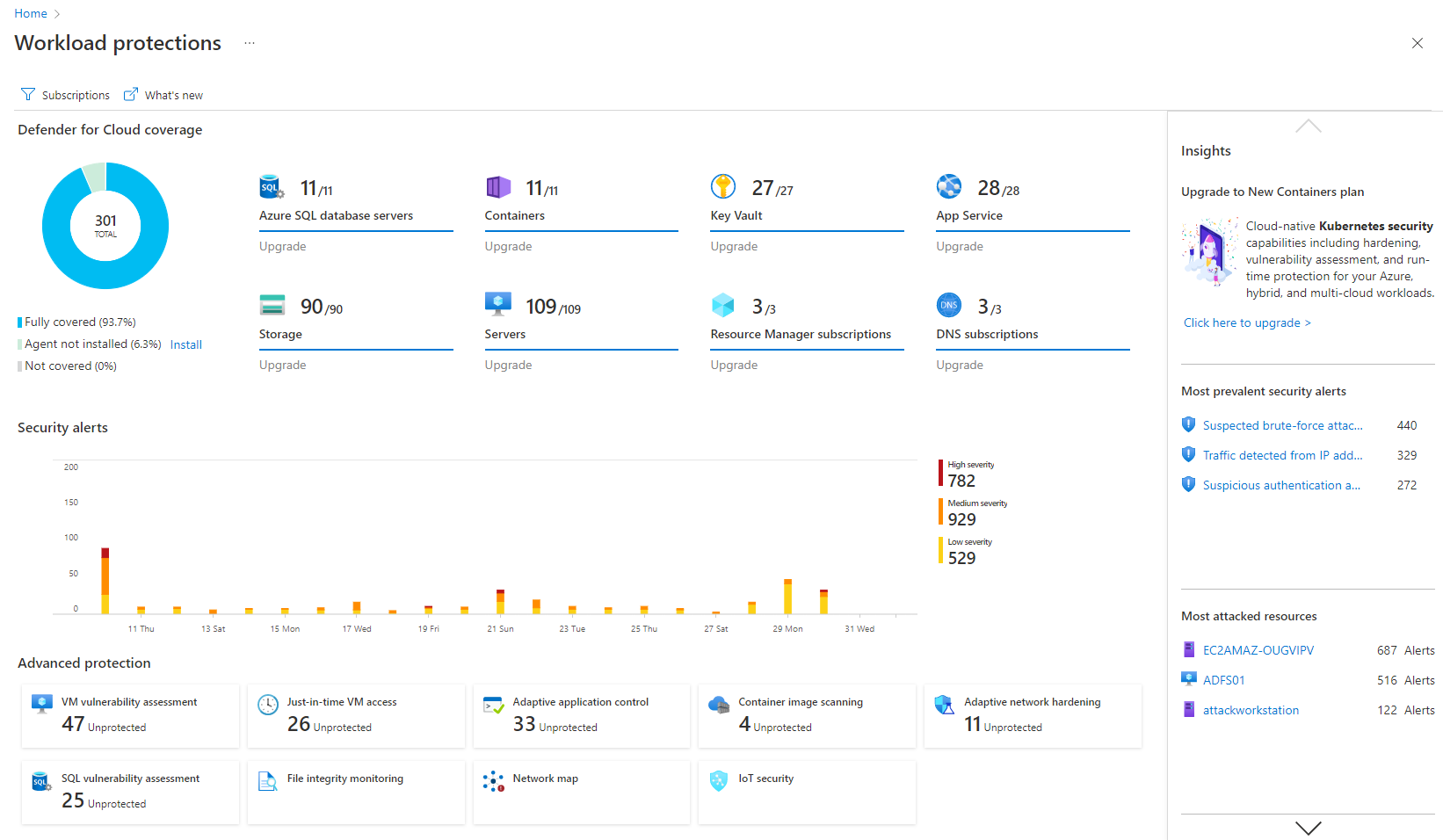
Microsoft Defender for Cloud is a Cloud Security Posture Management (CSPM) and Cloud Workload Protection Platform (CWPP) for Azure, on-premises, and multicloud (Amazon AWS and Google GCP) resources.
AWS Control Tower is great if you have multiple organizations or disciplines inside a company that needs to be separated for billing purposes or separation of concern. Multiple accounts is part of AWS's well-architected framework and are generally a good idea. AWS Control Tower makes central logging easy which enables those logs to be quickly picked up by a logging tool to provide even more reports and insight. For smaller organizations, AWS Control Tower may seem like an over-engineered solution
If you need to proceed with pay as you go service then go ahead with Microsoft Defender for Cloud. This could be expensive in the long run but if the organization usage is slightly less than then this would suite the purpose. Also, it has the latest threat updates, so you're future proof in terms of potential treats.
AWS Control Tower integrates with AWS organizations
AWS Control Tower provides Account Factory to provision preconfigured AWS accounts
AWS Control Tower helps to isolate workloads and billing via AWS accounts separation
AWS Control Tower supports data residency controls out of the box
AWS Control Tower supports post provisioning actions to newly provisioned AWS accounts: for example it can trigger enabling VPC flow logs in the new account
Automation is crucial to managing sprawl and the additional complexity that comes with it. SOC management workbooks and process automation give significant flexibility.
The Security posture score and Security Alerts are neatly centralized and offer me crucial information quickly.
Defender for Cloud avoids the common compromise of simplicity for completeness (former Azure Security Center). The security warnings and advice go into great detail while remaining current and useful.
UI/UX. It can get a little messy when navigating around with all the flyouts in the Azure portal which can be frustrating, particularly when under time pressure.
The query languages for the queries and workbooks are another language that needs to be learned - it would be nice to have kept it closer to T-SQL or something like that to minimize the need to learn new syntax.
Adding cost estimations to the security recommendations would really improve the experience.
It is a great product that integrates nicely when running an Azure platform and even multi-cloud environment. Not looking for point-solutions but a suite that answers most requirements. It is very comfortable being able to use KQL, workbooks and automation that is native to the azure platform
There is no way to easily close an AWS account whether it was created manually or via the AWS Control Tower. It takes too many steps to close it vs to provision a new AWS account
Using AWS Systems Manager and other slightly lower level components has been helpful for us to manage parts of our AWS presence at a more granular level than AWS Control Tower was designed for. It's not at all an apples-to-apples comparison as they solve different use cases, but for us, the use case associated with AWS Systems Manager was a better fit for our specific needs and skillsets. We did not need everything that AWS Control Tower was doing for us.
I believe Microsoft Defender for Cloud stacks up well against the other tools we looked at. It is native to the Azure platform and provides the same insights as the other tools. We selected Microsoft Defender for Cloud because it integrates well with the Azure resources and gives the needed insight, security alerts and recommendations.