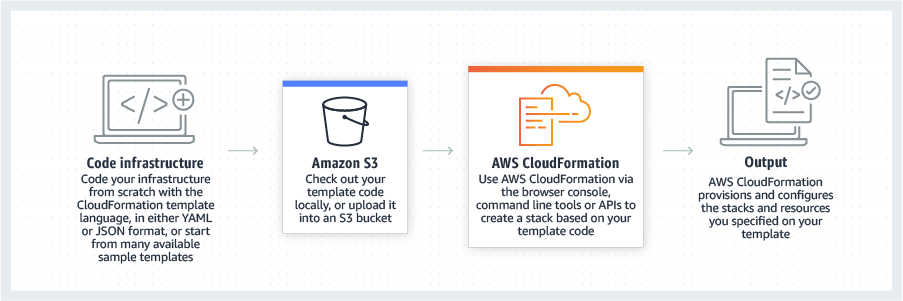
AWS CloudFormation gives developers and systems administrators a way to create and manage a collection of related AWS resources, provisioning and updating them in a predictable fashion. Use AWS CloudFormation’s sample templates or create templates to describe the AWS resources, and any associated dependencies or runtime parameters, required to run an application. Users don’t need to figure out the order for provisioning AWS services or the subtleties of making those dependencies work.…
$0
TeamCity
Score 7.4 out of 10
N/A
TeamCity is a continuous integration server from Czeck company JetBrains.
N/A
Pricing
AWS CloudFormation
TeamCity
Editions & Modules
Free Tier - 1,000 Handler Operations per Month per Account
$0.00
Handler Operation
$0.0009
per handler operation
No answers on this topic
Offerings
Pricing Offerings
AWS CloudFormation
TeamCity
Free Trial
Yes
No
Free/Freemium Version
Yes
No
Premium Consulting/Integration Services
No
No
Entry-level Setup Fee
No setup fee
No setup fee
Additional Details
There is no additional charge for using AWS CloudFormation with resource providers in the following namespaces: AWS::*, Alexa::*, and Custom::*. In this case you pay for AWS resources (such as Amazon EC2 instances, Elastic Load Balancing load balancers, etc.) created using AWS CloudFormation as if you created them manually. You only pay for what you use, as you use it; there are no minimum fees and no required upfront commitments.
When you use resource providers with AWS CloudFormation outside the namespaces mentioned above, you incur charges per handler operation. Handler operations are create, update, delete, read, or list actions on a resource.
Cloning a virtual machine creates a virtual machine that is a copy of the original. The new virtual machine is configured with the Cloning Cloning a virtual machine creates a virtual machine that is a copy of the original. The new virtual machine is configured with the same virtual hardware, installed software, and other properties that were configured for the original virtual machine. For information about persistent memory and PMem storage, see the vSphere Resource Management Guide. For information virtual machine creates a virtual machine that is a copy of the original. The new virtual machine is configured with the same virtual hardware, installed software, and other properties that were configured for the original virtual machine. For information about persistent memory and PMem storage, see the vSphere Resource. Management guide. For information virtual hardware, installed software cloning a virtual machine creates a virtual machine that is a copy of the original. The new virtual machine is configured with the same virtual hardware, installed software, and other properties that were configured for the original virtual machine. For information about persistent memory and PMem storage, see the vSphere Resource Management Guide. For information and other properties that were configured for the original virtual machine. For information about persistent memory and PMem storage, see the vSphere Resource Management Guide. For information.
TeamCity is well suited for an organization using continuous integration, meaning you release code to production often, and an agile project management system. There are free versions available for small teams and enterprise versions available for large teams with many different builds. TeamCity is probably overkill for basic e-commerce or blog website builds that do not require much development after the initial launch
Fully customizable build process. Each step of the build process can be parameterized and customized to address specific needs of particular applications. This allowed us to easily convert from a custom VM-based environment to our current Docker-based environment.
Manages large numbers of build agents seamlessly. This allows us to run multiple builds on many different applications in a most efficient manner.
Build steps can be managed in an arbitrary manner, allowing some parts of the process to proceed in parallel while restricting others to depend on completion of all relevant steps.
It's easy enough to get a shared template & apply it. You don't even have to download-then-upload or copy-and-paste, a publicly-accessible url works.
Diving deeper, it has enough powerful capabilities to make the life of a platform / DevOps engineer bearable.
However, you need equally deep knowledge to troubleshoot issues, when they inevitably pop up. This is the same for all IaC technologies, as they are additional abstraction layers on top of the native API provided by the cloud providers.
TeamCity runs really well, even when sharing a small instance with other applications. The user interface adequately conveys important information without being overly bloated, and it is snappy. There isn't any significant overhead to build agents or unit test runners that we have measured.
Since the product I'm involved is primarily hosted on AWS we use CloudFormation but in some other products where we have hybrid cloud deployments we prefer Terraform which is opensource.
Jenkins relies on being open source as the primary driver for its success. This low cost is a huge factor for many companies, both small and large. The professional, free tier of TeamCity offers a huge amount of growth before ever needing to pay anything. I personally also find the user experience of TeamCity to be much better, both from a look and feel, as well as from an out-of-the-box feature set perspective. The big selling feature of ADO is its native integration with Azure. TeamCity integrates very well with out-of-the-box .NET support and greatly simplifies our use of another diverse tooling outside of the Microsoft ecosystem.
TeamCity was a key contributor to our organization's adoption of Agile.
TeamCity made it possible to KILL "It works on my laptop" conversations with Developers. If it does not compile in TeamCity - the project is not deployable. TeamCity's easy to use interface made it possible to quickly adopt a "Deploy Only from TeamCity" policy, further ensuring TeamCity Builds were the gold-standard for well-configured source code.