AWS CloudFormation vs. Salt Project

Overview
ProductRatingMost Used ByProduct SummaryStarting Price
AWS CloudFormation
Score 8.8 out of 10
N/A
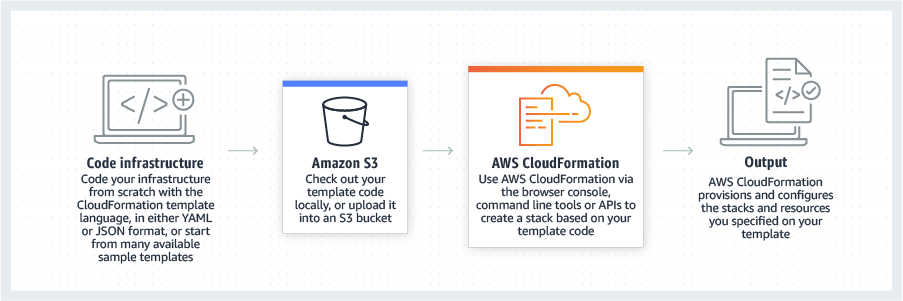
AWS CloudFormation gives developers and systems administrators a way to create and manage a collection of related AWS resources, provisioning and updating them in a predictable fashion. Use AWS CloudFormation’s sample templates or create templates to describe the AWS resources, and any associated dependencies or runtime parameters, required to run an application. Users don’t need to figure out the order for provisioning AWS services or the subtleties of making those dependencies work.…
$0
Salt
Score 6.2 out of 10
N/A
Built on Python, Salt is an event-driven automation tool and framework to deploy, configure, and manage complex IT systems. Salt is used to automate common infrastructure administration tasks and ensure that all the components of infrastructure are operating in a consistent desired state.N/A
Pricing
AWS CloudFormationSalt Project
Editions & Modules
Free Tier - 1,000 Handler Operations per Month per Account
$0.00
Handler Operation
$0.0009
per handler operation
No answers on this topic
Offerings
Pricing Offerings
AWS CloudFormationSalt
Free Trial
YesNo
Free/Freemium Version
YesNo
Premium Consulting/Integration Services
NoNo
Entry-level Setup FeeNo setup feeNo setup fee
Additional DetailsThere is no additional charge for using AWS CloudFormation with resource providers in the following namespaces: AWS::*, Alexa::*, and Custom::*. In this case you pay for AWS resources (such as Amazon EC2 instances, Elastic Load Balancing load balancers, etc.) created using AWS CloudFormation as if you created them manually. You only pay for what you use, as you use it; there are no minimum fees and no required upfront commitments. When you use resource providers with AWS CloudFormation outside the namespaces mentioned above, you incur charges per handler operation. Handler operations are create, update, delete, read, or list actions on a resource.
More Pricing Information
Community Pulse
AWS CloudFormationSalt Project
Best Alternatives
AWS CloudFormationSalt Project
Small Businesses
HashiCorp Terraform
HashiCorp Terraform
Score 8.5 out of 10
HashiCorp Terraform
HashiCorp Terraform
Score 8.5 out of 10
Medium-sized Companies
Ansible
Ansible
Score 9.2 out of 10
Ansible
Ansible
Score 9.2 out of 10
Enterprises
Ansible
Ansible
Score 9.2 out of 10
Ansible
Ansible
Score 9.2 out of 10
All AlternativesView all alternativesView all alternatives
User Ratings
AWS CloudFormationSalt Project
Likelihood to Recommend
7.6
(0 ratings)
8.0
(0 ratings)
Support Rating
-
(0 ratings)
8.2
(0 ratings)
User Testimonials
AWS CloudFormationSalt Project
Likelihood to Recommend
Cloning a virtual machine creates a virtual machine that is a copy of the original. The new virtual machine is configured with the Cloning Cloning a virtual machine creates a virtual machine that is a copy of the original. The new virtual machine is configured with the same virtual hardware, installed software, and other properties that were configured for the original virtual machine. For information about persistent memory and PMem storage, see the vSphere Resource Management Guide. For information virtual machine creates a virtual machine that is a copy of the original. The new virtual machine is configured with the same virtual hardware, installed software, and other properties that were configured for the original virtual machine. For information about persistent memory and PMem storage, see the vSphere Resource. Management guide. For information virtual hardware, installed software cloning a virtual machine creates a virtual machine that is a copy of the original. The new virtual machine is configured with the same virtual hardware, installed software, and other properties that were configured for the original virtual machine. For information about persistent memory and PMem storage, see the vSphere Resource Management Guide. For information and other properties that were configured for the original virtual machine. For information about persistent memory and PMem storage, see the vSphere Resource Management Guide. For information.
Read full review
Managing heterogeneous environments of large numbers of nodes, especially nodes which may need sudden changes (security updates, for instance), or frequent replacement, is a strength for Saltstack. Simplicity is not a strength for Saltstack. In a homogenous environment (all CentOS 7, for example, with no Debian or Windows) I might recommend using Ansible instead - it is less flexible and granular, but simpler to configure.
Read full review
Pros
  • IaC, transactional on top of that
  • Support for "mainstream" general programming languages
  • Sharable IaC "snippets" that can setup standardized environments for individuals quickly
  • OOP techniques are available thanks to OOP languages
Read full review
  • A superb remote execution framework! SaltStack allows us to easily program numerous functions on top of it. For example, we developed a fast parallel asynchronous deployment tool that handles all software deployment, including interdependent service management.
  • Configuration management is now easy. We take advantage of this to automate (in tandem with AWS tools) the stand-up of all servers and services. It is also relatively easy to create new configuration management states for software not yet supported by the community (e.g. Grafana).
  • Flexibility. Numerous small utilities have been built which simply wrap around SaltStack to allow tedious tasks to become easy.
Read full review
Cons
  • Error Description upon Failure Needs to be Improved.
  • Slow to create, delete or update.
  • Need to delete resources manually. It can ask before starting deletion whether to skip those resources or delete them.
Read full review
  • Managing network hardware should be more native and easy
  • SaltStack should buffer jobs and, when a client returns, make sure it is executed proberly
  • SaltStack should provide basic pillar and states structures to help get newbies started
Read full review
Usability
It's easy enough to get a shared template & apply it. You don't even have to download-then-upload or copy-and-paste, a publicly-accessible url works.
Diving deeper, it has enough powerful capabilities to make the life of a platform / DevOps engineer bearable.
However, you need equally deep knowledge to troubleshoot issues, when they inevitably pop up. This is the same for all IaC technologies, as they are additional abstraction layers on top of the native API provided by the cloud providers.
Read full review
No answers on this topic
Support Rating
No answers on this topic
We haven't had to spend a lot of time talking to support, and we've only had one issue, which, when dealing with other vendors is actually not that bad of an experience.
Read full review
Alternatives Considered
Since the product I'm involved is primarily hosted on AWS we use CloudFormation but in some other products where we have hybrid cloud deployments we prefer Terraform which is opensource.
Read full review
I've used shell scripts over ssh, custom in-house deployment tools, Chef, and SaltStack. I've evaluated Ansible, but I was never happy with performance over SSH. Chef's loose configuration data model and lack of philosophy and conventions around use makes it difficult for a team to share responsibility for configuration code. Needing to use additional tools to do orchestration for cross-host/agent dependency relationships made me look for more. SaltStack, while not as mature when I first tried it, impressed me with its speed and elegant design
Read full review
Return on Investment
  • + We can standup a VPC in minutes
  • - It took a lot of inital time to set up
  • + With logging/rollback, made testing much easier.
Read full review
  • SaltStack has reduced the time it takes to deploy new machines for us 10-fold.
  • It is much easier for us to maintain compliance with industry standards with SaltStack.
  • No negative impacts!
Read full review
ScreenShots

AWS CloudFormation Screenshots

Screenshot of CloudFormation - How it works overviewScreenshot of CloudFormation - High level how it worksScreenshot of CloudFormation - Template exampleScreenshot of CloudFormation - Template inputs overview