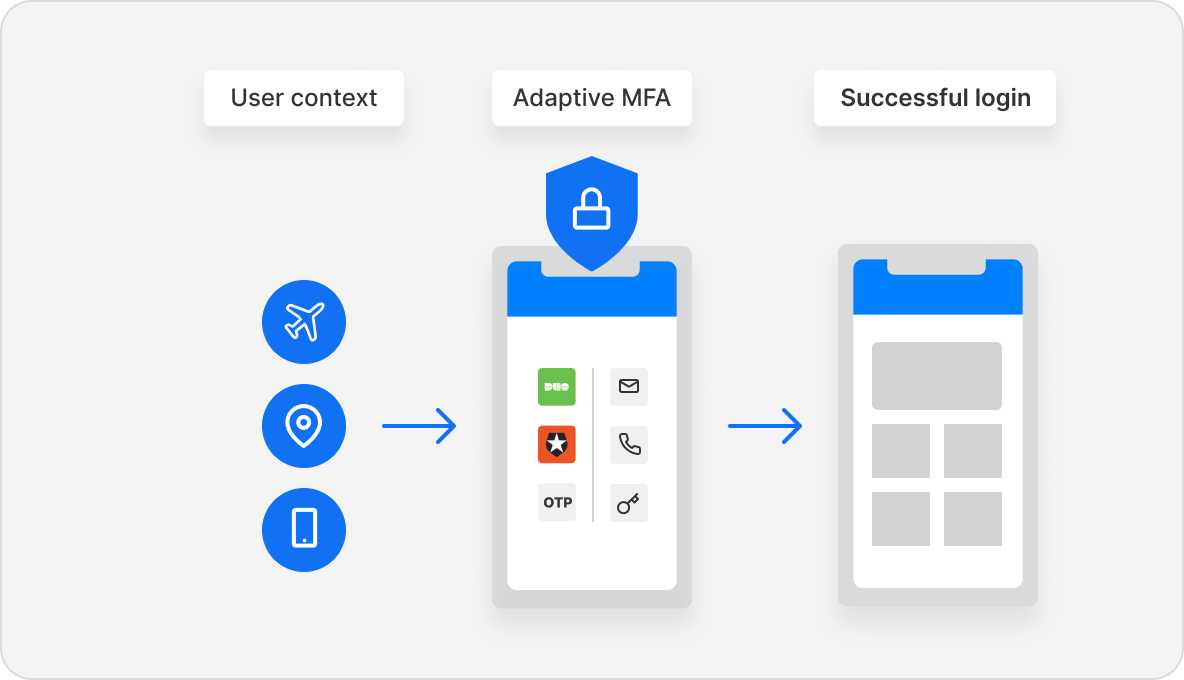
Auth0 is an identity management platform for developers and application teams. It gives users a platform to authenticate and authorize, providing secure access to applications, devices, and users. Auth0 aims to provide the simplicity, extensibility, and expertise to scale and protect any application, for any audience. Integrate Auth0 into any app, written in any language, and any framework.
$23
per month
Google Authenticator
Score 8.1 out of 10
N/A
Google Authenticator is a mobile authentication app.
N/A
Pricing
Auth0
Google Authenticator
Editions & Modules
1,000 External Active Users
$23
per month
2,000 External Active Users
$57
per month
5,000 External Active Users
$114
per month
500 External Active Machines
$130
per month
10,000 External Active Users
$228
per month
20,000 External Active Users
$455
per month
50,000 External Active Users
1,138
per month
Over 50,000 External Active Users
Contact for quote
Enterprise
Contact for quote
No answers on this topic
Offerings
Pricing Offerings
Auth0
Google Authenticator
Free Trial
Yes
No
Free/Freemium Version
Yes
No
Premium Consulting/Integration Services
No
No
Entry-level Setup Fee
Optional
Optional
Additional Details
—
—
More Pricing Information
Community Pulse
Auth0
Google Authenticator
Features
Auth0
Google Authenticator
Identity Management
Comparison of Identity Management features of Product A and Product B
Auth0 is very well suited for situations where a JSON web token can be used for authorizing APIs, websites, and mobile devices. It's especially useful if the JWT validation can happen at a gateway layer. It's especially useful if you only need to verify the user's email address or mobile number as the passwordless login is easy to implement.
It is supported by virtually all cloud-based software applications for business. I am happy to allow users to use this in addition to other authenticators. Certainly, if your business is in the Google cloud it makes sense, but my approach to the remote/virtual work world these past couple of years has been structured flexibility. Leaving some choice up to the users for their own comfort, particularly when they are using their own devices. I cannot think of a scenario where it is less appropriate - perhaps where you run the risk of "app sprawl". I.e., where you are requiring users to handle multiple authenticators (which can happen with certain pieces of hardware) you may want to encourage consolidation into one to avoid frustration.
Easy implementation: The product is very easy to implement both from embedding it into the application and from end users using it via their smartphones.
You can use Google Authenticator to manage multiple two-factor authentication keys.
Easy to add keys options: You can scan a QR code to set up 2FA in Google Authenticator. You can also do a manual entry using the unique key provided by the application you are setting up 2FA for.
Auth0 can be somewhat limiting if you want a lot of control over the design of your authentication flow. Custom branding can be done, but it may be limited depending on how you plan to integrate.
The Auth0 API documentation has proven confusing at times; a single API endpoint's behaviour will change based on inputs and configured settings (e.g. offline_access). Consequently fields that are advertised as being returned in a response might not be there or have different values if you miss a key detail and it can be difficult to debug when this happens. All information required is available in the documentation but requires some digging.
The toggle to switch tenants feels a bit odd, it works, but I've had a few instances where I didn't realize I was on a staging tenant looking for something that was on the production tenant. Not a big deal, just something to watch out for.
It runs on only a few platforms, specifically Android, iOS, and Blackberry and in my opinion it needs to be available on every platform that is out there.
SA drawback I have noticed is that if you swap phones you have to blitz the entire app and go back and sync up all the accounts again which can be very frustrating for new users.
It can also be risky ( for some ) having all all your data centralized in one place.
- integration and ease of implementation - great over all product support specially for passkey biometric authentication -Auth0 is very reliable to use their API integration for security verification. It provides best API to integrate our website and application with Single Sign In option and two step verification option. Sales and technical teams are always there to provide support
It's as easy as opening the app and what I need it for is there. I don't have to fumble with other accounts or getting something else to open it for me. I have all the access that I need for the use of the app within seconds and I can get access to the info that I need.
There isn't a clear method to get a hold of support when trouble arises if you're on their standard plan. You can file a support ticket and they generally are responsive. I've often been able to find similar questions to the questions I've had when it comes to support in their ticket history, however, some have been closed without a satisfactory conclusion for the original poster.
I have found Google’s support to be hit or miss. There are times when they are very responsive, and I get my issue resolved quickly, and there are times where a response from them takes weeks. There is no in-between. But my support experience with this particular product is nonexistent because I have not had a problem with it yet. Hopefully, we do not have any problems with it either.
Auth0 is non-evasive and does not require software download. It is user friendly, seamless, and doesn't require additional actions on the part of the user. IBM Trusteer is none of these things and is based on a technology stack that cannot scale in the same way as Auth0. We believe Auth0 provides a superior solution and is well suited for our own technology stack.
This product doesn't ensure single-use, real-time codes. This puts our data at risk and is not as secure as Google Authenticator. I anticipate using Google Authenticator as long as we continue to use the full Google Suite for business. It helps to streamline data and accounts.
Development time has been allocated to the more core parts of our business.
We are confident in the security of our user's accounts and their data.
Auth0's login flows are customizable which means that we don't have to worry about users being confused when logging in/changing their passwords, and we didn't event have to spend that much time configuring this. (Full in-house development for login could take weeks to get right.)
I would say from my limited role in the programs deployed and just being a user, this has been a valuable tool so our ROI is high. We get security and can breathe knowing we have authentication for those who have to be on our network and we are able to protect our work.