
Armis vs. SolarWinds Engineer's Toolset
| Product | Rating | Most Used By | Product Summary | Starting Price |
|---|---|---|---|---|
 Armis | Score9.1 out of 10 | N/A | Armis headquartered in Palo Alto offers an agentless, enterprise-class security platform to address the new threat landscape of unmanaged and IoT devices, an out-of-band sensing technology to discover and analyze all managed, unmanaged, and IoT devices—from traditional devices like laptops and smartphones to new unmanaged smart devices like smart TVs, webcams, printers, HVAC systems, industrial robots, medical devices and more. Armis discovers devices on and off the network, continuously… | N/A |
 SolarWinds Engineer's Toolset | Score9.3 out of 10 | N/A | SolarWinds® Engineer’s Toolset (ETS) helps users monitor and troubleshoot a network with over 60 tools for network management. ETS allows users to monitor and receive alerts in real time on network availability and health, and perform network diagnostics for faster troubleshooting and resolution of complex network issues. With ETS users can deploy an array of network discovery tools including Port Scanner, Switch Port Mapper or advanced Subnet Calculator, manage Cisco® devices with specialized… | $1,585 Per Instance |
| Armis | SolarWinds Engineer's Toolset | |||||||||||||||
|---|---|---|---|---|---|---|---|---|---|---|---|---|---|---|---|---|
| Editions & Modules | No answers on this topic |
| ||||||||||||||
| Offerings |
| |||||||||||||||
| Entry-level Setup Fee | No setup fee | No setup fee | ||||||||||||||
| Additional Details | — | — | ||||||||||||||
| More Pricing Information | ||||||||||||||||
| Armis | SolarWinds Engineer's Toolset | |
|---|---|---|
| Considered Both Products | No answer on this topic | No answer on this topic |
| Key User Insights | ||
| Would buy again | ||
No answers on this topic | 100% Would buy again 11 Answers | |
| Delivers good value for the price | ||
No answers on this topic | 90% Delivers good value for the price 9 Answers | |
| Happy with the feature set | ||
No answers on this topic | 100% Happy with the feature set 11 Answers | |
| Lived up to sales and marketing promises | ||
No answers on this topic | 100% Lived up to sales and marketing promises 10 Answers | |
| Implementation went as expected | ||
No answers on this topic | 100% Implementation went as expected 10 Answers | |
| Armis | SolarWinds Engineer's Toolset | |
|---|---|---|
| Small Businesses | No answers on this topic |  Pulseway Score9.9 out of 10 |
| Medium-sized Companies | No answers on this topic |  Cisco Meraki Dashboard Score9.3 out of 10 |
| Enterprises | No answers on this topic |  Cisco Prime LAN Management (discontinued) Score8.5 out of 10 |
| All Alternatives | View all alternatives | View all alternatives |
| Armis | SolarWinds Engineer's Toolset | |
|---|---|---|
| Likelihood to Recommend | 10.0 | 8.6 |
| Usability | - | 8.2 |
| Support Rating | - | 8.2 |
| Armis | SolarWinds Engineer's Toolset | |
|---|---|---|
| Likelihood to Recommend |
|
|
| Pros |
|
|
| Cons |
|
|
| Usability | No answers on this topic |
|
| Support Rating | No answers on this topic |
|
| Alternatives Considered |
|
|
| Return on Investment |
|
|
| ScreenShots | SolarWinds Engineer's Toolset Screenshots   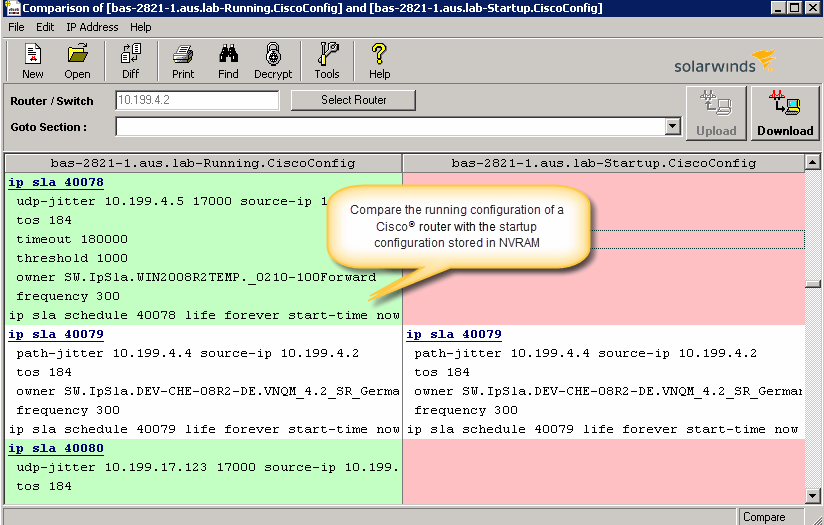  |

