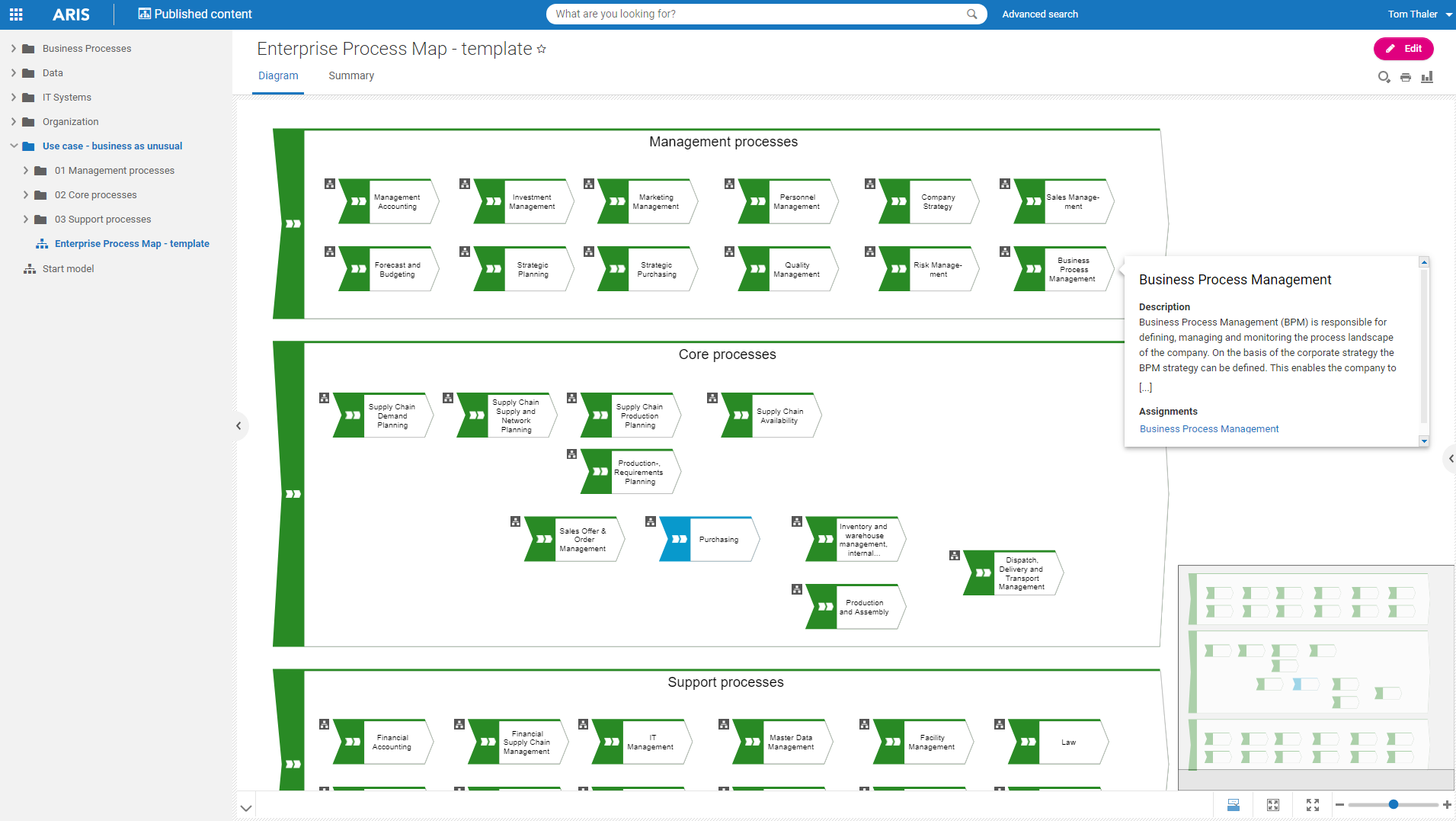
Software AG's Business Process Analysis Platform, ARIS, uses robust architecture and process management / analysis capability to drive integrations with the existing business processes along with information technology and SAP systems.
$100
designer
Bonita Platform
Score 8.1 out of 10
N/A
Bonita is an open-source business process and workflow management platform created by the French National Institute for Research in Computer Science. It is available as a free community edition or as a commercial subscription product.
N/A
Pricing
ARIS
Bonita Platform
Editions & Modules
ARIS Elements
$100
designer
ARIS Advanced
$200
designer
ARIS Enterprise
contact us
ARIS Enterprise
contact us
No answers on this topic
Offerings
Pricing Offerings
ARIS
Bonita Platform
Free Trial
Yes
No
Free/Freemium Version
Yes
Yes
Premium Consulting/Integration Services
No
No
Entry-level Setup Fee
No setup fee
No setup fee
Additional Details
—
—
More Pricing Information
Community Pulse
ARIS
Bonita Platform
Features
ARIS
Bonita Platform
Reporting & Analytics
Comparison of Reporting & Analytics features of Product A and Product B
ARIS
9.1
Ratings
11% above category average
Bonita Platform
6.4
Ratings
24% below category average
Dashboards
7.90 Ratings
6.00 Ratings
Standard reports
9.70 Ratings
5.50 Ratings
Custom reports
9.80 Ratings
7.70 Ratings
Process Engine
Comparison of Process Engine features of Product A and Product B
ARIS
7.4
Ratings
12% below category average
Bonita Platform
7.7
Ratings
8% below category average
Process designer
8.20 Ratings
9.00 Ratings
Process simulation
8.60 Ratings
6.90 Ratings
Business rules engine
6.40 Ratings
8.20 Ratings
SOA support
7.50 Ratings
6.40 Ratings
Process player
6.00 Ratings
6.70 Ratings
Support for modeling languages
9.10 Ratings
9.00 Ratings
Form builder
7.00 Ratings
8.10 Ratings
Model execution
6.80 Ratings
6.90 Ratings
Collaboration
Comparison of Collaboration features of Product A and Product B
ARIS
8.4
Ratings
0% below category average
Bonita Platform
5.9
Ratings
35% below category average
Social collaboration tools
8.40 Ratings
5.90 Ratings
Content Management Capabilties
Comparison of Content Management Capabilties features of Product A and Product B
ARIS is well suited when we want to understand the interrelationship between different processes and their decencies on systems etc. It allows to create an integrated view with easy navigation from one process to another and allows to add information like metrics, risks, cycle time, FTE, etc. Overall, it is a great tool for modeling and analysis. Though it offers BPMN notation, it has limited compatibility with some other tools, hence if the objective is to implement these processes using tools like PEGA then is it not suitable. Further, it is very high priced, so for basic modeling, it might give the right ROI.
Well suited for low code/no code applications centered around approval flows. It has built-in task management for users to see their pending actions, comments, statuses, etc. It has a very nice design for process flows. Less appropriate may be for generic type applications with complex screens and logic within those screens that need a lot of data to process.
Efficient and fast prototyping: a process can be modeled and tried out quickly and with low investment.
Full stack prototyping for development and implementation allows the process to be developed and implemented as an application from the prototype. It's not just drawings and wire frames that are tossed over the wall to developers.
Data modeling is integral from the beginning of the prototype which is appropriate for the stakeholders in the beginning.
There is only one business data model. Even if deploying new processes does not require stopping the platform, the BDM update requires it.
During the platform evolution often new bugs were introduced so it was risky to deploy the platform in the low minor version. For example, there were memory leaks from 7.2.0 to 7.2.3.
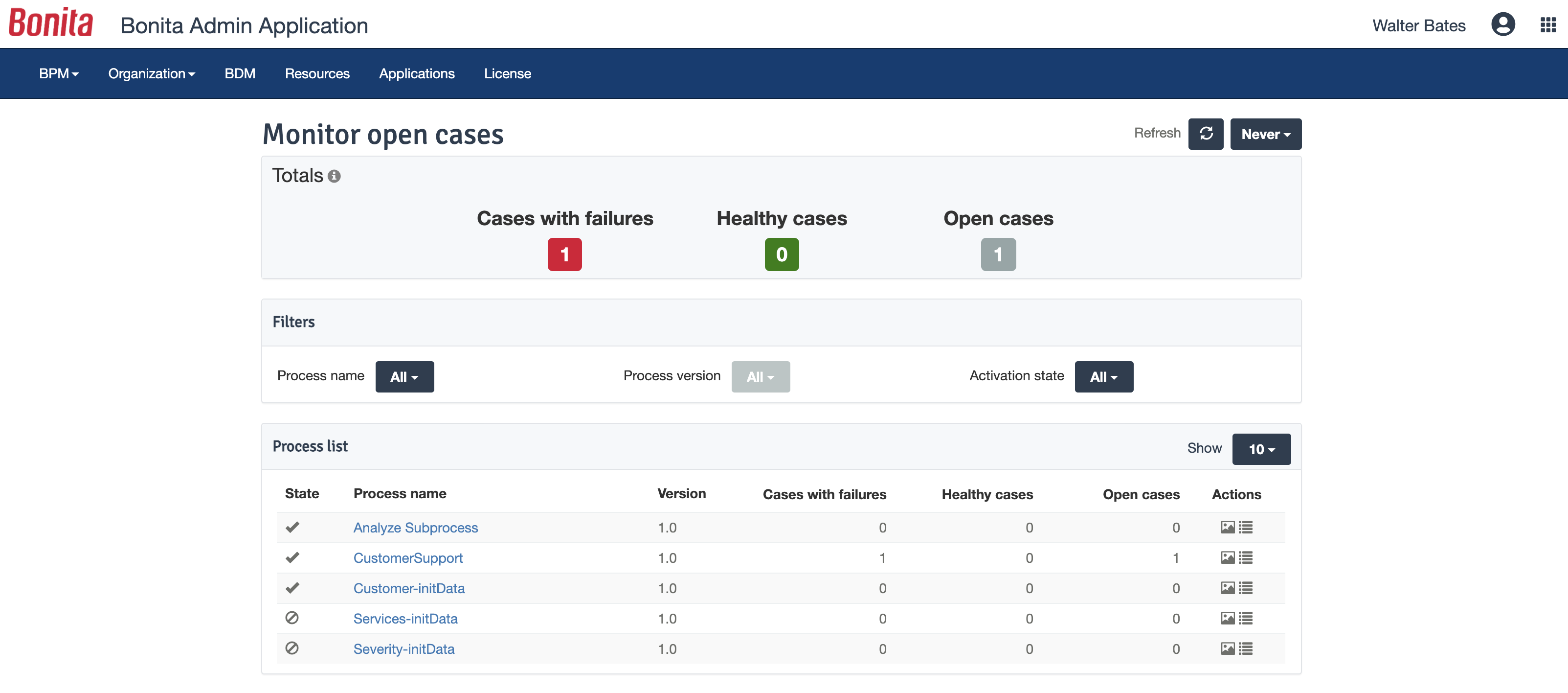
The administrator portal could be improved. It is hard to look at subprocess data, for example and it is sometimes better to investigate with SQL queries. I don't like new (7.3) task list either.
I am a BPM and Enterprise Architect Consultant and hence have been using different BPM and EA tools for consulting practice. Until now I have used Opentext Provision EA,Sparx EA, MS Visio and IBM Blueworks. All of the tools used are good and have their own unique features and capabilities. ARIS BPA is widely used by my current organization for different projects.
Bonita Platform has allowed us to develop GUI relatively fast using its UI Designer while being able to seamlessly integrate our business logic in Java in a BPMN2 process diagram. It gives a nice productivity boost but still requires programming know-how to be able to deliver the final solution to your business problems.
Engine itself is efficient enough for most cases I dealt with. It can also be extended by clustering. I have done performance tests with JMeter and only managed to induce the crash of... JMeter. If there are efficiency issues they usually concern bad design/implementation of created apps or bottlenecks in integrated systems. Although I have met two cases with efficiency loss.
1. Java 7 related PermGen saturation caused by big number of installed apps (there is no jar dependency reusal between apps option).
2. Big number of waiting event handlers in processes stresses the database.
It has good, even complex functionality that is provided by its library and ability to create relations between items, yet it is not hard to use. Anyone can use it in a short time. It provides reporting abilities and good documentation with the availability of exporting options. The only drawback I have seen was user management/login issues.
Yes, ARIS is one of the leading process modeling and analysis tools with advanced reporting and modeling capabilities. It also provides a license for simulation and process mining.
Respect of BPMN standard over the long term. Good enhancements by Bonitasoft for new use cases, for example the introduction of a real form editor even if it has been technically difficult to manage. Once done though, we have far greater possibility of human interaction.
We've had serious problems with 'automated' processes in earlier versions of Bonita (via Talend), especially with connectors. In Bonita 7 we replaced these with REST calls, hoping for better performance.
Overall, using Bonita has not had a positive impact on our development efficiency. Moving from Talend (using Bonita 5) to Bonita 7 has improved this somewhat. Still, it remains a pain to integrate Bonita in the development and delivery process.
Migrating from Bonita 7.0 to 7.1 has proven to be a difficult undertaking, mainly on the database level. This has cost us a lot of time and better support would be welcomed.