Appian is a low-code development and business process management platform. It features drag-and-drop design for app building, automated work processes, unified data management, and cloud-based deployment.
$0
Bonita Platform
Score 8.1 out of 10
N/A
Bonita is an open-source business process and workflow management platform created by the French National Institute for Research in Computer Science. It is available as a free community edition or as a commercial subscription product.
N/A
Pricing
Appian
Bonita Platform
Editions & Modules
Appian Community Edition
$0
Application - Input-Only
$2
per month per user
Application - Infrequent
$9
per month per user
Application - Standard
$75
per month per user
Platform
Custom Quote Priced per user with unlimited apps.
minimum 100 users, no maximum
Unlimited
Custom Quote Priced per development with unlimited apps.
unlimited
Platform
Custom Quote Priced per user with unlimited apps.
Minimum 100, no maximum
Unlimited
Custom Quote Priced per development with unlimited apps.
Unlimited
No answers on this topic
Offerings
Pricing Offerings
Appian
Bonita Platform
Free Trial
Yes
No
Free/Freemium Version
Yes
Yes
Premium Consulting/Integration Services
No
No
Entry-level Setup Fee
No setup fee
No setup fee
Additional Details
—
—
More Pricing Information
Community Pulse
Appian
Bonita Platform
Features
Appian
Bonita Platform
Low-Code Development
Comparison of Low-Code Development features of Product A and Product B
Appian
9.1
Ratings
8% above category average
Bonita Platform
-
Ratings
Visual Modeling
8.80 Ratings
00 Ratings
Drag-and-drop Interfaces
8.90 Ratings
00 Ratings
Platform Security
9.20 Ratings
00 Ratings
Platform User Management
8.80 Ratings
00 Ratings
Reusability
9.50 Ratings
00 Ratings
Platform Scalability
9.50 Ratings
00 Ratings
Reporting & Analytics
Comparison of Reporting & Analytics features of Product A and Product B
Appian
-
Ratings
Bonita Platform
6.4
Ratings
24% below category average
Dashboards
00 Ratings
6.00 Ratings
Standard reports
00 Ratings
5.50 Ratings
Custom reports
00 Ratings
7.70 Ratings
Process Engine
Comparison of Process Engine features of Product A and Product B
Appian
-
Ratings
Bonita Platform
7.7
Ratings
8% below category average
Process designer
00 Ratings
9.00 Ratings
Process simulation
00 Ratings
6.90 Ratings
Business rules engine
00 Ratings
8.20 Ratings
SOA support
00 Ratings
6.40 Ratings
Process player
00 Ratings
6.70 Ratings
Support for modeling languages
00 Ratings
9.00 Ratings
Form builder
00 Ratings
8.10 Ratings
Model execution
00 Ratings
6.90 Ratings
Collaboration
Comparison of Collaboration features of Product A and Product B
Appian
-
Ratings
Bonita Platform
5.9
Ratings
35% below category average
Social collaboration tools
00 Ratings
5.90 Ratings
Content Management Capabilties
Comparison of Content Management Capabilties features of Product A and Product B
Appian is well suited for the areas which involve a workflow. For Example: Consider there is a task and 3 teams are required to work on the task, with Appian we can create tasks for each team and monitor the comments and completion. Together with the integration capabilities, this tool can function in many areas. In our firm, we are using it to automate the workflows for our business teams and help them in capturing the OLA's and SLA's.
Well suited for low code/no code applications centered around approval flows. It has built-in task management for users to see their pending actions, comments, statuses, etc. It has a very nice design for process flows. Less appropriate may be for generic type applications with complex screens and logic within those screens that need a lot of data to process.
Allows at a glance workflow documentation which assists in the need we have for information readiation.
Drag and drop interface for workflow development greatly speeds our apps time to market.
Using the advanced features of Appian, we are able to create working sites in a fraction of the time it would take to do so using "traditional" development.
Efficient and fast prototyping: a process can be modeled and tried out quickly and with low investment.
Full stack prototyping for development and implementation allows the process to be developed and implemented as an application from the prototype. It's not just drawings and wire frames that are tossed over the wall to developers.
Data modeling is integral from the beginning of the prototype which is appropriate for the stakeholders in the beginning.
Search issues when type ahead and database search are used in the same field.
Buttons implementation where user is require[d] to click on the button description - if clicks on the button outside that text - button will not work.
Problems with using certain off-the-shelf performance tools like WebLoad or Neoload. That is because of different dynamic variables being used internally in Appian - which these tools are unable to correlate. We are still investigating using other tools like Jmeter to overcome dynamic correlation problem for performance testing.
There is only one business data model. Even if deploying new processes does not require stopping the platform, the BDM update requires it.
During the platform evolution often new bugs were introduced so it was risky to deploy the platform in the low minor version. For example, there were memory leaks from 7.2.0 to 7.2.3.
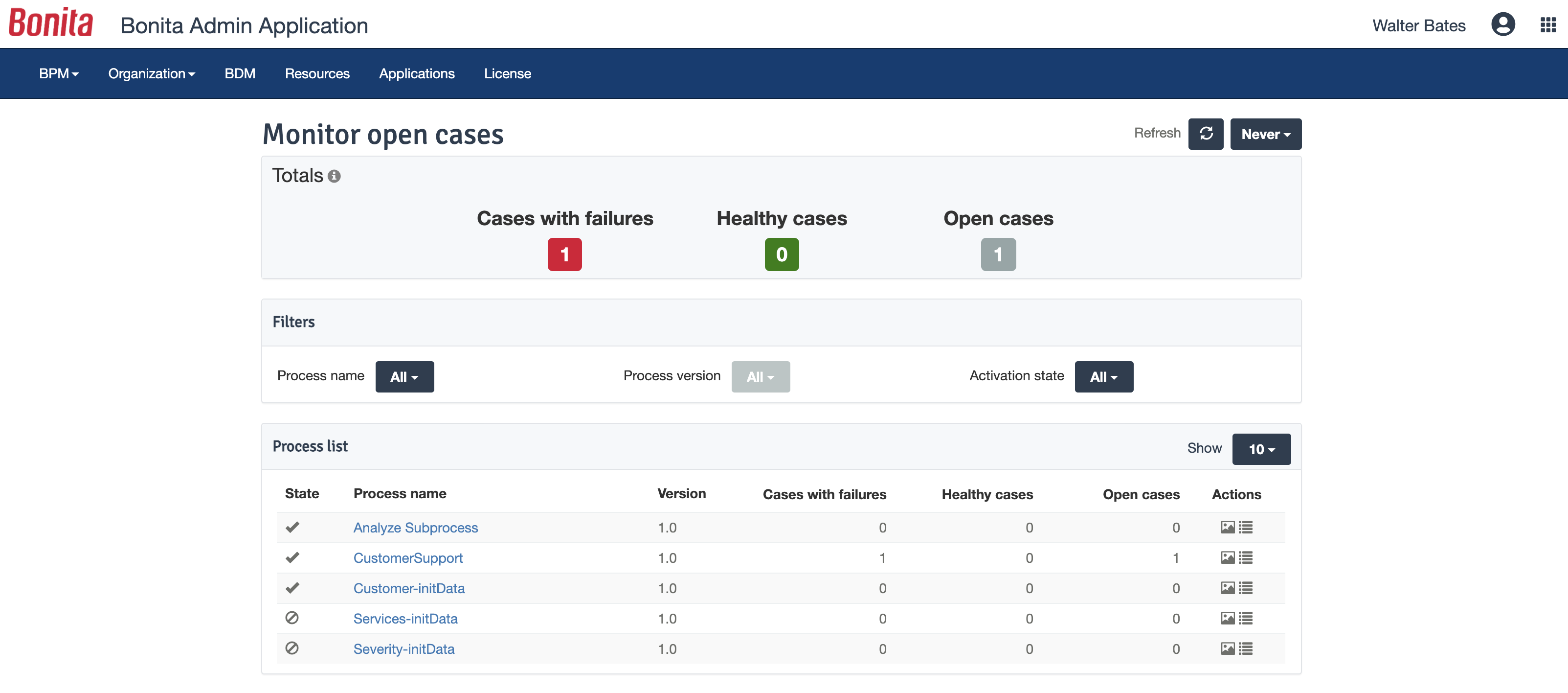
The administrator portal could be improved. It is hard to look at subprocess data, for example and it is sometimes better to investigate with SQL queries. I don't like new (7.3) task list either.
We recently renewed our license with Appian. We are convinced that its flexibility, relative ease of use, the support they provide, there mobile advancements and their general willingness and desire to see us succeed all contributed to our reason to renew our agreement with Appian
There are many differences between using Appian and using other programming languages. Additionally, there are many trade offs that have to be made and that have to be accepted for using Appian. In some cases, you give up control of one small area, but in others, it may open settings that are unavailable to a developer when using other program languages.
Bonita Platform has allowed us to develop GUI relatively fast using its UI Designer while being able to seamlessly integrate our business logic in Java in a BPMN2 process diagram. It gives a nice productivity boost but still requires programming know-how to be able to deliver the final solution to your business problems.
Engine itself is efficient enough for most cases I dealt with. It can also be extended by clustering. I have done performance tests with JMeter and only managed to induce the crash of... JMeter. If there are efficiency issues they usually concern bad design/implementation of created apps or bottlenecks in integrated systems. Although I have met two cases with efficiency loss.
1. Java 7 related PermGen saturation caused by big number of installed apps (there is no jar dependency reusal between apps option).
2. Big number of waiting event handlers in processes stresses the database.
Appian is one of the leading low code business automation platforms that support RPA, decision rules, case management, workflow automation, and machine learning all in a single bundle. But it is also harder to implement and replace the traditional business process.
As analyst I participated in a developer boot camp. At times it was hard to keep up but most of the time it made sense. Trainer took the time to explain and slowed pace down to answer questions etc.
Appian compares favorably with other vendors in the space. It is strongest with business workflow automation and to create custom business applications. The tool base for coding is extremely straightforward and allows for faster coding and deployment. Handles very complex process flows and has the ability to discover new opportunities for automation.
Respect of BPMN standard over the long term. Good enhancements by Bonitasoft for new use cases, for example the introduction of a real form editor even if it has been technically difficult to manage. Once done though, we have far greater possibility of human interaction.
Our IT automated procurement process has sped up time to get paid by a few days on every transaction
Our approvals are more organized as a result of being put in digitally
Managing our own tenant requires more than we have available, given the quarterly updates
Since we have business-critical functions running in the platform, we have to thoroughly review every note of every update. Because of this we skip half of the updates since we don't have enough time to review these changes four times a year.
We've had serious problems with 'automated' processes in earlier versions of Bonita (via Talend), especially with connectors. In Bonita 7 we replaced these with REST calls, hoping for better performance.
Overall, using Bonita has not had a positive impact on our development efficiency. Moving from Talend (using Bonita 5) to Bonita 7 has improved this somewhat. Still, it remains a pain to integrate Bonita in the development and delivery process.
Migrating from Bonita 7.0 to 7.1 has proven to be a difficult undertaking, mainly on the database level. This has cost us a lot of time and better support would be welcomed.