AppFog (discontinued) vs. Splunk Observability Cloud

Overview
ProductRatingMost Used ByProduct SummaryStarting Price
AppFog (discontinued)
Score 6.6 out of 10
N/A
AppFog was a cloud-agnostic application and infrastructure management platform used to manage workloads across on-premises and third-party cloud environments. It has been discontinued.N/A
Splunk Observability Cloud
Score 9.0 out of 10
N/A
Splunk Observability Cloud aims to enable operational agility and better customer experience through real-time AI-driven streaming analytics allowing accurate alerts in seconds. It is designed to shorten MTTD and MTTR by providing real-time visibility into cloud infrastructure and services.
$15
per month (billed annually) per host
Pricing
AppFog (discontinued)Splunk Observability Cloud
Editions & Modules
No answers on this topic
Infrastructure
$15
per month (billed annually) per host
App & Infra
$60
per month (billed annually) per host
End-to-End
$75
per month (billed annually) per host
Offerings
Pricing Offerings
AppFog (discontinued)Splunk Observability Cloud
Free Trial
NoYes
Free/Freemium Version
YesNo
Premium Consulting/Integration Services
NoNo
Entry-level Setup FeeNo setup feeNo setup fee
Additional Details
More Pricing Information
Community Pulse
AppFog (discontinued)Splunk Observability Cloud
Features
AppFog (discontinued)Splunk Observability Cloud
Platform-as-a-Service
Comparison of Platform-as-a-Service features of Product A and Product B
AppFog (discontinued)
6.5
Ratings
21% below category average
Splunk Observability Cloud
-
Ratings
Ease of building user interfaces7.00 Ratings00 Ratings
Scalability5.30 Ratings00 Ratings
Platform management overhead6.00 Ratings00 Ratings
Workflow engine capability6.00 Ratings00 Ratings
Platform access control6.00 Ratings00 Ratings
Services-enabled integration6.60 Ratings00 Ratings
Development environment creation7.40 Ratings00 Ratings
Development environment replication8.40 Ratings00 Ratings
Issue monitoring and notification6.00 Ratings00 Ratings
Issue recovery6.40 Ratings00 Ratings
Upgrades and platform fixes7.00 Ratings00 Ratings
Best Alternatives
AppFog (discontinued)Splunk Observability Cloud
Small Businesses
AWS Lambda
AWS Lambda
Score 8.7 out of 10
InfluxDB
InfluxDB
Score 8.8 out of 10
Medium-sized Companies
Red Hat OpenShift
Red Hat OpenShift
Score 9.3 out of 10
Sumo Logic
Sumo Logic
Score 9.4 out of 10
Enterprises
Red Hat OpenShift
Red Hat OpenShift
Score 9.3 out of 10
NetBrain Technologies
Score 9.2 out of 10
All AlternativesView all alternativesView all alternatives
User Ratings
AppFog (discontinued)Splunk Observability Cloud
Likelihood to Recommend
6.6
(0 ratings)
8.6
(0 ratings)
Likelihood to Renew
-
(0 ratings)
6.4
(0 ratings)
Usability
-
(0 ratings)
7.3
(0 ratings)
User Testimonials
AppFog (discontinued)Splunk Observability Cloud
Likelihood to Recommend
AppFog is good for academic purposes. It comes in very handy for cloud deployments.
Read full review
The query language is relatively easy and flexible when looking into an application's problems. These queries can then be used for alerts, reports, and dashboards. I believe Splunk is a platform that can help a system grow into its proactive application management, using incidents to add insights as needed without trying to work out every scenario in advance.
Read full review
Pros
  • Quick deployment of pre-built virtual machines
  • Some of the virtual machines also are readily available with a pack of softwares
  • Good Stability. Using it as a student, I have never experienced any downtime issues with the projects deployed on AppFog.
Read full review
  • The first one is its Kubernetes container monitoring.
  • I really like this features because as we know how much K8s is vast and to manually monitor each part of the Kubernetes it takes so much time but Splunk Observability Cloud makes it easier. And even once we integrate K8s with Splunk Observability Cloud it gives us some prebuilt dashboards which gives holistic view of our Cluster and its nodes, pods, etc.
  • The dashbaord feature of Splunk Observability Cloud, it gives us full flexibility to customize our dashboard with a wide range of predefined chart types.
  • Now it also supports OTEL, which is a plus point for observability. As now everyone is moving towards Otel and in current market there are only few tools who supports OTEL based integrations, Splunk Observability Cloud is one out of them.
Read full review
Cons
  • Though it is good and easy for developers, it lacks operational activities and monitoring tools.
  • It is easy to deploy WAR on AppFog with its console but sometimes it can lack on the performance and feasibility.
Read full review
  • An indicator for errors on the navigations pane so that we don't have to go through each tab.
  • As we go more and more cloud maybe you guys can implement a pay-as-you-use strategy so that small companies using it not frequently can also afford it.
  • That's it can't think of any and it wont let me skip to next question. Thanks
Read full review
Likelihood to Renew
No answers on this topic
Good: Stable system with low error rate Easy to use for simple use cases Bad: UI is not very clear for complex usage Mobile view (when logged in from phone) is bad No library for .net
Read full review
Usability
No answers on this topic
When there is an issue, it’s a win if one can easily identify the root cause. To do the same, it should allow the user to dig deep with multiple data points and compare the data and identify the anomaly. In this use case, it’s good to drive from Splunk 011y.
Read full review
Support Rating
No answers on this topic
Splunk support is very quick and efficient. Pre-sale specialists are very skilled and available.
Read full review
Implementation Rating
No answers on this topic
Follow a training before starting.
Read full review
Alternatives Considered
Appfog was one of the requirements of our project since it was the fastest growing PAAS provider. Also it was easy to deploy an application with multiple options to choose for the development environment for our application. It was "ALL in ONE."
Read full review
We initially chose Splunk Observability Cloud because it promised full-stack visibility and tighter integration. The other tools didn't offer this as part of the core package. Their analytics and real-time dashboards looked strong during the demo but it turned out to a lot heavier and more complex than expected. If I had to decide again, I’d probably go with something more streamlined and easier to manage.
Read full review
Return on Investment
  • Our project was deployed with good efficiency and easily accessible.
  • The platform was much recommeded across the groups and peers.
Read full review
  • Significantly reduced the MTTR (Mean Time To Recovery), which in turn has improved the end-user experience tremendously.
  • Meets compliance requirements of security policies, audit, regulation, and forensics.
  • Helps us to track/manage the resource usage on our cloud instances which has a direct implication on the recurring cost.
Read full review
ScreenShots

Splunk Observability Cloud Screenshots

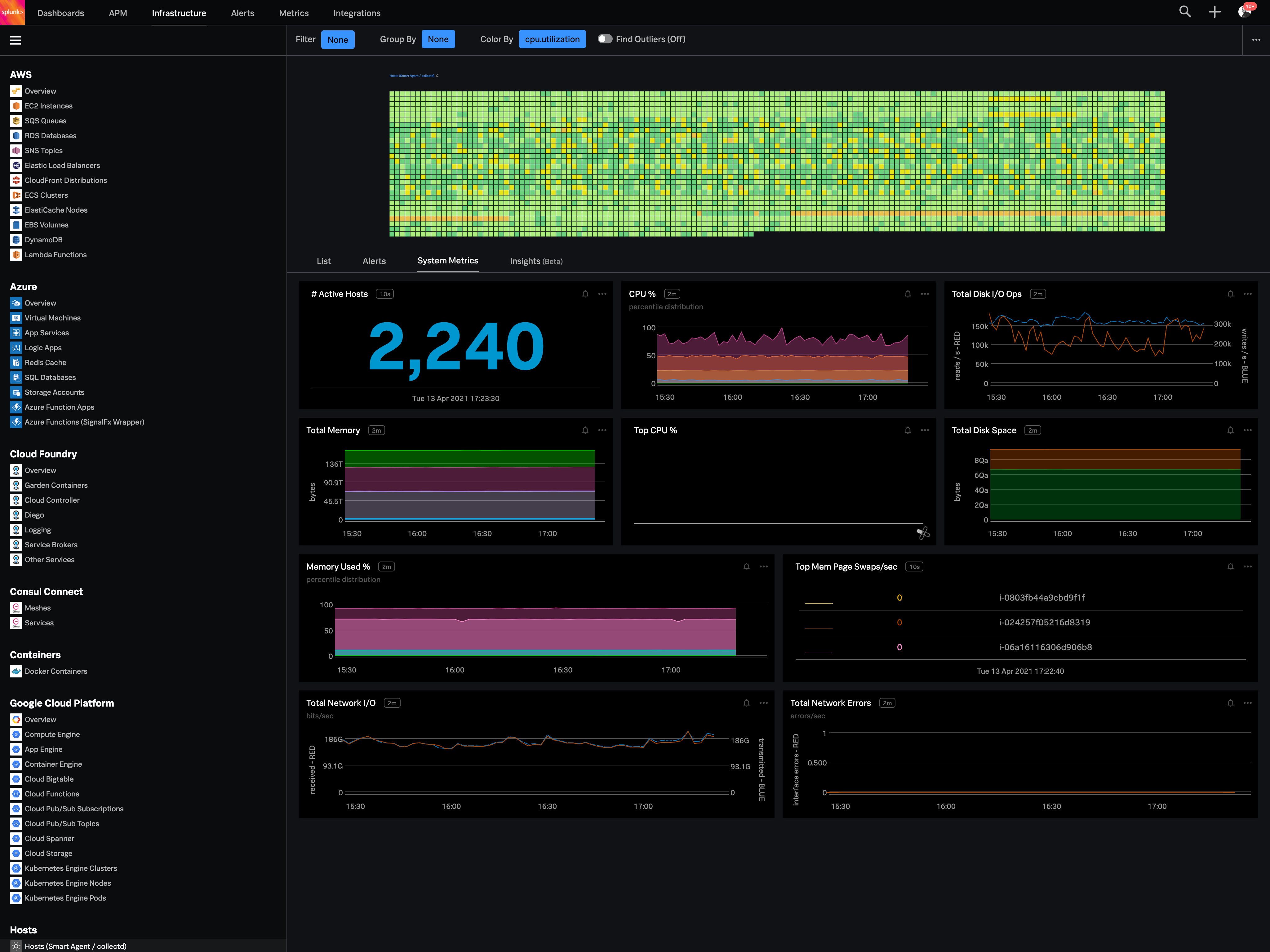
Screenshot of Real-time monitoring for public, private and hybrid cloud