Anaplan is a scenario planning and analysis platform designed to optimize decision-making in complex business environments so that enterprises can outpace their competition and the market. By building connections and collaboration across organizational silos, the Anaplan platform surfaces key insights.
N/A
Quantrix
Score 7.4 out of 10
N/A
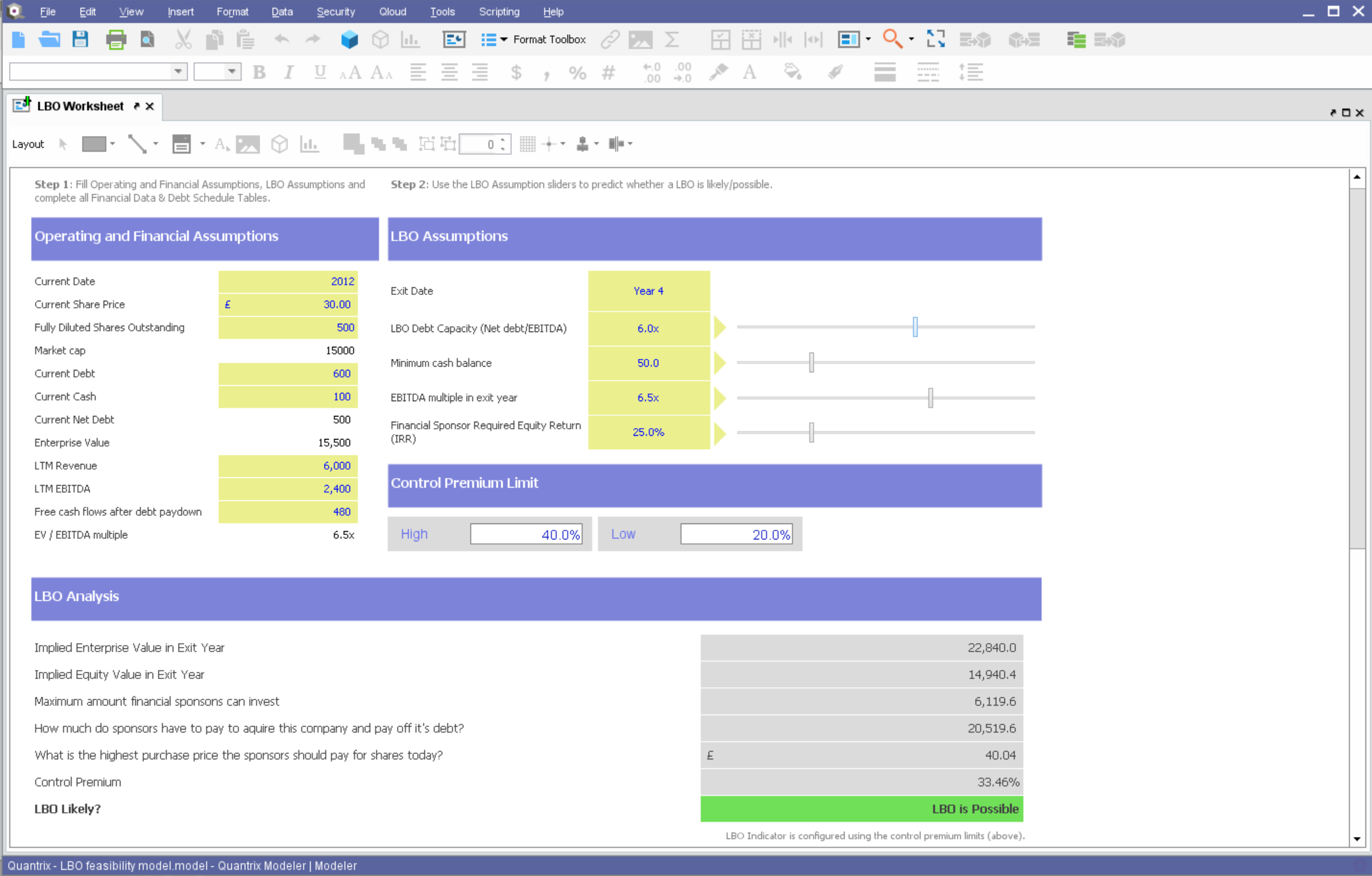
Quantrix is designed to allow users to address the limitations and risks inherent to spreadsheets when developing business-critical models. According to the vendor, this solution offers unmatched capability for forecasting, planning, budgeting, risk modeling and visual analytics, and also allows users to develop ‘what if’ scenarios and model the financial and operational impact of business decisions. Additionally, the vendor says sharing insight is made easier through the creation of interactive…
N/A
Pricing
Anaplan
Quantrix
Editions & Modules
No answers on this topic
No answers on this topic
Offerings
Pricing Offerings
Anaplan
Quantrix
Free Trial
No
Yes
Free/Freemium Version
No
No
Premium Consulting/Integration Services
No
No
Entry-level Setup Fee
Optional
No setup fee
Additional Details
—
Quantrix Modeler is licensed on a per user subscription basis.
More Pricing Information
Community Pulse
Anaplan
Quantrix
Features
Anaplan
Quantrix
BI Standard Reporting
Comparison of BI Standard Reporting features of Product A and Product B
Anaplan
7.4
Ratings
3% below category average
Quantrix
-
Ratings
Pixel Perfect reports
6.40 Ratings
00 Ratings
Customizable dashboards
7.90 Ratings
00 Ratings
Report Formatting Templates
7.90 Ratings
00 Ratings
Ad-hoc Reporting
Comparison of Ad-hoc Reporting features of Product A and Product B
Anaplan
9.1
Ratings
11% above category average
Quantrix
-
Ratings
Drill-down analysis
9.10 Ratings
00 Ratings
Formatting capabilities
9.10 Ratings
00 Ratings
Report sharing and collaboration
9.10 Ratings
00 Ratings
Report Output and Scheduling
Comparison of Report Output and Scheduling features of Product A and Product B
Anaplan
8.4
Ratings
2% above category average
Quantrix
-
Ratings
Publish to Web
8.60 Ratings
00 Ratings
Publish to PDF
7.90 Ratings
00 Ratings
Report Versioning
9.20 Ratings
00 Ratings
Report Delivery Scheduling
7.90 Ratings
00 Ratings
Data Discovery and Visualization
Comparison of Data Discovery and Visualization features of Product A and Product B
Anaplan is best suited for strategic planning initiatives in industries like CPG, Manufacturing, FS, Pharma. It can handle multiple use cases for each function in the company like Supply chain, Finance, Sales and more. It is one of the best tools I have seen in scenario modelling. It is not suitable for very detailed level planning, essentially execution level eg. Production scheduling.
Quantrix Modeler is one of the most appropriate software tools for developing dynamic financial planning models in small teams composed by skilled power users. There is an also Enterprise version supporting larger user bases and stronger integration with company backend systems. It's not advisable to put Quantrix desktop application in the hands of non-skilled staff since the learning curve is much steeper than what's the typical experience with spreadsheets. Adding a table with ad hoc simple calculations can be done by anyone in a spreadsheet, but requires knowledgeable design in a Quantrix model. On the positive side, experience with students in our classes shows that with focused training an user can be become productive in a relatively short time. There is a web version of Quantrix Modeler, Qloud, that is aimed to end users that only modify input data and consume model results, without the possibility of changing the model logic (structure and formulas)
Quantrix gathers info from numerous sources in a single click. Thereby making structure to process sustainable and scale-able. Once the logic is written the data refreshes and you are good to go with furture analysis and planning. There is no need for rework, copying down formulas, etc. In our latest product wheel build process we reduced our time from 3 weeks of time to 2 days to build out product wheels. There was a sharp contrast between Excel ( previous method) and Quantrix.
Quantrix links perfectly to SQL Server which allows us to get actual data quickly, push out forecasts or other data for other systems to consume.
Quantrix range based formula writing and common term formulas are a HUGE time saver. Debugging formulas is a breeze in Quantrix using what is called the dependency inspector. There is no need to copy down formulas; make sure cell ranges are locked etc. It is one formula controlling a multitude of cells that scales as the data set shrinks or grows. Also if there is an error in the formula you have 1 formula to fix not hundreds or even thousands. Common terms in your formulas helps immensely and reduces the amount of headache of debugging your formulas.
Quantrix Scales with ease. Adding additional data or shrinking the data does not require (manual) structure updates to Quantrix. It accordions according to the data imported. Pivoting data and looking at it as well as filtering it and then building off of those filters and pivots is a joy to do in Quantrix!
Complexity - Excel does not have it! Where the vlookup ends in Excel the Quantrix Select statement is just warming up. Functions like: Select, Selects, SelectList, SelectGreaterThan, SelectBetween, SelectLessThan, and one of my new favorites SelectLike in addition to CASE and Switch Logic make Quantrix a dominating force when it comes to writing complex logic in your business model. Quantrix does is beautifully.
Quantrix was able to free the definition of calculation rules from cells. It would be interesting to be able to separate the default template structure from changes when importing data.
Just to be clear to prevent the import (example from a CSV or DB) the creation of new items in addition to those already existing.
An import navigation by level would be interesting. Or to obtain a split of the number on a tree structure (I bring as an example that of Corporate Planning (https://www.corporate-planning.com/de/).
As a further enhancement of the above, it would be interesting to be able to define reports like an explosion of a tree structure.
Anaplan is already an established market leader in enterprise planning area. Its flexibility to build multi-dimensional models, real time scenario plannings are proven to be the best features and successfully implemented by global organizations. Anaplan's ambitious product team is ensuring to roll out new features regularly based on customer/ partner feedback. e.g their new improved polaris environment has strong potential to build very large models without worrying about sparsity. The integration with other tools/technologies is being easier (e.g. cloudworks). Hence, considering Anaplan as a platform that has proved to be successful tool in enterprise level planning, its focus on regular feature enhancements and future release roadmaps I believe this platform has potential to evolve further along with our business processes and requirements
Anaplan is interesting because it is at the same time easy to use and difficult to use. An end user can navigate a well-constructed app, being pointed in the right direction every time they feel a slight bit of confusion, and find everything they need in what feels like a straight line. Similarly, a model builder (developer of sorts) can have the exact same experience, but the journey is longer and more complicated. End users have great experiences with Anaplan, but sometimes model builders have a frustrating one. That is not to say model building is hard (because it truly is not), but things change, and when things change in complex systems, the effort required simply to investigate where a model builder needs to make an adjustment may frustrate them but also frustrate their non-technical bosses. However, the reality is that with complicated businesses, complicated business problems, come complicated solutions. It is actually a testament to Anaplan's capabilities that it has taken on the biggest problems at the biggest companies. It may be daunting to adjust it in those environments, but at least you know it did meet the needs there, which is more than most tools can say.
There are very few outages. Maintenance is scheduled on two or three Saturdays per month, so as not to affect businesses. When there is an outage, users are kept informed of progress to restore the platform and typically this takes no more than an hour. Anaplan customer support is very responsive if we ever have questions about platform issues
Generally, pages load quickly and reports complete within a reasonable timeframe. However, when working with large or complex datasets or during times of multiple active users, performance can sometimes be impacted. That said, much of the performance depends on how the model is built and whether best practices have been followed. Optimized models tend to perform much better, so the experience can be somewhat subjective based on the setup.
Support quality has dropped since Thoma Bravo has taken over. I think some serious re-focus needs to happen here -- part of the beauty of being in the Anaplan community was how involved you felt in it before. Before I didn't dread sending a support ticket, now I am starting to.
In my opinion, in-person training is always the best if you have the option to do so. This allows real-time interactions with the instructions, whereas the online training I took required me to write-down questions, email them, and wait for responses. This slows down the process, as you can imagine. That said, in-person training is an extra cost and it likely isn't needed for everyone. I would suggest selecting a small number of people to take in-person training and then having them act as mentors to the rest of your team. That way, as the rest of the team takes the online training, they have a resource to help them in real time.
Learning made easy . One of the best trainings i have attended. Training was very detailed training by the trainer, which helped me understand the basics of the model building. Level 1 training was easy and instructor was most helpful here. Level 2 training was challenging but was able to go thru due to understanding of the basics.
Agile methodology and breaking the work down into sprints was very helpful. Implementation required a deeper dive into our data than expected for the consultants to be able to construct the data model. But once it was in place, the focus on knowledge transfer enabled us to be able to use the product effectively after the team rolled off.
Anaplan is one of the only tools flexible to handle bespoke commission calculations. In addition to Sales Performance Management, Anaplan can be used to support other business functions, such as workforce planning or financial planning & analysis. Anaplan provides the scalability needed for an enterprise-level solution. While taking longer to implement, it also can provide a greater ROI.
Microsoft Excel, Infor, Tagetik, Palantir Quantrix is not ready to use budgeting and planning tool, it is basically data modeling tool. That makes Quantrix different. You yourself or with help of consultant create model according to your specific business needs. You will get cost-effective, tailored solution. It is a modeling tool that allows the easy and quick creation of multiple scenarios, conducting “what-if” analysis to accommodate uncertainty associated with forecasts.
We have managed to leverage Anaplan for financial planning and forecasting across the business. It is now used by almost every department, with more than 50 users (but I know of companies that have hundreds of users) and still the platform is quick and reliable. It is easy to make changes to divisions and departments or add users and apply different user settings - the core part of the model is not affected and end users can continue their work without any disruption
Reduction in time spent by sales ops team in processing compensation by almost 20 %
Ability to drill down into each compensation calculation to understand the details of how the comp is calculated. This has provided more transparency / traceability to end users
we are able to release updates to the system faster as it is easier to maintain and sync
Quantrix has boosted profitability and has proven its worth time and again. The platform has put us on the radar doing things even our biggest competitors could only dream of. We are still early in the development and deployment of our Quantrix Qloud based system to clients, but we already have early adopters coming over from competitor systems that cost exponentially more and do significantly less than what we provide. We feel it is only a matter of time for our Qloud driven analytics to become more mainstream in our space.