If your application needs a relational data store and uses other AWS services, AWS RDS is a no-brainer. It offers all the traditional database features, makes it a snap to set up, creates cross-region replication, has advanced security, built-in monitoring, and much more at a very good price. You can also set up streaming to a data lake using various other AWS services on your RDS.
From my own perspective and the tasks that I perform on a daily basis, MySQL is perfect. It has a reasonable footprint, is fast enough and offers the security and flexibility I need. Everyone has their preferred applications and, no doubt, for larger data warehouses or more intensive applications, MySQL may have its limits, but for the area that I operate in, it's a great match.
Automated Database Management: We use it for streamlining routine tasks like software patching and database backups.
Scalability on Demand: we use it to handle traffic spikes, scaling both vertically and horizontally.
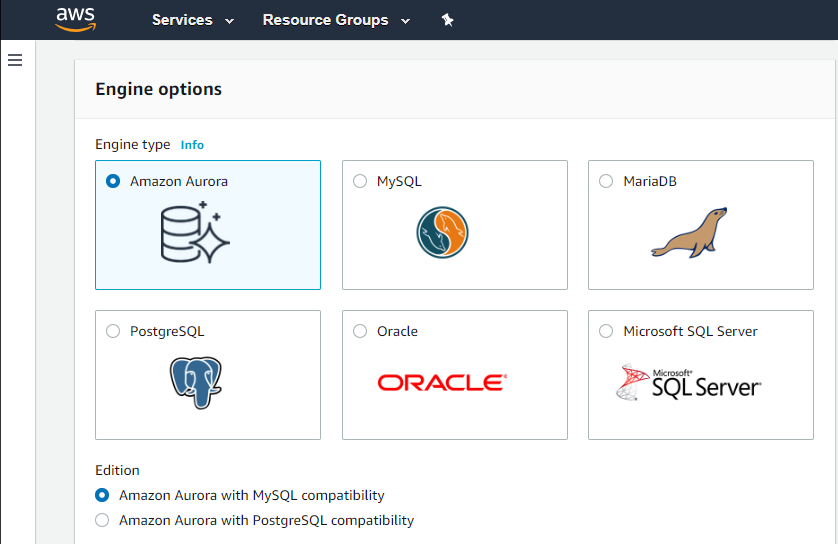
Database Engine Compatibility: It works amazingly with multiple database engines used by different departments within our organization including MySQL, PostgreSQL, SQL Server, and Oracle.
Monitoring: It covers our extensive monitoring and logging, and also has great compatibility with Amazon CloudWatch
Security: is embedded at each level in MySQL. Authentication mechanisms are in place for configuring user access and even service account access to applications. MySQL is secure enough under the hood to store your sensitive information. Also, additional plugins are available that sit on top of MySQL for even tighter security.
Widely adopted: MySQL is used across the industry and is trusted the most. Therefore, if you face any problems, simply Google it and you shall land in plenty of forums. This is a great relief as when you are in a need of help, you can find it right in your browser.
Lightweight application: MySQL is not a heavy application. However, the data you store in the database can get heavy with time, but as in the configuration and MySql application files, those are not very heavy and can easily be installed on legacy systems as well.
It is a little difficult to configure and connect to an RDS instance. The integration with ECS can be made more seamless.
Exploring features within RDS is not very easy and intuitive. Either a human friendly documentation should be added or the User Interface be made intuitive so that people can explore and find features on their own.
There should be tools to analyze cost and minimize it according to the usage.
Although you can add the data you require as more and more data is added, the fixity of it becomes more critical.
As the demand, size, and use of the system increase, you may also need to change or acquire more equipment on your servers, although this is an internal inconvenience for the company.
We do renew our use of Amazon Relational Database Service. We don't have any problems faced with RDS in place. RDS has taken away lot of overhead of hosting database, managing the database and keeping a team just to manage database. Even the backup, security and recovery another overhead that has been taken away by RDS. So, we will keep on using RDS.
For teaching Databases and SQL, I would definitely continue to use MySQL. It provides a good, solid foundation to learn about databases. Also to learn about the SQL language and how it works with the creation, insertion, deletion, updating, and manipulation of data, tables, and databases. This SQL language is a foundation and can be used to learn many other database related concepts.
I've been using AWS Relational Database Services in several projects in different environments and from the AWS products, maybe this one together to EC2 are my favourite. They deliver what they promise. Reliable, fast, easy and with a fair price (in comparison to commercial products which have obscure license agreements).
I give MySQL a 9/10 overall because I really like it but I feel like there are a lot of tech people who would hate it if I gave it a 10/10. I've never had any problems with it or reached any of its limitations but I know a few people who have so I can't give it a 10/10 based on those complaints.
I have only had good experiences in working with AWS support. I will admit that my experience comes from the benefit of having a premium tier of support but even working with free-tier accounts I have not had problems getting help with AWS products when needed. And most often, the docs do a pretty good job of explaining how to operate a service so a quick spin through the docs has been useful in solving problems.
The support staff is friendly, knowledgeable, and efficient. I only had to get part way through my explanations before they had a solution. They will walk you through a fix or actually connect in and fix the problem for you--or would if you can allow it. I've done it both ways with them. They are always forthcoming with 'how to do this if it happens again' information. I love working with MySQL support.
Amazon Relational Database Service (RDS) stands out among similar products due to its seamless integration with other AWS services, automated backups, and multi-AZ deployments for high availability. Its support for various database engines, such as MySQL, PostgreSQL, and Oracle, provides flexibility. Additionally, RDS offers managed security features, including encryption and IAM integration, enhancing data protection. The pay-as-you-go pricing model makes it cost-effective. Overall, Amazon RDS excels in ease of use, scalability, and a comprehensive feature set, making it a top choice for organizations seeking a reliable and scalable managed relational database service in the cloud.
Each of the products has its own merits and demerits. however since MySQL is a very good documentation and global community its easy to learn and apply in different stages for analytics work. compare to other data bases its simple for setup and work on it. MySQL is cost effective and low risk choice for start up organization makes it more suitable for small to medium enterprises.