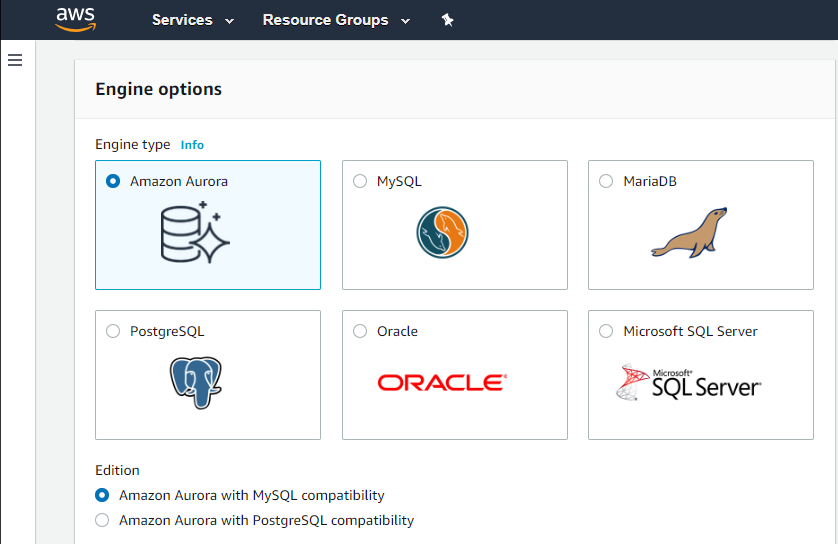
Amazon Relational Database Service (Amazon RDS) is a database-as-a-service (DBaaS) from Amazon Web Services.
N/A
MongoDB Atlas
Score 8.2 out of 10
N/A
MongoDB Atlas is the company's automated managed cloud service, supplying automated deployment, provisioning and patching, and other features supporting database monitoring and optimization.
Running MySQL RDS was a simpler solution than running standalone MySQL servers as the semi-managed nature of RDS saved us the need to install, maintain, secure, and backup our database servers. Using MySQL RDS was in addition to running MongoDB Atlas workloads and allowed us to …
Because we have our whole architecure on AWS cloud so to provide close connectivity we have choose AWS RDS and also due to Features offered by AWS RDS.
Amazon Relational Database Service solves part of our architecture problem - more inclined towards on-line transactions and simple user data storage - whereas MongoDB is good for storing structured complex data. For most of the requirements we use Amazon Relational Database …
Although the Rackspace service is not comparable, even though it is very good, it requires a lot of administration on my part. Regarding Atlas, although it is not the same as RDS in terms of provisioning and administration panel, I mention it because I found it simpler and more …
It is more suitable for our data structure and also has a lower management and implementation cost since we don`t have to do everything from scratch. It also offers great integration with other AWS services which makes it really good to work with.
As most of our infra is on AWS it is good that we use the same service provider as we want all of our infra to be in a single service provider for ease of maintaining. also, other services target very specific database engines vs RDS comes with lots of options which is …
Atlas is easier to use, but we selected RDS because of its ability to use Postgres and MySQL as opposed to a document database. Amazon offers a document database service, but ultimately it made more sense architecturally to choose a standard database.
amazon provides wide range of support for multiple database engines so we dont have to look for any other providers integration with aws ecosystem so we can seemlessly use other aws services connected to database aws have data points globally so it if data needs to be in …
In general, they all compete against each other, and each solution has its own advantages and disadvantages. While MongoDB Atlas was the way to go for some cases, however, other databases were more fit for some services that MongoDB Atlas, especially if they were managed by us, …
MongoDB Atlas has been in the market for very long time and there are bunch of documentation, training and support for it. It also is specifically designed for the use case similar to our project and big companies in the market uses them for very high load which made us …
Both AWS RDS and MongoDB Atlas provide a state-of-the-art managed database hosting service, with the difference being the type of databases they support. AWS RDS does not support MongoDB engine and Atlas only supports MongoDB. So I consider them complimentary services and we …
If your application needs a relational data store and uses other AWS services, AWS RDS is a no-brainer. It offers all the traditional database features, makes it a snap to set up, creates cross-region replication, has advanced security, built-in monitoring, and much more at a very good price. You can also set up streaming to a data lake using various other AWS services on your RDS.
It is good if you: 1. Have unstructured data that you need to save (since it is NoSQL DB) 2. You don't have time or knowledge to setup the MongoDB Atlas, the managed service is the way to go (Atlas) 3. If you need a multi regional DB across the world
Automated Database Management: We use it for streamlining routine tasks like software patching and database backups.
Scalability on Demand: we use it to handle traffic spikes, scaling both vertically and horizontally.
Database Engine Compatibility: It works amazingly with multiple database engines used by different departments within our organization including MySQL, PostgreSQL, SQL Server, and Oracle.
Monitoring: It covers our extensive monitoring and logging, and also has great compatibility with Amazon CloudWatch
Generous free and trial plan for evaluation or test purposes.
New versions of MongoDB are able to be deployed with Atlas as soon as they're released—deploying recent versions to other services can be difficult or risky.
As the key supporters of the open source MongoDB project, the service runs in a highly optimized and performant manner, making it much easier than having to do the work internally.
It is a little difficult to configure and connect to an RDS instance. The integration with ECS can be made more seamless.
Exploring features within RDS is not very easy and intuitive. Either a human friendly documentation should be added or the User Interface be made intuitive so that people can explore and find features on their own.
There should be tools to analyze cost and minimize it according to the usage.
For someone new, it could be challenging using MongoDB Atlas. Some official video tutorials could help a lot
Pricing calculation is sometimes misleading and unpredictable, maybe better variables could be used to provide better insights about the cost
Since it is a managed service, we have limited control over the instances and some issues we faced we couldn't;'t know about without reaching out to the support and got fixed from their end. So more control over the instance might help
The way of managing users and access is somehow confusing. Maybe it could be placed somewhere easy to access
We do renew our use of Amazon Relational Database Service. We don't have any problems faced with RDS in place. RDS has taken away lot of overhead of hosting database, managing the database and keeping a team just to manage database. Even the backup, security and recovery another overhead that has been taken away by RDS. So, we will keep on using RDS.
I've been using AWS Relational Database Services in several projects in different environments and from the AWS products, maybe this one together to EC2 are my favourite. They deliver what they promise. Reliable, fast, easy and with a fair price (in comparison to commercial products which have obscure license agreements).
I would give it 8. Good stuff: 1. Easy to use in terms of creating cluster, integrating with Databases, setting up backups and high availability instance, using the monitors they provide to check cluster status, managing users at company level, configure multiple replicas and cross region databases. Things hard to use: 1. roles and permissions at DB level. 2. Calculate expected costs
I have only had good experiences in working with AWS support. I will admit that my experience comes from the benefit of having a premium tier of support but even working with free-tier accounts I have not had problems getting help with AWS products when needed. And most often, the docs do a pretty good job of explaining how to operate a service so a quick spin through the docs has been useful in solving problems.
We love MongoDB support and have great relationship with them. When we decided to go with MongoDB Atlas, they sent a team of 5 to our company to discuss the process of setting up a Mongo cluster and walked us through. when we have questions, we create a ticket and they will respond very quickly
Amazon Relational Database Service (RDS) stands out among similar products due to its seamless integration with other AWS services, automated backups, and multi-AZ deployments for high availability. Its support for various database engines, such as MySQL, PostgreSQL, and Oracle, provides flexibility. Additionally, RDS offers managed security features, including encryption and IAM integration, enhancing data protection. The pay-as-you-go pricing model makes it cost-effective. Overall, Amazon RDS excels in ease of use, scalability, and a comprehensive feature set, making it a top choice for organizations seeking a reliable and scalable managed relational database service in the cloud.
MongoDB is a great product but on premise deployments can be slow. So we turned to Atlas. We also looked at Redis Labs and we use Redis as our side cache for app servers. But we love using MongoDB Atlas for cloud deployments, especially for prototyping because we can get started immediately. And the cost is low and easy to justify.