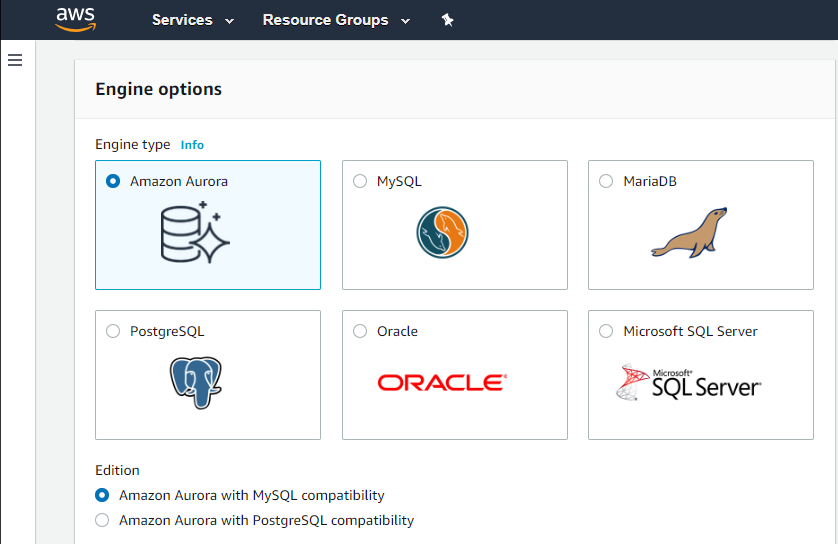
Amazon Relational Database Service (Amazon RDS) is a database-as-a-service (DBaaS) from Amazon Web Services.
N/A
Db2
Score8.5 out of 10
N/A
DB2 is a family of relational database software solutions offered by IBM. It includes standard Db2 and Db2 Warehouse editions, either deployable on-cloud, or on-premise.
$0
Pricing
Amazon RDS
Db2
Editions & Modules
Amazon RDS for PostgreSQL
$0.24 ($0.48)
per hour, R5 Large (R5 Extra Large)
Amazon RDS for MariaDB
$0.25 ($0.50)
per hour, R5 Large (R5 Extra Large)
Amazon RDS for MySQL
$0.29 ($0.58)
per hour, R5 Large (R5 Extra Large)
Amazon RDS for Oracle
$0.482 ($0.964)
per hour, R5 Large (R5 Extra Large)
Amazon RDS for SQL Server
$1.02 ($1.52)
per hour, R5 Large (R5 Extra Large)
Db2 on Cloud Lite
$0
Db2 on Cloud Standard
$99
per month
Db2 Warehouse on Cloud Flex One
$898
per month
Db2 on Cloud Enterprise
$946
per month
Db2 Warehouse on Cloud Flex for AWS
2,957
per month
Db2 Warehouse on Cloud Flex
$3,451
per month
Db2 Warehouse on Cloud Flex Performance
13,651
per month
Db2 Warehouse on Cloud Flex Performance for AWS
13,651
per month
Db2 Standard Edition
Contact Sales
Db2 Advanced Edition
Contact Sales
Offerings
Pricing Offerings
Amazon RDS
Db2
Free Trial
No
Yes
Free/Freemium Version
No
Yes
Premium Consulting/Integration Services
No
Yes
Entry-level Setup Fee
Optional
Optional
Additional Details
—
—
More Pricing Information
Community Pulse
Amazon RDS
Db2
Considered Both Products
Amazon AWS
No answer on this topic
IBM
Verified User
Chose Db2
IBM Db2 in my organization has had overall a much better consistency rating and effectiveness. Turnaround times are shorter and the need for human intervention is significantly less. We find Db2 to be more reliable overall and a better experience to use. In terms on real time …
A de minimis incentive was given to thank the reviewer for their time. The incentive was not used to bias or drive a particular response, nor was the incentive contingent on a positive endorsement. TR verified that a representative sample of customers was invited. More Info
Verified User
Chose Db2
Db2 provides a combination of performance and scalability. Security wise, Db2 is always a first choice, especially for the systems where security can't be compromised. For mainframe systems, there is no other DB in the market that can perform better than Db2. If an organization …
A de minimis incentive was given to thank the reviewer for their time. The incentive was not used to bias or drive a particular response, nor was the incentive contingent on a positive endorsement. More Info
DevOps Engineer in Engineering at Freecharge (Information Technology & Services, 501-1000 employees)
Chose Db2
Considering Price, features configurations timelines of the IBM Db2 we found that is very Robust in Scalability, Reliability, Highly Available. also, we are already a IBM products user and we are much satisfied with the overall product as well as customer support from IBM team. …
A de minimis incentive was given to thank the reviewer for their time. The incentive was not used to bias or drive a particular response, nor was the incentive contingent on a positive endorsement. TR verified that a representative sample of customers was invited. More Info
Verified User
Chose Db2
I have experience with the above-mentioned similar products but mainly with MySQL. In terms of speed and query optimization capabilities, Db2 is far ahead in comparison to MySQL. Because of various issues like scalability, multiple departments hitting DB together causing …
A de minimis incentive was given to thank the reviewer for their time. The incentive was not used to bias or drive a particular response, nor was the incentive contingent on a positive endorsement. TR verified that a representative sample of customers was invited. More Info
If your application needs a relational data store and uses other AWS services, AWS RDS is a no-brainer. It offers all the traditional database features, makes it a snap to set up, creates cross-region replication, has advanced security, built-in monitoring, and much more at a very good price. You can also set up streaming to a data lake using various other AWS services on your RDS.
A de minimis incentive was given to thank the reviewer for their time. The incentive was not used to bias or drive a particular response, nor was the incentive contingent on a positive endorsement. More Info
I have primarily used it as the basis for a SIS - but I have migrated more than a few systems from there database systems to DB2 (Filemaker, MySQL, etc.). DB2 does have a better structural approach, as opposed to Filemaker, which allows for more data consistency, but this can also lead to an inflexibility that can sometimes be counterintuitive when attempting to compensate for the flexibility of the work environment as Schools tend to have an all in one approach.
A de minimis incentive was given to thank the reviewer for their time. The incentive was not used to bias or drive a particular response, nor was the incentive contingent on a positive endorsement. More Info
Automated Database Management: We use it for streamlining routine tasks like software patching and database backups.
Scalability on Demand: we use it to handle traffic spikes, scaling both vertically and horizontally.
Database Engine Compatibility: It works amazingly with multiple database engines used by different departments within our organization including MySQL, PostgreSQL, SQL Server, and Oracle.
Monitoring: It covers our extensive monitoring and logging, and also has great compatibility with Amazon CloudWatch
A de minimis incentive was given to thank the reviewer for their time. The incentive was not used to bias or drive a particular response, nor was the incentive contingent on a positive endorsement. TR verified that a representative sample of customers was invited. More Info
A de minimis incentive was given to thank the reviewer for their time. The incentive was not used to bias or drive a particular response, nor was the incentive contingent on a positive endorsement. More Info
It is a little difficult to configure and connect to an RDS instance. The integration with ECS can be made more seamless.
Exploring features within RDS is not very easy and intuitive. Either a human friendly documentation should be added or the User Interface be made intuitive so that people can explore and find features on their own.
There should be tools to analyze cost and minimize it according to the usage.
A de minimis incentive was given to thank the reviewer for their time. The incentive was not used to bias or drive a particular response, nor was the incentive contingent on a positive endorsement. TR verified that a representative sample of customers was invited. More Info
A de minimis incentive was given to thank the reviewer for their time. The incentive was not used to bias or drive a particular response, nor was the incentive contingent on a positive endorsement. TR verified that a representative sample of customers was invited. More Info
We do renew our use of Amazon Relational Database Service. We don't have any problems faced with RDS in place. RDS has taken away lot of overhead of hosting database, managing the database and keeping a team just to manage database. Even the backup, security and recovery another overhead that has been taken away by RDS. So, we will keep on using RDS.
A de minimis incentive was given to thank the reviewer for their time. The incentive was not used to bias or drive a particular response, nor was the incentive contingent on a positive endorsement. More Info
The DB2 database is a solid option for our school. We have been on this journey now for 3-4 years so we are still adapting to what it can do. We will renew our use of DB2 because we don’t see. Major need to change. Also, changing a main database in a school environment is a major project, so we’ll avoid that if possible.
A de minimis incentive was given to thank the reviewer for their time. The incentive was not used to bias or drive a particular response, nor was the incentive contingent on a positive endorsement. TR verified that a representative sample of customers was invited. More Info
I've been using AWS Relational Database Services in several projects in different environments and from the AWS products, maybe this one together to EC2 are my favourite. They deliver what they promise. Reliable, fast, easy and with a fair price (in comparison to commercial products which have obscure license agreements).
A de minimis incentive was given to thank the reviewer for their time. The incentive was not used to bias or drive a particular response, nor was the incentive contingent on a positive endorsement. More Info
You have to be well versed in using the technology, not only from a GUI interface but from a command line interface to successfully use this software to its fullest.
A de minimis incentive was given to thank the reviewer for their time. The incentive was not used to bias or drive a particular response, nor was the incentive contingent on a positive endorsement. More Info
I have never had DB2 go down unexpectedly. It just works solidly every day. When I look at the logs, sometimes DB2 has figured out there was a need to build an index. Instead of waiting for me to do it, the database automatically created the index for me. At my current company, we have had zero issues for the past 8 years. We have upgrade the server 3 times and upgraded the OS each time and the only thing we saw was that DB2 got better and faster. It is simply amazing.
A de minimis incentive was given to thank the reviewer for their time. The incentive was not used to bias or drive a particular response, nor was the incentive contingent on a positive endorsement. TR verified that a representative sample of customers was invited. More Info
The performances are exceptional if you take care to maintain the database. It is a very powerful tool and at the same time very easy to use. In our installation, we expect a DB machine on the mainframe with access to the database through ODBC connectors directly from branch servers, with fabulous end users experience.
A de minimis incentive was given to thank the reviewer for their time. The incentive was not used to bias or drive a particular response, nor was the incentive contingent on a positive endorsement. More Info
I have only had good experiences in working with AWS support. I will admit that my experience comes from the benefit of having a premium tier of support but even working with free-tier accounts I have not had problems getting help with AWS products when needed. And most often, the docs do a pretty good job of explaining how to operate a service so a quick spin through the docs has been useful in solving problems.
A de minimis incentive was given to thank the reviewer for their time. The incentive was not used to bias or drive a particular response, nor was the incentive contingent on a positive endorsement. More Info
Easily the best product support team. :) Whenever we have questions, they have answered those in a timely manner and we like how they go above and beyond to help.
A de minimis incentive was given to thank the reviewer for their time. The incentive was not used to bias or drive a particular response, nor was the incentive contingent on a positive endorsement. More Info
A de minimis incentive was given to thank the reviewer for their time. The incentive was not used to bias or drive a particular response, nor was the incentive contingent on a positive endorsement. More Info
A de minimis incentive was given to thank the reviewer for their time. The incentive was not used to bias or drive a particular response, nor was the incentive contingent on a positive endorsement. TR verified that a representative sample of customers was invited. More Info
Amazon Relational Database Service (RDS) stands out among similar products due to its seamless integration with other AWS services, automated backups, and multi-AZ deployments for high availability. Its support for various database engines, such as MySQL, PostgreSQL, and Oracle, provides flexibility. Additionally, RDS offers managed security features, including encryption and IAM integration, enhancing data protection. The pay-as-you-go pricing model makes it cost-effective. Overall, Amazon RDS excels in ease of use, scalability, and a comprehensive feature set, making it a top choice for organizations seeking a reliable and scalable managed relational database service in the cloud.
DB2 was more scalable and easily configurable than other products we evaluated and short listed in terms of functionality and pricing. IBM also had a good demo on premise and provided us a sandbox experience to test out and play with the product and DB2 at that time came out better than other similar products.
A de minimis incentive was given to thank the reviewer for their time. The incentive was not used to bias or drive a particular response, nor was the incentive contingent on a positive endorsement. More Info
By using DB2 only to support my IzPCA activities, my knowledge here is somewhat limited.
Anyway, from what I was able to understand, DB2 is extremely scallable.
Maybe the information below could serve as an example of scalability.
Customer have an huge mainframe environment, 13x z15 CECs, around 80 LPARs, and maybe more than 50 Sysplexes (I am not totally sure about this last figure...)
Today we have 7 IzPCA databases, each one in a distinct Syplex.
Plans are underway to have, at the end, an small LPAR, with only one DB2 sub-system, and with only one database, then transmit the data from a lot of other LPARs, and then process all the data in this only one database.
The IzPCA collect process (read the data received, manipulate it, and insert rows in the tables) today is a huge process, demanding many elapsed hours, and lots of CPU.
Almost 100% of the tables are PBR type, insert jobs run in parallel, but in 4 of the 7 database, it is a really a huge and long process.
Combining the INSERTs loads from the 7 databases in only one will be impossible.......,,,,
But, IzPCA recently introduced a new feature, called "Continuous Collector".
By using that feature, small amounts of data will be transmited to the central LPAR at every 5 minutes (or even less), processed immediately,in a short period of time, and withsmall use of CPU, instead of one or two transmissions by day, of very large amounts of data and the corresponding collect jobs occurring only once or twice a day, with long elapsed times, and huge comsumption of CPU
I suspect the total CPU seconds consumed will be more or less the same in both cases, but in the new method it will occur insmall bursts many times a day!!
A de minimis incentive was given to thank the reviewer for their time. The incentive was not used to bias or drive a particular response, nor was the incentive contingent on a positive endorsement. More Info
A de minimis incentive was given to thank the reviewer for their time. The incentive was not used to bias or drive a particular response, nor was the incentive contingent on a positive endorsement. More Info
A de minimis incentive was given to thank the reviewer for their time. The incentive was not used to bias or drive a particular response, nor was the incentive contingent on a positive endorsement. More Info