Amazon's Elastic Load Balancing automatically distributes incoming application traffic across multiple targets, such as Amazon EC2 instances, containers, IP addresses, and Lambda functions. It can handle the varying load of your application traffic in a single Availability Zone or across multiple Availability Zones. Elastic Load Balancing offers three types of load balancers with the vendor states all feature the high availability, automatic scaling, and robust security necessary to make…
$0.01
Partial Hour
NGINX
Score 9.2 out of 10
Enterprise companies (1,001+ employees)
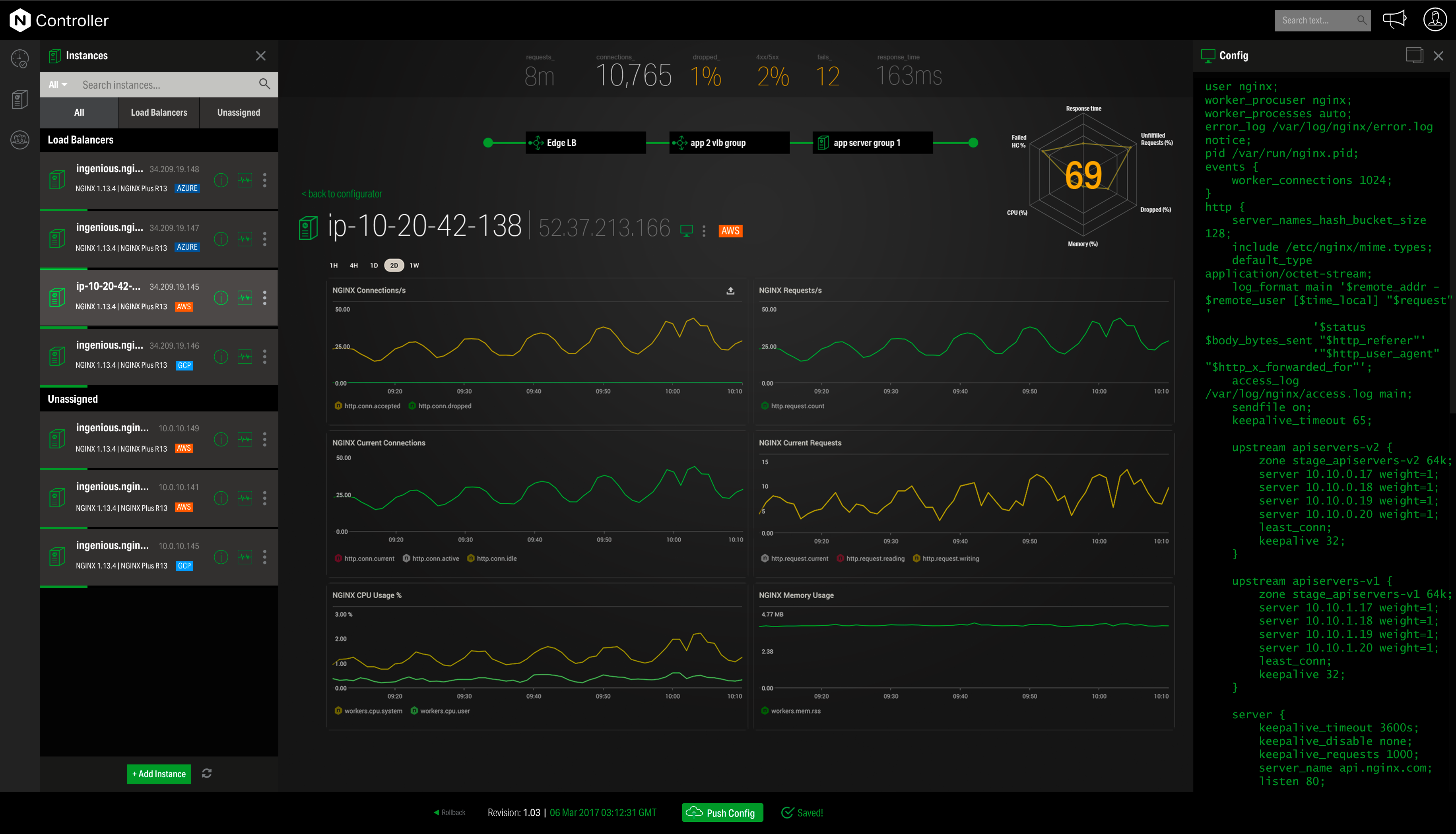
NGINX, a business unit of F5 Networks, powers over 65% of the world's busiest websites and web applications. NGINX started out as an open source web server and reverse proxy, built to be faster and more efficient than Apache. Over the years, NGINX has built a suite of infrastructure software products o tackle some of the biggest challenges in managing high-transaction applications. NGINX offers a suite of products to form the core of what organizations need to create…
N/A
Pricing
Amazon Elastic Load Balancing
NGINX
Editions & Modules
Gateway
$0.0125
Partial Hour
Application
$0.0225
Partial Hour
Network
$0.025
Partial Hour
No answers on this topic
Offerings
Pricing Offerings
Elastic Load Balancing
NGINX
Free Trial
No
Yes
Free/Freemium Version
No
Yes
Premium Consulting/Integration Services
No
No
Entry-level Setup Fee
No setup fee
Optional
Additional Details
—
—
More Pricing Information
Community Pulse
Amazon Elastic Load Balancing
NGINX
Features
Amazon Elastic Load Balancing
NGINX
Application Servers
Comparison of Application Servers features of Product A and Product B
It really is a straight-up situation. From my current experience if you have two or more services hosted on Amazon web services that need transactions between each other with a variable flow of traffic then elb is a fantastic method for routing that traffic and making sure that no one back and component gets overloaded with requests while other existing components are just standing there idle waiting for some traffic. As noted earlier in my review we are still doing a trial run with the service as not all of our components are hosted on AWS yet and we aren't having as great luck with transactions between hosted and non-hosted but that could also simply be a learning curve on our part.
Nginx is well suited for serving any static content - whether that be images, JS files, HTML files, CSS files, videos, etc. If you have a high-traffic website, Nginx will be a great fit because it handles large number of requests extremely efficiently. Nginx has full support on Unix systems, but only has limited support on Microsoft Windows machines.
Straight-forward configuration format that users of all skill levels can learn, and yet is powerful enough for the huge breadth of features that Nginx provides.
Massive scale right out the box. We've never had a Nginx instance overwhelmed by requests, and if we did it would be trivial to spin up more Nginx instances to handle the load.
SSL termination means that we can deliver content over HTTPS without needing our individual services to require TLS support. This saves us a lot of time and headache while keeping us secure.
Nginx is open-source and free, meaning that anyone can use it to power their services, from individual projects to billion-dollar websites.
Nginx often requires some initial configuration. It's worth doing, because you'll end up with great results, but it can be slightly daunting for someone to get started using it. Apache might have a leg up in that regard--When you install Apache, typically it's just about ready to do what you want already. But the issue with Apache is that most people skip the extensive tuning phase required after that, and with nginx it becomes more just a part of the configuration process.
Sometimes, the configuration syntax, even though it's powerful and terse, isn't the most intuitive. Luckily there's plenty of documentation about what things mean and how to accomplish certain things. There may not be much that can be done about this--to have a powerful web server, you need a powerful-enough configuration language.
The nginx brand is somewhat fragmented, and it can be confusing. There's the open source nginx web server, which I've primarily been referring to. But then there's NGINX Plus, a premium subscription-based service which works with a range of other NGINX products (NGINX WAF, NGINX Amplify, NGINX Controller). I've met a number of people who weren't very familiar with nginx, and instinctively went to nginx.com first, and from there it seems like everything costs money. It's only when they realize there's a different site, nginx.org, that they find what they went looking for.
AWS Elastic Load Balancing has this trick. First, you need to know how it works. ELB is not the only piece here. ELB has a very close relation with AWS Target Groups. You create or select a target group every time you create a Load balancer. Target groups allow you to connect the load balancer to EC2 autoscaling groups, Lambda functions, or even a single EC2 instance. While this sounds complex, it becomes easy, once you know his tricks. Thanks to the user interface, managing a ELB is an easy task. The rules editor is really useful, although it will need a bit of improvement to some interface items
Front end proxy and reverse proxy of Nginx is always useful. I always prefer to Nginx in overall usability when you have application server and database or multiple application servers and single database i.e. clustered application. Nginx provides really good features and flexibility which helps the system administrator in case of troubleshooting and also from the administration perspective. Also, Nginx doesn't delay any request because of internal performance issues.
AWS gives you several support plans. On the free plan, you basicaly need to google for help, but the good news is that AWS Elastic Load Balancing works. We has more than 15 load balancers and we never run into a problem that require support. But you mght consider a support plan if you are going to do something more complex or critical
Community support is great, and they've also had a presence at conferences. Overall, there is no shortage of documentation and community support. We're currently using it to serve up some WordPress sites, and configuring NGINX for this purpose is well documented.
We have not used any other solution out there in the market but our dev-ops team did deep research and AWS provided us the solution we needed to be cost-effective. Also, the decision to keep working with Amazon was strategic. We were already using other AWS features and [Amazon Elastic Load Balancing] integrates great with those.
I have found that [NGINX] seems to perform better throughout the years with less issues although I've used Apache more. I would definitely recommend [NGINX] for any high volume site and I've seen this to usually be the case from most provided web hosts who will pick [NGINX] over alternatives
When we first migrated our primary bidding environment architecture to Nginx, it was under duress due to Apache's inability to keep up when we consolidated away from an HAproxy model to a central HTTP proxy. So we even when we did not know what we were doing, we were able to make it work in a bad situation, and everyone was quite happy.
The biggest complaint I have is that I find the module compilation requirements for nginx+ rather burdensome. If we pay for Nginx+, I'd love to see then have pre-built modules for ready for each release of more modules. We are spending our own time engineering an in-house solution for module testing for nginx+ releases, which is disappointing.
I've also, as the primary Nginx person at my organization, inserted my expertise into other projects, and have saved our company lots of money getting rid of big $$$ appliances for general SSL proxying.
Speaking of Nginx replacing SSL appliances, we had an instance where we had to suddenly enable elliptic-curve SSL ciphers and our big $$$ appliances (you know who they are), were falling over. Even their SSL accelerator cards, after all, are just a few extra cores to process SSL. But in an environment of our size, we use DNS to spread the load to hundreds of frontend proxies with dozens of cores each to spread this load out, all at a lower price than ONE of the appliance pairs running Nginx. We couldn't even tell the change in load in our Nginx architecture when we enabled the ciphers.