Amazon Elastic Compute Cloud (Amazon EC2) is a web service that provides secure, resizable compute capacity in the cloud. Users can launch instances with a variety of OSs, load them with custom application environments, manage network access permissions, and run images on multiple systems.
$0.01
per IP address with a running instance per hour on a pro rata basis
AWS CloudFormation
Score 8.8 out of 10
N/A
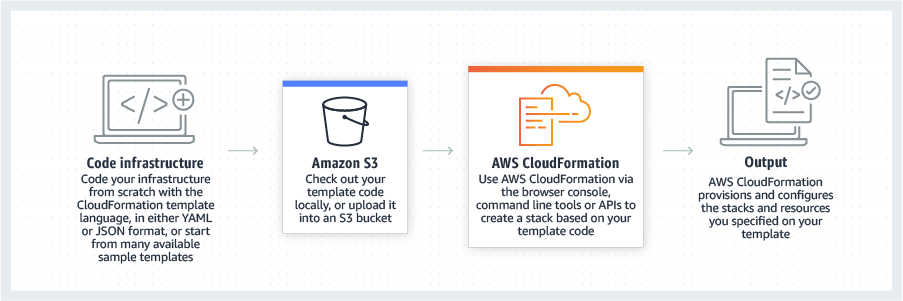
AWS CloudFormation gives developers and systems administrators a way to create and manage a collection of related AWS resources, provisioning and updating them in a predictable fashion. Use AWS CloudFormation’s sample templates or create templates to describe the AWS resources, and any associated dependencies or runtime parameters, required to run an application. Users don’t need to figure out the order for provisioning AWS services or the subtleties of making those dependencies work.…
$0
Pricing
Amazon Elastic Compute Cloud (EC2)
AWS CloudFormation
Editions & Modules
Data Transfer
$0.00 - $0.09
per GB
On-Demand
$0.0042 - $6.528
per Hour
EBS-Optimized Instances
$0.005
per IP address with a running instance per hour on a pro rata basis
Carrier IP Addresses
$0.005 - $0.10
T4g Instances
$0.04
per vCPU-Hour Linux, RHEL, & SLES
T2, T3 Instances
$0.05 ($0.096)
per vCPU-Hour Linux, RHEL, & SLES (Windows)
Free Tier - 1,000 Handler Operations per Month per Account
$0.00
Handler Operation
$0.0009
per handler operation
Offerings
Pricing Offerings
Amazon Elastic Compute Cloud (EC2)
AWS CloudFormation
Free Trial
No
Yes
Free/Freemium Version
No
Yes
Premium Consulting/Integration Services
No
No
Entry-level Setup Fee
No setup fee
No setup fee
Additional Details
—
There is no additional charge for using AWS CloudFormation with resource providers in the following namespaces: AWS::*, Alexa::*, and Custom::*. In this case you pay for AWS resources (such as Amazon EC2 instances, Elastic Load Balancing load balancers, etc.) created using AWS CloudFormation as if you created them manually. You only pay for what you use, as you use it; there are no minimum fees and no required upfront commitments.
When you use resource providers with AWS CloudFormation outside the namespaces mentioned above, you incur charges per handler operation. Handler operations are create, update, delete, read, or list actions on a resource.
More Pricing Information
Community Pulse
Amazon Elastic Compute Cloud (EC2)
AWS CloudFormation
Features
Amazon Elastic Compute Cloud (EC2)
AWS CloudFormation
Infrastructure-as-a-Service (IaaS)
Comparison of Infrastructure-as-a-Service (IaaS) features of Product A and Product B
Suitable for companies that are looking for performance at a competitive price, flexibility to switch instance type even with RI, flexibility to add-on IOPS, option to lower running cost with the regular introduction of new instance type that comes with higher performance but at a lower cost.
Cloning a virtual machine creates a virtual machine that is a copy of the original. The new virtual machine is configured with the Cloning Cloning a virtual machine creates a virtual machine that is a copy of the original. The new virtual machine is configured with the same virtual hardware, installed software, and other properties that were configured for the original virtual machine. For information about persistent memory and PMem storage, see the vSphere Resource Management Guide. For information virtual machine creates a virtual machine that is a copy of the original. The new virtual machine is configured with the same virtual hardware, installed software, and other properties that were configured for the original virtual machine. For information about persistent memory and PMem storage, see the vSphere Resource. Management guide. For information virtual hardware, installed software cloning a virtual machine creates a virtual machine that is a copy of the original. The new virtual machine is configured with the same virtual hardware, installed software, and other properties that were configured for the original virtual machine. For information about persistent memory and PMem storage, see the vSphere Resource Management Guide. For information and other properties that were configured for the original virtual machine. For information about persistent memory and PMem storage, see the vSphere Resource Management Guide. For information.
A great variety of choices in Amazon Machine Image (AMI) types. Users can select a more basic type to run generic workloads, but also have the choice to pick an AMI pre-installed with specific services in the AWS Marketplace.
The range of instance types can support the usage from a student's exploration (inexpensive general-purpose nano instances) to an enterprise's most intense workloads (memory or storage-optimized instances with terabytes of memory and ultra-fast network connection).
The pricing options, from regular instances, reserved instances to spot instances allow users to get the job done and make smart choices about how much they want to pay and when they want to pay.
This service is a bit difficult to consume. New users need a big learning curve to use this service effectively.
UI for EC2 service is a little complex and at many places, it misses detailed explanation.
Sometimes it takes too long to create images of EC2 instances. This keeps your EC2 up for that extra time. When instances are heavy, it penalizes a lot of money.
It's easy and straightforward for a technical person to use it via SSH, but when working in cross-functional teams, using Amazon's web console is difficult for this particular service. Most modern cloud providers provide a more seamless user interface to interact with their cloud machines, and the same should have been the case with EC2.
It's easy enough to get a shared template & apply it. You don't even have to download-then-upload or copy-and-paste, a publicly-accessible url works.
Diving deeper, it has enough powerful capabilities to make the life of a platform / DevOps engineer bearable.
However, you need equally deep knowledge to troubleshoot issues, when they inevitably pop up. This is the same for all IaC technologies, as they are additional abstraction layers on top of the native API provided by the cloud providers.
AWS's support is good overall. Not outstanding, but better than average. We have had very little reason to engage with AWS support but in our limited experience, the staff has been knowledgeable, timely and helpful. The only negative is actually initiating a service request can be a bit of a pain.
Azure VM Builder offers good service, but the options are quite limited (Too much inclined to Windows as it is prepared by Microsoft). EC2 image building capabilities are the best in the market, and offer Windows, Linux (CentOS, rh2, debian, ubuntu), along with other distros, which helps customers choose according to their needs.
Since the product I'm involved is primarily hosted on AWS we use CloudFormation but in some other products where we have hybrid cloud deployments we prefer Terraform which is opensource.
With EC2 you pay only when is Running, so you can save up to 75% on Dev environments which are running only on office hours
You have several ways to pay for EC2, with EC2 Reserved Instances you pay with a discount of up to 72% if you make a commitment of using them from 1 or 3 years
With EC2 spot you can use spare AWS EC2 capacity with a discount of up to 90%, your workload must be interrupt tolerant as your EC2 could be reclaim by AWS and the EC2 terminated