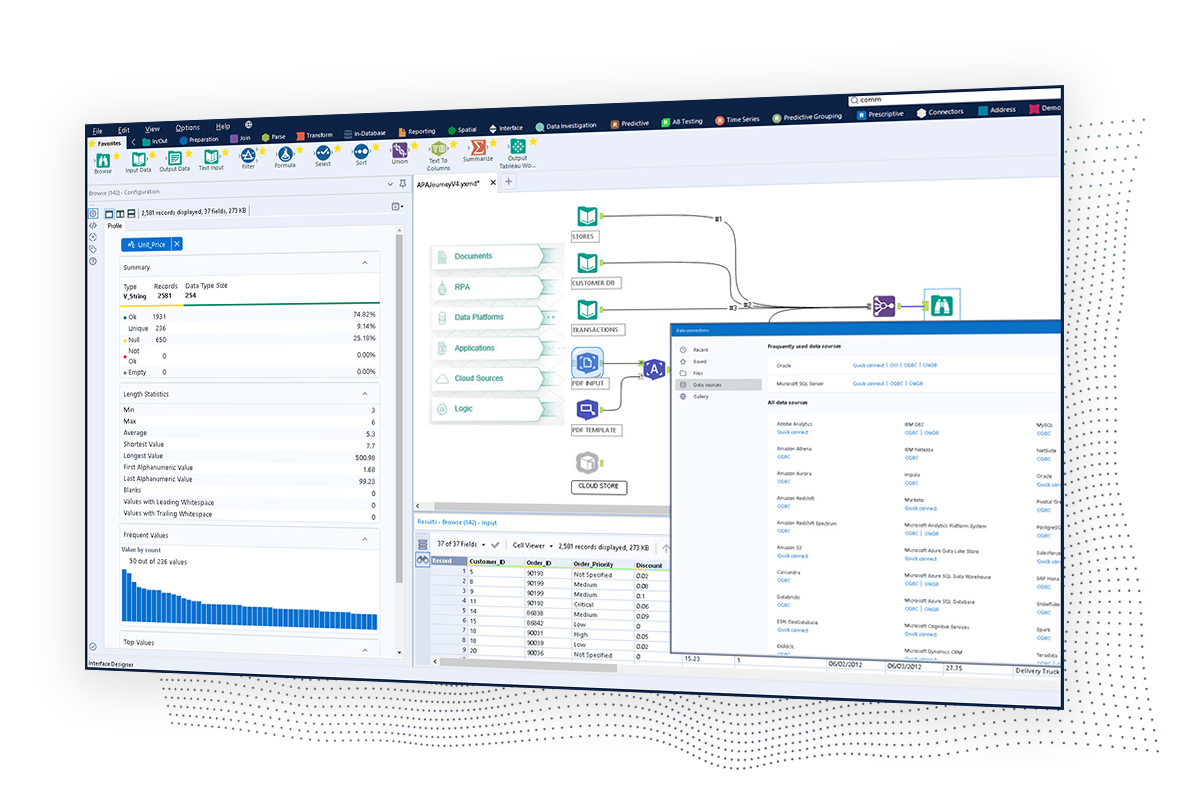
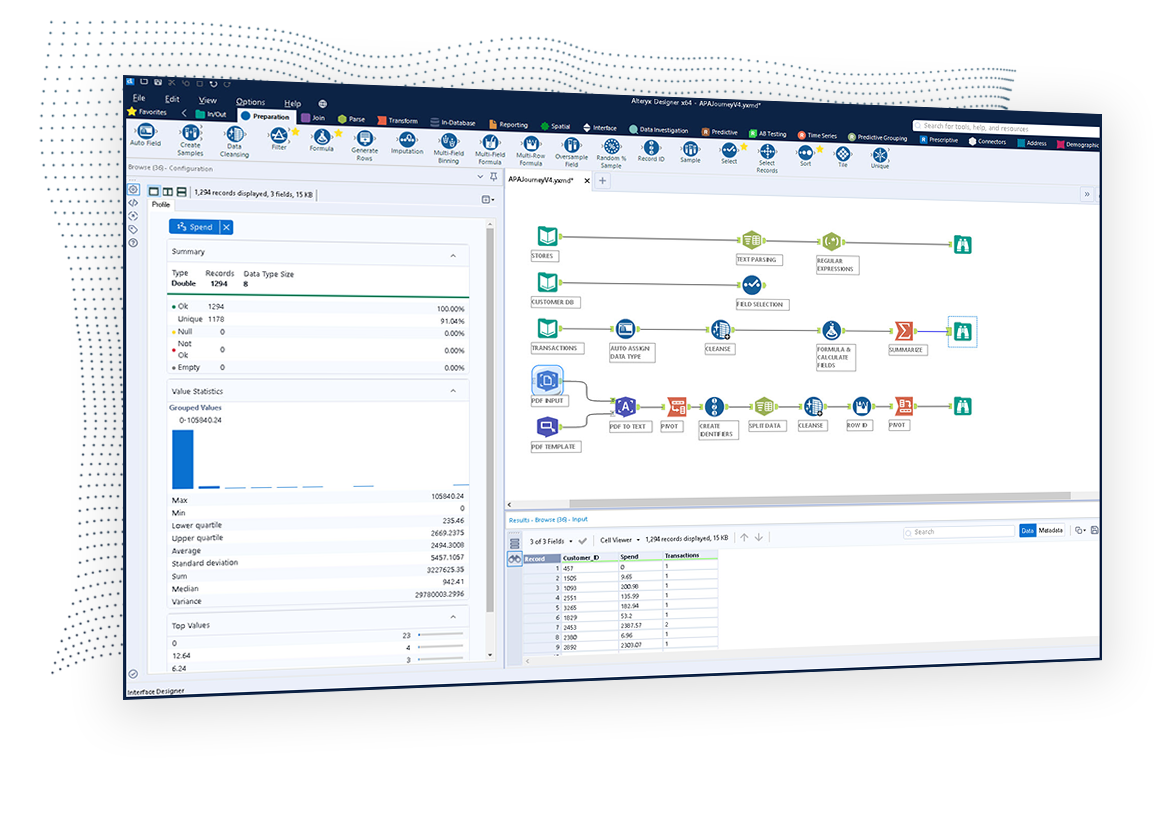
The Alteryx AI Platform gives organization automated data preparation, AI-powered analytics, and machine learning with embedded governance and security. Its self-service functionality, with self-service data prep, machine learning, and AI-generated insights, gives enterprise teams with a simplified user experience allowing everyone to create analytic solutions that improve productivity, efficiency, and the bottom line. Alteryx Designer can be used to automate every analytics step…
$4,950
per year per user (minimum of 3 users)
Anaconda
Score 8.1 out of 10
N/A
Anaconda provides access to the foundational open-source Python and R packages used in modern AI, data science, and machine learning. These enterprise-grade solutions enable corporate, research, and academic institutions around the world to harness open-source for competitive advantage and research. Anaconda also provides enterprise-grade security to open-source software through the Premium Repository.
$0
per month
Pricing
Alteryx Platform
Anaconda
Editions & Modules
Designer Desktop
starting at $5,195
per year per user
Designer Cloud Professional Edition
Starting at $4,950
per year per user (minimum of 3 users)
Free Tier
$0
per month
Starter Tier
$9
per month
Business Tier
$50
per month per user
Enterprise Tier
60.00+
per month per user
Offerings
Pricing Offerings
Alteryx Platform
Anaconda
Free Trial
Yes
No
Free/Freemium Version
No
Yes
Premium Consulting/Integration Services
No
No
Entry-level Setup Fee
No setup fee
No setup fee
Additional Details
—
—
More Pricing Information
Community Pulse
Alteryx Platform
Anaconda
Features
Alteryx Platform
Anaconda
Platform Connectivity
Comparison of Platform Connectivity features of Product A and Product B
Alteryx Platform
-
Ratings
Anaconda
9.3
Ratings
11% above category average
Connect to Multiple Data Sources
00 Ratings
9.80 Ratings
Extend Existing Data Sources
00 Ratings
8.00 Ratings
Automatic Data Format Detection
00 Ratings
9.70 Ratings
MDM Integration
00 Ratings
9.60 Ratings
Data Exploration
Comparison of Data Exploration features of Product A and Product B
Alteryx Platform
-
Ratings
Anaconda
8.5
Ratings
2% above category average
Visualization
00 Ratings
9.00 Ratings
Interactive Data Analysis
00 Ratings
8.00 Ratings
Data Preparation
Comparison of Data Preparation features of Product A and Product B
Alteryx Platform
-
Ratings
Anaconda
9.0
Ratings
10% above category average
Interactive Data Cleaning and Enrichment
00 Ratings
8.80 Ratings
Data Transformations
00 Ratings
8.00 Ratings
Data Encryption
00 Ratings
9.70 Ratings
Built-in Processors
00 Ratings
9.60 Ratings
Platform Data Modeling
Comparison of Platform Data Modeling features of Product A and Product B
Alteryx Platform
-
Ratings
Anaconda
9.2
Ratings
9% above category average
Multiple Model Development Languages and Tools
00 Ratings
9.00 Ratings
Automated Machine Learning
00 Ratings
8.90 Ratings
Single platform for multiple model development
00 Ratings
10.00 Ratings
Self-Service Model Delivery
00 Ratings
9.00 Ratings
Model Deployment
Comparison of Model Deployment features of Product A and Product B
We're trying right now to get more people using it at our company so we can send management documented cases for how we can expand and purchase Alteryx Server which will extend the capabilities even more and across more departments. It's been well suited for pretty much everything we do on a repeating schedule. It's worth the time to set up the workflows. When Treasury sends me the bank download now - I save it to a folder and run our workflows and send back 2 journal entries in .9 seconds. (yes - in less than a second it's finished running)
I have asked all my juniors to work with Anaconda and Pycharm only, as this is the best combination for now. Coming to use cases: 1. When you have multiple applications using multiple Python variants, it is a really good tool instead of Venv (I never like it). 2. If you have to work on multiple tools and you are someone who needs to work on data analytics, development, and machine learning, this is good. 3. If you have to work with both R and Python, then also this is a good tool, and it provides support for both.
Pulling data from multiple disparate data sources.
Allows users to see the data at every step of the workflow to be able to cleanse, analyze, and optimize the data.
Provides an analytics platform that is easy for users of all levels to thrive in whether they are just starting out in their analytics journey or they have a master's degree in Data Science.
Installing packages is very easy with Anaconda. Anaconda comes with 'anaconda navigator', a terminal-like utility from which you can easily install R packages and python libraries.
Launching R and python IDEs as well as Jupyter notebooks from anaconda navigator is simple, and Anaconda makes it very easy to keep these packages up-to-date.
I really like the fact that if you don't want to install the full version of Anaconda, you can opt to install a lightweight version (called Miniconda) that includes less python libraries and only core conda. I've installed it when I didn't want to take up as much disk space as Anaconda requires, but it works just the same.
Steeper Learning Curve: Alteryx can have a steep learning curve for users who are new to the platform or have limited experience with data analytics. Enhancements to the user interface and user onboarding resources could help make the learning process more intuitive and accessible to a wider range of users.
Enhanced Data Visualization Capabilities: Alteryx offers basic data visualization capabilities, but there is room for improvement in terms of advanced visualizations and interactive dashboarding features. Adding more sophisticated chart types, interactive widgets, and customization options would enhance the data visualization capabilities within the platform.
Improved Error Handling and Debugging: Alteryx provides error handling mechanisms, but enhancing the error reporting and debugging capabilities would be beneficial. Improved error messages, better visibility into data flow, and debugging tools could help users troubleshoot and resolve issues more efficiently.
We've developed a working partnership with Alteryx. As an enablement suite, we're continuing to innovate and deliver great products with use of Alteryx in our solutions. Alteryx use expands to our global product development teams and is in use in multiple parts of our organization. Alteryx also delivers Experian demographic content to other clients in their product offering. We're highly likely to renew, but that decision is way above my pay grade.
It's really good at data processing, but needs to grow more in publishing in a way that a non-programmer can interact with. It also introduces confusion for programmers that are familiar with normal Python processes which are slightly different in Anaconda such as virtualenvs.
I've found that while some things might take a little longer to create, the flexibility of Alteryx allows you to perform any function needed. I haven't found a use that was not available in Alteryx yet. APIs and XMLs can be created to perform certain functions. In addition, CMD line commands can be sent using Alteryx to perform certain functions as well.
I am giving this rating because I have been using this tool since 2017, and I was in college at that time. Initially, I hesitated to use it as I was not very aware of the workings of Python and how difficult it is to manage its dependency from project to project. Anaconda really helped me with that. The first machine-learning model that I deployed on the Live server was with Anaconda only. It was so managed that I only installed libraries from the requirement.txt file, and it started working. There was no need to manually install cuda or tensor flow as it was a very difficult job at that time. Graphical data modeling also provides tools for it, and they can be easily saved to the system and used anywhere.
I use many programs and compared to others, Alteryx virtually never goes down, freezes up or gives an application error. Over a 4 year time period that I have used this program, any of these may have happened 3 times. It is an incredibly stable program that I feel completely confident in.
Alteryx is an extremely reliable platform. If there is an error in my workflow, I feel pretty strongly it was probably my fault. The platform also handles large amounts of data very quickly and can join/match, sort, filter, calculate on that data quickly as well. One of my favorite things to build into a workflow are the messages based on data/metadata and error messages based on errors I have come across before.
Stellar, bar-none. Some of the best support folks of any vendor. The Alteryx Community is the most responsive and supportive. On the rare occasion of a release issue or bug, we've been able to get quick help to solve the core problem. Alteryx does not play the blame game. They genuinely help the users solve their issues or respond to questions
Anaconda provides fast support, and a large number of users moderate its online community. This enables any questions you may have to be answered in a timely fashion, regardless of the topic. The fact that it is based in a Python environment only adds to the size of the online community.
1st level of trainings which I've attended in Paris was easy and I was already knowing %90, that learning could have been an e-learning instead of in-person
Very good, detailed online trainings which you can take at your own pace, and strong certifications exists, certifications are extremely detailed and hard...
There is really not much to it (the installation, that is). Once you get it installed, along with any of the add-ons (demographics, R, etc.), you are up and running almost immediately. There is really no additional setup. You can immediately begin blending data, running demographics, performing spatial queries, running predictive analysis, etc. And for many of these functions, the learning curve is quite easy.
I used ACL before so all my scripts were written in SQL and it was not low code at all. After me and my team started using Alteryx, we moved all the scripts to workflows in Alteryx, it took some time, but works way better than ACL, it is faster and easier to maintain it any changes have to be done.
One of the main competitors to Anaconda can be Google products such as Colab. Colab gives you the flexibility to handle large datasets gives it an edge over Anaconda. But again, the ease of access and usability of Anaconda stacks up against Colab. Besides, Anaconda relies more on your machine which makes it safe to use.
Individual analysts can quickly generate results using their own copy of Alteryx Designer. But using the Server and developing macros for more complex needs can be time consuming.
Error handling - allows controls to be built into workflows easily and allows them to be isolated and spat into control reports that can be easily reviewed and audited, thanks to the ability to create multiple outputs in one go.
Time-saving - saved huge amounts of time, especially when moving Excel processes into Alteryx.
Product development - allowed my firm to create products that we have been able to market and sell to clients.
Positive impact - Multiple options for data presenting , visualizing and sharing. (Eg: R-Markdown).
Positive impact - Ease of access to build complex machine learning models. (I work in NLP, it has multiple built in models to analyze the various contexts).
Positive impact - Conda package let's to deal with external packages which can be used in Jupyter.