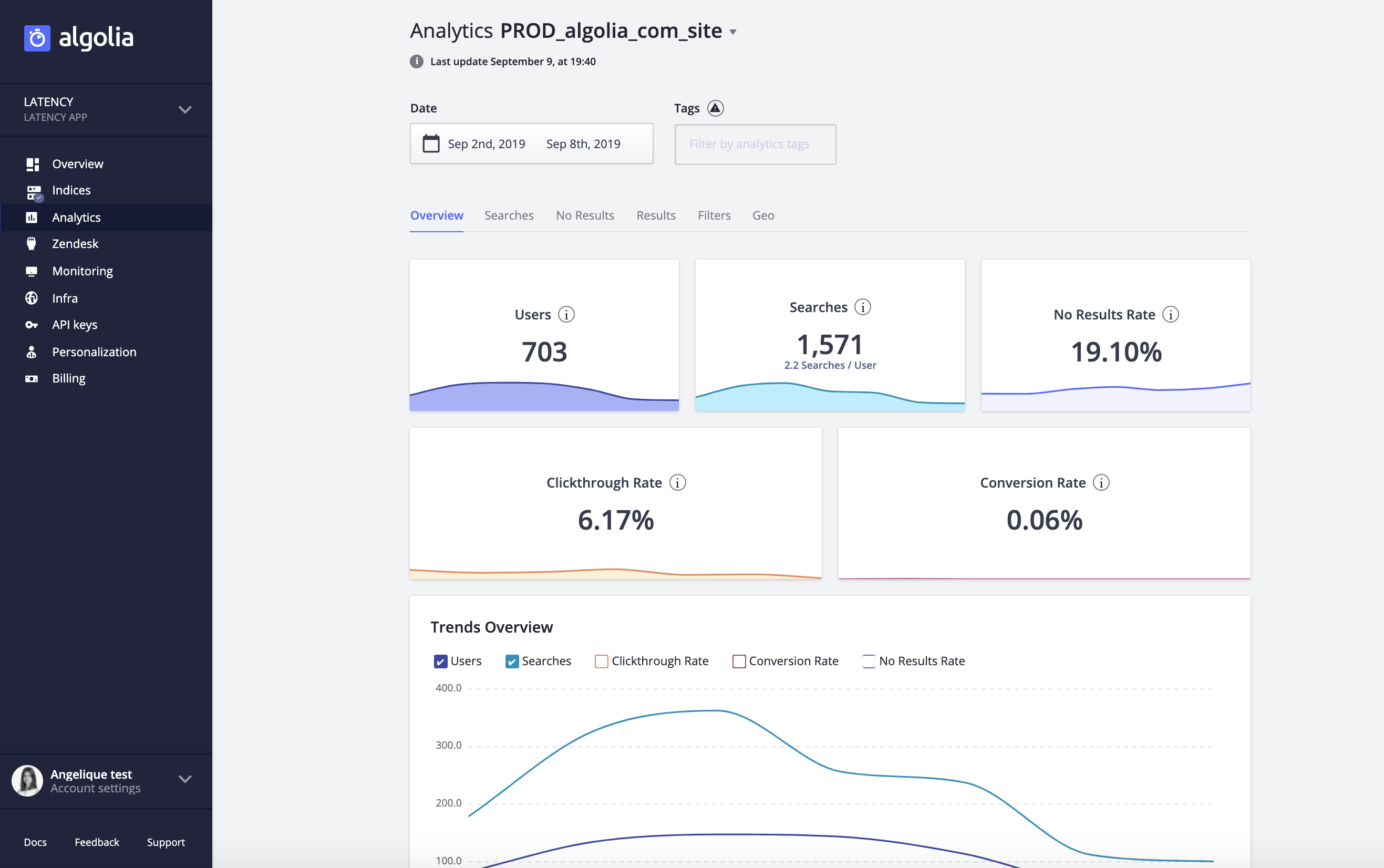
Algolia offers AI-powered solutions to improve online search and discovery experiences, with tools for business teams and APIs for developers that help to improve user engagement and conversions across websites, apps, and e-commerce platforms.
$0
per month Up to 10,000 search requests + 1 Million records
Amazon Elasticsearch Service
Score 6.3 out of 10
N/A
Amazon Elasticsearch Service is a fully managed service that enables users to search, analyze, and visualize your log data at petabyte-scale. As a fully managed service, Amazon Elasticsearch Service manages the setup, deployment, configuration, patching, and monitoring of Elasticsearch clusters, so users can spend less time managing clusters and more time building applications. With a few clicks in the AWS console, users create scalable, secure, and available Elasticsearch clusters. Amazon…
N/A
Pricing
Algolia
Amazon Elasticsearch Service
Editions & Modules
Build
$0
per month Up to 10,000 search requests + 1 Million records
Grow
$0.50
per month per 1,000 search requests
Algolia Recommend
$0.60
per month per 1,000 Recommend requests
Premium
Custom
per month Customized pricing
Elevate
custom
per year
No answers on this topic
Offerings
Pricing Offerings
Algolia
Amazon Elasticsearch Service
Free Trial
Yes
No
Free/Freemium Version
Yes
No
Premium Consulting/Integration Services
No
No
Entry-level Setup Fee
Optional
No setup fee
Additional Details
Pay as you go, scale instantly, or upgrade anytime for advanced features and capabilities.
Well-suited Scenarios: - Fast Car Browsing with Filters: Algolia shines when a user is browsing thousands of cars using filters like price, mileage, year, brand, and location. It returns instant, ranked results even with complex combinations. - Mobile Search with Typos: When users type “Camary” or “Toyta” on mobile, Algolia still returns accurate matches thanks to its typo tolerance and synonyms—improving UX and reducing zero-result queries. - Featured Car Prioritization: We can use custom ranking to boost certain listings (e.g., newly added, better margins, location-specific promos) without affecting the user’s search experience.
Less Appropriate Scenarios: - Complex Rule-Based Inventory Logic: If we want to show different results based on time of day, inventory pressure, or dynamic business rules, Algolia falls short. This logic needs to be applied before indexing. - Global Search Across Entities: Searching across cars, articles, FAQs, and service centers in one go requires heavy frontend orchestration due to lack of native multi-index blending. - Real-Time Updates at Scale: For highly dynamic data (e.g., car availability or pricing updates every few minutes), frequent indexing can be costly and requires batching, making it less real-time than needed
Elasticsearch is a good alternative to relational databases for setting up complex searching of data. It's inbuilt features for slicing the data [in] different ways and its ability to add weights to search results makes it easy to set up complex searching scenarios. Given that data must be pushed to this service, it may be best suited for data that is not changing very rapidly.
Algolia is brain-dead simple to set up. I've implemented search with Algolia in a dozen different ways now, and it never took me longer than a few minutes to get the functionality I want. With Algolia, the only challenge is designing your search UI -- if you don't want to use their baked in UI solutions.
Results come back incredibly fast. I'm not sure how Algolia does it, but every keystroke I make in a search field returns new results instantly. It's hard to believe that I'm searching large datasets on a remote server when it works so fast.
Very little customization is needed for 99% of use-cases. Algolia's out of the box setup works great, and it takes no prior knowledge to set up.
Algolia can be a bit complex -- for smaller companies or companies without many tech resources, it may be difficult to implement and use without the help of a third party
Manually manipulating search results (for specific queries having listings show up first) is a bit difficult to do without custom developing that functionality
Algolia is a great tool, we didn't have to build a custom search platform (using Elasticsearch for example) for a while. It has great flexibility and the set of libraries and SDKs make using it really easy. However, there are two major blockers for our future: - Their pricing it's still a bit hard to predict (when you are used to other kind of metrics for usage) so I really recommend to take a look at it first. - Integrating it within a CI/CD pipeline is difficult to replicate staging/development environments based on Production.
Algolia has a good interface and they have done some improvements. However, some non technical users have a challenging time in the use for the first days of learning. But once the main aspects are learned is a straight forward operation
It is an extremely powerful tool if the time is put in to learn it. There are basic skeletons of out of the box behavior, it involves having really dedicated people to learn how to use it to take full advantage of its capabilities. A 10 for the tool itself, minus 3 for the difficulty in learning and maintenance
Performance is always a major concern when integrating services with our client's websites. Our tests and real-world experience show that Algolia is highly performant. We have more extremely satisfied with the speed of both the search service APIs and the backend administrative and analytic interface.
It’s non existent. No tech support and no customer service… my application was blocked and is currently inactive causing huge business disruption, and I’m still waiting days later for a response to an issue which could be resolved very very quickly if only they would respond. Very poor from a company of that size
There are many open source search products available. Prior to Algolia, we used an in-house search system adopted from an open-source system. While this was nice in that we could modify it in any way we wanted, it also required dedicated engineering and setting up many analytics tools and monitoring systems to ensure it stayed performant/could adapt to our ever evolving needs. Algolia takes a load off our plate and frees our engineers to work on bigger problems vs minute search changes or monitoring. It also empowers our product teams to directly use the AI to make basic changes and see analytics in one easy place. We chose Algolia to increase development velocity and reduce the hidden costs of maintaining and operating open-source code/search tools.
Splunk is the most flexible of the 3 where you can manipulate the data to whatever fits your specific use case. Grafana has the most powerful capabilities but the steepest learning curve. Grafana also does offer the most flexibility as you can visualize almost any data source. Elastic is a solid middle ground between the 2
Overall is a scalable tool as the environment and the backend functions are the same and many things are done directly on the tool so without the need of further specific developments. However some things could be improved such as documentation for integration that could help in doing whitelabel solutions
Users who had abandoned our product (attributing slow search speeds as the reason) returned to us thanks to Algolia
We used Algolia as our product's backbone to relaunch it, making it the center of all search on our platform which paid off massively.
Considering we relaunched our product, with Aloglia functioning as its engine, we got a lot of press coverage for our highly improved search speeds.
One negative would be how important it is to read the fine print when it comes to the technical documentation. As pricing is done on the basis of records and indexes, it is not made apparent that there is a size limit for your records or how quickly these numbers can increase for any particular use case. Be very wary of these as they can quite easily exceed your allotted budget for the product.