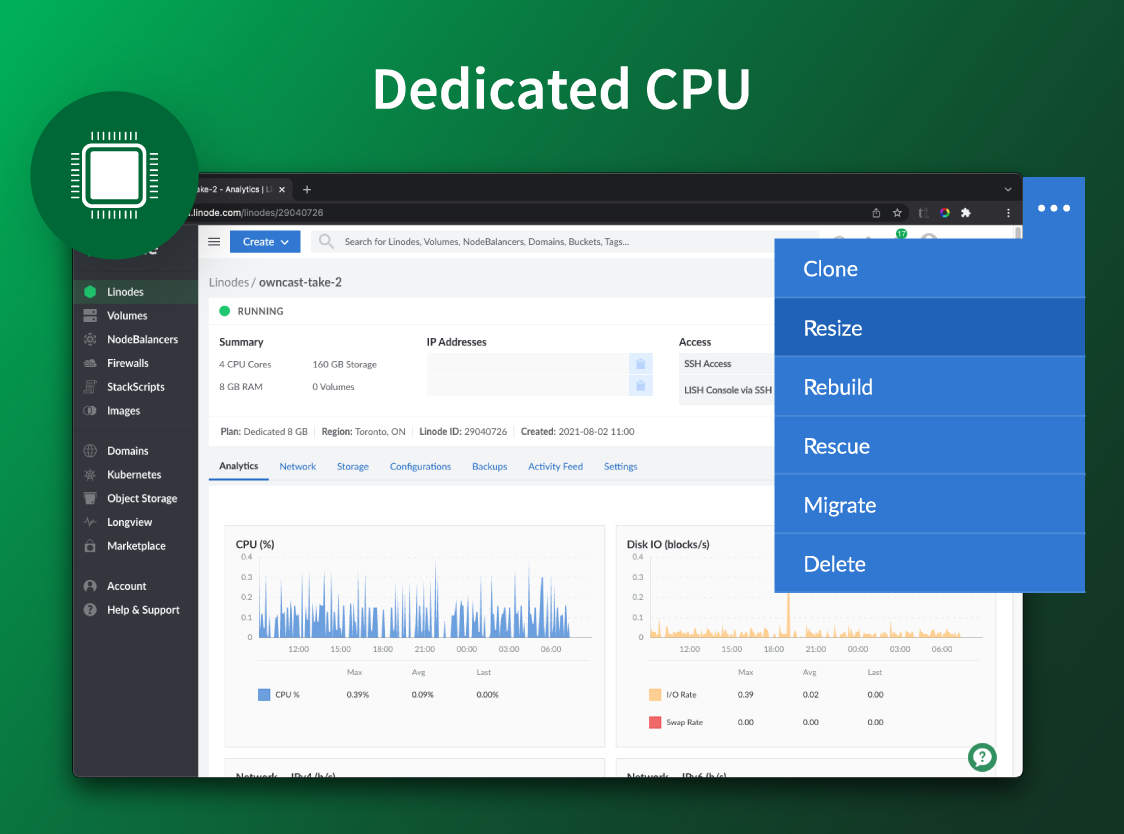
Akamai Cloud Computing (formerly Linode) include scalable and accessible Linux cloud solutions and services. These products and services support developers and enterprises as they build, deploy, secure, and scale applications.
N/A
Google Container Registry
Score 8.0 out of 10
N/A
Google Cloud Container Registry is a place to manage Docker images, perform vulnerability analysis, and decide who can access what with fine-grained access control. Existing CI/CD integrations let users set up fully automated Docker pipelines.
N/A
Pricing
Akamai Cloud Computing
Google Container Registry
Editions & Modules
No answers on this topic
No answers on this topic
Offerings
Pricing Offerings
Akamai Cloud Computing
Google Container Registry
Free Trial
Yes
No
Free/Freemium Version
No
No
Premium Consulting/Integration Services
No
No
Entry-level Setup Fee
Optional
No setup fee
Additional Details
CPU, transfer, storage, and RAM are bundled into one price. Storage capacity can be increased with additional Block Storage or S3-compatible Object Storage. Instant Backups can be added with complete independence to the stack. Linode NodeBalancers ensure applications are available.
—
More Pricing Information
Community Pulse
Akamai Cloud Computing
Google Container Registry
Features
Akamai Cloud Computing
Google Container Registry
Container Management
Comparison of Container Management features of Product A and Product B
Akamai Connected Cloud Linode would be a good service to host a content delivery network (CDN) because of its edge network but I'd prefer not to use Akamai Connected Cloud Linode for tasks that need GPU power such as Machine Learning or Artificial Intelligence (AI) because Akamai Connected Cloud Linode lacks deep GPU compute compared to AWS or Google Cloud or Microsoft Azure
As a Cloud Engineer while working on a migration project we used GCR and my experience of using it is actually good the reason behind this is: 1: GCR uses industry-standard encryption to protect your data.2: GCR offers data loss prevention features to help you prevent sensitive data from being leaked or exposed and last but not the least is GCR provides audit logging so you can track who has accessed your data and when, because of these reasons its my go to tool.
The (new) 'create custom image' function needs a bit of work before it is useable.
New accounts have limited features until a support requested is made to turn specific ones on. It would be useful to have an account page that tells you what is disabled so unpleasant surprises are not had at the pointy end of a deadline.
Stackscripts would be better if it more info was transferred to the script. Eg the Linode Label given, plan requested, etc. But now I am just nit-picking
In this eight years of being Linode's customer, there hasn't been a single day we faced problem. Even the migration or maintenance activities have been planned, organised and priorly informed. Kudos to taking care of even such small metrics. Though the instances are unmanaged, the support team helps with relevant document links, or their own articles that help us to fix or solve the issues we face.
It's pretty easy for me, but I preferred their old interface before it was called 'cloud' (not a computer science term.) The new interface looks easier but I had to ask for help for things I used to be able to find myself. If someone was new to it--without having used their old interface--it might be easier for them than it originally was for me.
There is very little planned downtime. Whenever planned downtime is necessary I'm always given lots of advanced notice and an explanation that I can pass along to my users that they'll understand. I really appreciate that Linode appreciates my commitment to reliable service to my users. It shows that they believe they've been successful when I'm successful.
Servers are well dimensioned and price performant. Of course one always wants more, so if they were to upgrade their hardware for the same price I'd consider moving more workloads. Networking - never had an issue. Hardware speeds - disks are fast and can grow to great size.
Support was excellent and fast. The documentation is extensive and helpful. I learned many things from their online documentation. I did not contact them by phone, but email took a day or less. Complex problems would probably need a service contract. I liked the friendly and polite tone of the support.
We got kick started with an initial walkthrough along with some free credits. The initial walkthrough helped us to understand Linode's ecosystem and start our hands on with Linode. We tried out some apps from Marketplace initially with the free credits, which not only helped us understand Linode better, but also those apps. We had implemented many such apps to our customers with Linode
We're a small organization. The implementation of our Linode solution was trivial. Once I justified a cloud server to my bosses over a co-location -- the co-lo wasn't as fast as our linode server in load tests -- it was a matter of moving one Linux implementation to another. Trivial.
It is more user-friendly than the big three cloud providers like AWS and GCP. The interface blows them out of the water; pricing is so much more competitive—no egregious bandwidth fees like AWS. As a small startup, cutting out the overhead of ultra-complex UI and pricing dramatically helps. It seems to be matched tit-for-tat with DigitalOcean, and their UI is similar in many ways. DigitalOcean has more mature capabilities, even though Linode/Akamai was founded earlier. Linode/Akamai provides better price-per-performance, though, as DigitalOcean is expensive nowadays.
It is very easy to integrate GCR with other services and I integrated GCR with GKE and Cloud Build. 1: While working on one project I created one pipeline pulls the app's Docker image from GCR and builds the app's Docker image. Deployed that apps image in GKE. 2: Ive stored the data in GCR and that data was being used by cloud Run applications
I completely agree with the above statement. Linode provides the best option in terms of configurations and scalability. We have chosen share CPU instances many times and then moved on with dedicated CPU instances, just with a click of button.
As a DevOps Engineer , GCR has made a important contribution to my organisation because GCR can be used to store code and assets, which can help to reduce the development time for new projects.
Using GCR has been a cost-effective solution for us since we only pay for the storage we actually utilise. This has resulted in significant savings on our cloud storage expenses.
We trust GCR because they prioritise the security of our data by utilising industry-standard encryption. This assurance brings us peace of mind, as we know our information is protected.