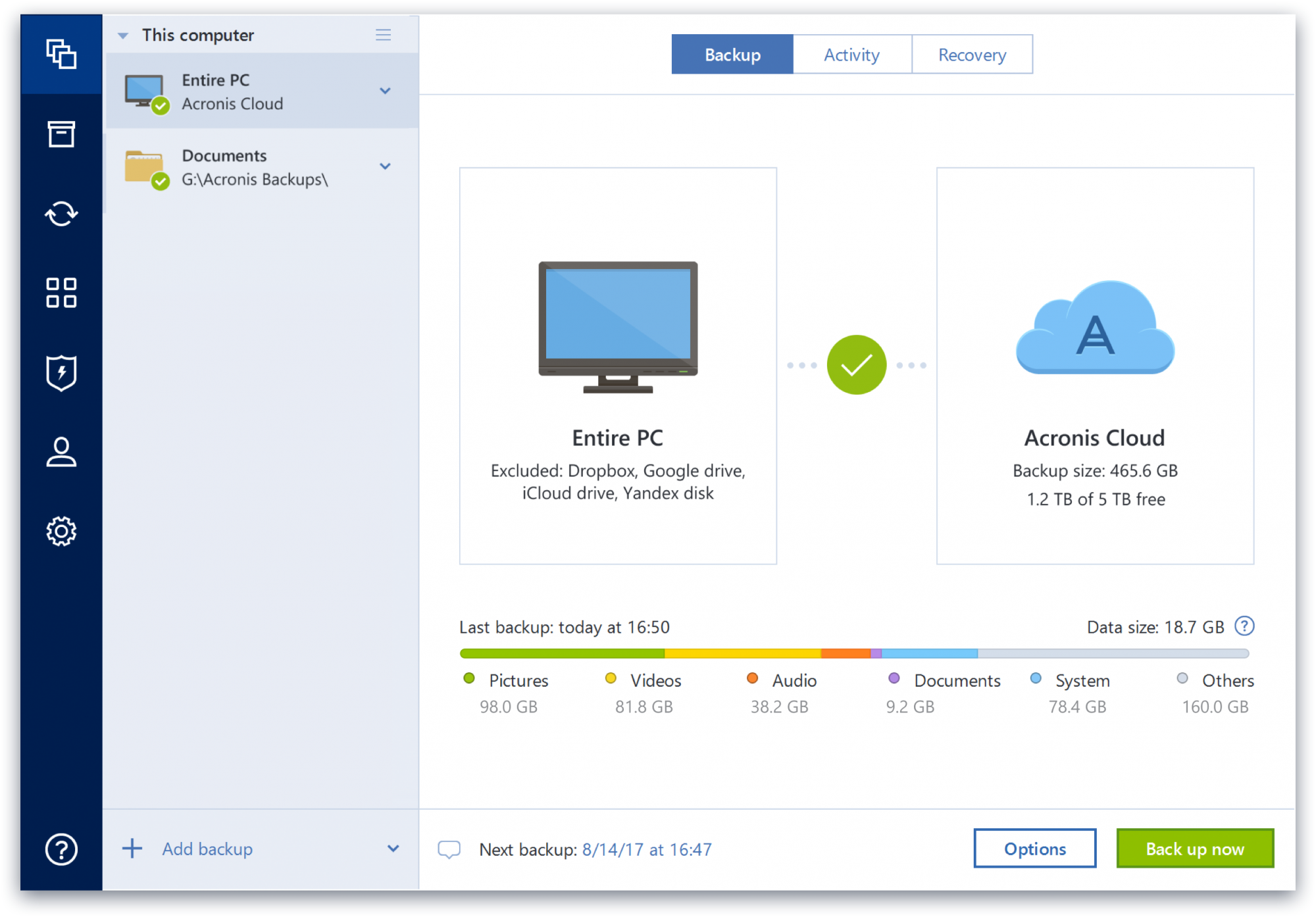
Acronis True Image is a backup, cloning, cyber protection and privacy tool suite for home users.
N/A
PowerProtect DD Series
Score 8.9 out of 10
N/A
PowerProtect DD (a next-generation appliance replacing Dell EMC Data Domain) is a suite of hardware appliances used for
data protection, backup, storage and deduplication. PowerProtect appliance offerings are
cloud-enabled and vary by organization size, capable of supporting small
business and enterprises.
PowerProtect appliances are separated into two categories: entry-level
to midrange, and enterprise.
Entry-Level to Midrange Backup Appliances
PowerProtect…
N/A
Pricing
Acronis True Image
PowerProtect DD Series
Editions & Modules
No answers on this topic
No answers on this topic
Offerings
Pricing Offerings
Acronis True Image
PowerProtect DD Series
Free Trial
Yes
No
Free/Freemium Version
No
No
Premium Consulting/Integration Services
No
No
Entry-level Setup Fee
No setup fee
No setup fee
Additional Details
—
—
More Pricing Information
Community Pulse
Acronis True Image
PowerProtect DD Series
Features
Acronis True Image
PowerProtect DD Series
Data Center Backup
Comparison of Data Center Backup features of Product A and Product B
The imaging capability seems to be solid [with Acronis True Image], although I have not had to recover a drive yet so cannot compare. The logs tell me when it is (and isn't) working. The "Cloud Replication" that is supposed to simultaneously replicate the local backup image is perfectly awful and the months of tech support ended with them telling me I had a "VSS issue" on a brand new workstation and that I should just create a separate cloud image. After months of it taking 3-4 DAYS to run, IF it worked, and then failing altogether, I discontinued it. It was even logging (running?) under another separate critical files backup, and forced to use the same encryption password. Setting up a new one failed. The cloud backup of my critical files is still running at kb/sec speeds. The ransomware protection hasn't caught anything yet to my knowledge, and consumes a lot of resources. Changing the settings takes at least 10 minutes to log into the cloud. Cloud storage is tiny and a push to get you to pay more. Will not be renewing.
When used as a backup target PowerProtect DD models offer incredible density and can efficiently replicate to another cloud-based or offsite unit. Most complaints about these have been addressed in software over the years and they are now a intuitive and easily managed backup system. You are not buying a Swiss army knife, you are getting a machine designed for a purpose, use it for that and you will not be disappointed. While they have the ability to serve as a CIFS server, they are not a filer and lack many of the features inherent to filers and are a poor substitute.
Upon a system restore after a crash, the program was able to see my server but was unable to complete the process. However, once I copied everything to a detachable USB hard disk, it had no further problems.
I'd love to see an exact copy of the functionality of Time Machine, except on a PC. Seamless, nearly flawless. It's already pretty decent, though.
Okay, Acronis, you've knocked it out of the park already, but ...it's time to offer some hardware! Develop your own secure version of the Time Capsule that can be plugged into the network. It will only do one thing, and it will be the best at what it does.
Depending on the model of Data Domain, there is a limit to the number of NFS/SMB threads that can run concurrently. When this limit is reached, the system is slow to respond to client requests.
Data Domain support is very slow to turn out new features and bug fixes in their code.
DD has performed flawlessly for almost 10 years as our backup/recovery storage with offsite replication. Given its track record and great support from EMC, we're unlikely to look elsewhere any time soon.
Protect my system from data loss and also can manage multiple devices via online cloud from any where and also can set Multifactor authentication for more secure login access. Archive any backup which will use less space and we can transfer it to any other space also so it is very easy as server admin to manage acronics utilities
I have never had an issue with their software and therefore have never had to reach out to their support for anything. I have however used their online help to answer questions about functionality. I found no issues getting the information I was looking for. It seemed that if their own support didn't have the answer, there was a user on their forums who did.
Customer support has had some ups and downs here. We've had several issues with EMC support before and during the acquisition by Dell, but in the last 18 months support has been top notch. Quick and knowledgeable help is but a chat away, or they will call you back so you don't have to wait on hold. The team supporting us is responsive and is quick to assist with any request or issue.
Acronis fits in with the rest of our software as it saves us a ton of time and money. Usability is incredibly intuitive - and a new employee can be taught the ins and outs in less than 15 minutes. The software is also updated regularly to improve the security and functionality of the suite.
We already had Avamar in place, and since we have a good ecosystem of Dell Solution suite and wanted to evaluate PowerProtect DD also from that perspective, hence we thought of going ahead with it. We knew the limitations with Avamar and PowerProtect DD were right there from that side of the business.
The Windows version is generally reliable and only ran into one issue thus far. Restores are easy and there are many features. On MacOS, it's a completely different story. There is significant resource leakage related to the updater app that can bog down part of a CPU core continuously until it is disabled. The mobile backup feature also needs to be disabled via UNIX command line or CPU usage will go up when a mobile device on the same network like an iPad or iPhone's screen is turned on.